


Products


Food Grade Liposomal Nicotinamide Riboside NR 50% Powder Advanced Encapsulation Clean Label Wellness CAS 1341-23-7
LIPOSOMAL NICOTINAMIDE RIBOSIDE
Nicotinamide Riboside (NR) is a Vitamin B3 derivative and direct dietary precursor to nicotinamide adenine dinucleotide (NAD+) — a coenzyme essential to mitochondrial energy metabolism and cellular redox balance. However, unencapsulated NR presents well-documented handling challenges: pronounced hygroscopicity accelerates moisture-driven degradation, and rapid dissolution in aqueous environments complicates blend uniformity. Liposomal encapsulation addresses both. By enclosing NR (CAS 1341-23-7) within phospholipid bilayer vesicles — the same molecular architecture found in all cell membranes — this delivery system creates a moisture-protective micro-environment and modulates release behavior during manufacturing. The result is NR powder engineered for predictable performance across capsule, tablet, and beverage powder workflows. Available at 50% and 70% loading.
50% & 70% Loading
Liposomal Delivery
Clean Label Ready
NR and the NAD+ Salvage Pathway
Nicotinamide adenine dinucleotide (NAD+) is a coenzyme present in every living cell, cycling between oxidized and reduced states to shuttle electrons in enzymatic reactions — most critically within the mitochondrial electron transport chain. NAD+ is consumed continuously and must be replenished through endogenous biosynthesis.
NR enters this system via the NAD+ salvage pathway: NR is first phosphorylated by nicotinamide riboside kinases (NRK1/2) to NMN, then converted to NAD+ by NMN adenylyltransferase. This two-step biochemical route is one of the body’s endogenous mechanisms for maintaining cellular NAD+ availability.
The Formulation Challenge
The same nucleoside structure that enables NR’s cellular uptake also makes it inherently hygroscopic — absorbing atmospheric moisture during storage, blending, and capsule filling. In humid production environments, unencapsulated NR can exhibit visible caking, color shifts, and active-content drift within weeks of opening bulk containers.
Furthermore, NR’s aqueous solubility creates difficulties in wet-granulation and multi-phase beverage powder systems, where rapid, non-uniform dissolution can introduce content-variability issues batch to batch.
How Liposomal Encapsulation Helps
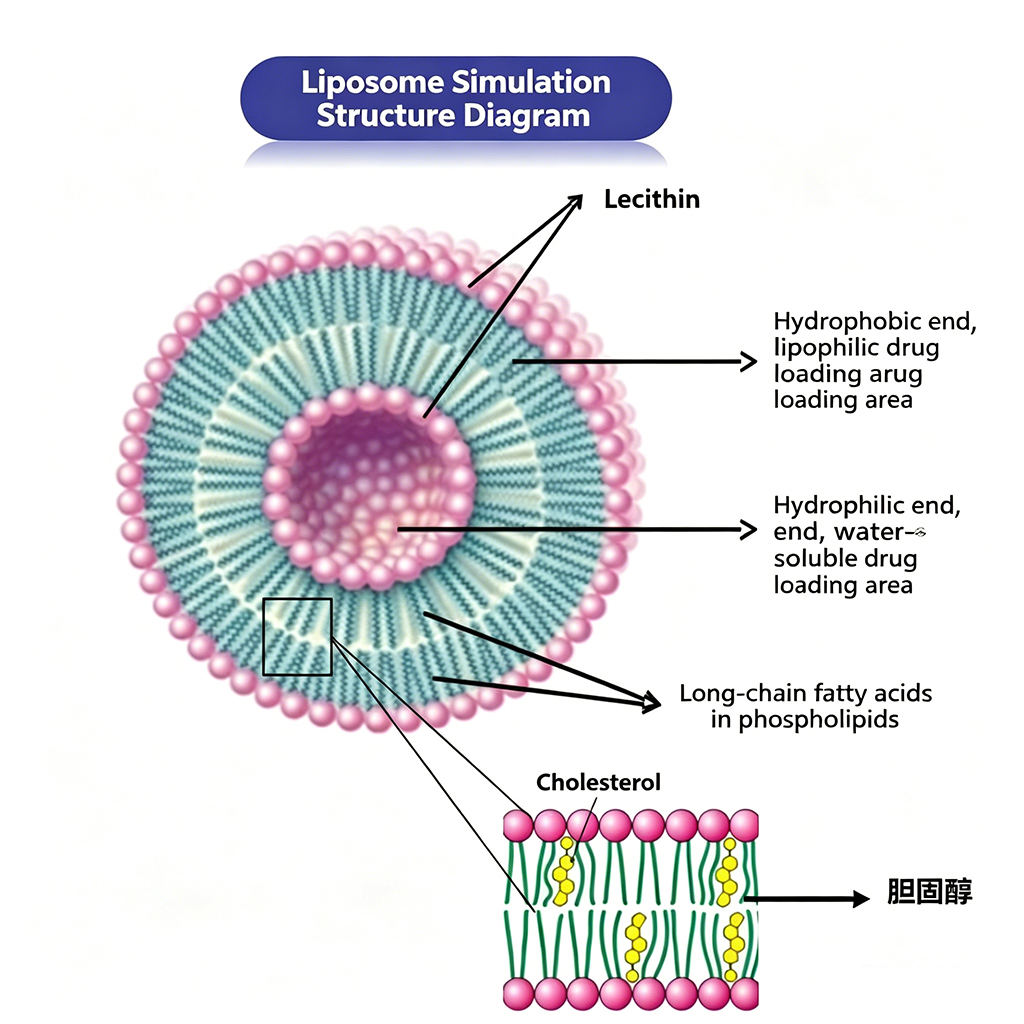
(1) Moisture Barrier. The phospholipid bilayer physically separates encapsulated NR from ambient humidity. While not an absolute seal, this lipid barrier slows moisture ingress — reducing hydrolytic degradation during manufacturing steps where controlled-humidity conditions are impractical.
(2) Controlled Aqueous Release. Liposomal vesicles swell gradually upon rehydration rather than bursting instantly. This modulated release supports more uniform blend distribution in wet-granulation and beverage premix operations.
(3) QC-Verified Quality. EE% ≥ 80% by dialysis/HPLC confirms genuine encapsulation — distinguishing this product from simple physical blends of NR with phospholipids. DLS particle sizing verifies consistent nano-scale vesicle dimensions (80–300 nm) across every batch.
1. Hygroscopicity Protection — Real-World Formulation
NR’s moisture sensitivity is a practical problem — not a theoretical one. Unencapsulated NR shows visible caking and active-content drift within weeks. The phospholipid bilayer acts as a diffusion barrier, slowing water-vapor contact. For humid-climate manufacturers or extended production campaigns, this means more predictable batch performance and less waste.
2. Dual Loading: 50% & 70%
50% offers balanced dosing for B3-complex, NAD+ precursor blends, and multivitamins. 70% maximizes NR per gram — enabling smaller capsules, fewer units per serving, and high-potency single-active products. Both grades share identical QC protocols and CoA documentation.
3. Verified Encapsulation — Beyond Blending
EE% ≥ 80% measured by dialysis/HPLC distinguishes true liposomal NR from simple dry blends of NR plus phospholipids. This analytical verification is documented on every CoA — not a one-off claim but a routine QC checkpoint.
4. DLS Particle Size — Why Nano-Scale Matters
Consistent 80–300 nm vesicles (PDI ≤ 0.35) indicate well-controlled emulsification and spray-drying. Larger or polydisperse populations suggest process variability that could affect rehydration and release behavior. DLS is run on every batch as a routine QC checkpoint.
1. HPLC Active Assay
Every batch tested to confirm 50% or 70% NR loading. Batch-specific CoA provided with each shipment.
2. DLS Particle Size Analysis
Confirms stable liposome formation (80–300 nm) upon rehydration, verifying uniform nano-scale vesicle dimensions across production lots.
3. Encapsulation Efficiency (EE%)
EE% ≥ 80% by dialysis/HPLC confirms genuine liposomal encapsulation rather than simple physical blending with phospholipids.
4. Heavy Metal & Microbial Screening
Full compliance: Pb ≤ 10 ppm, As/Cd ≤ 1 ppm, Hg ≤ 0.1 ppm; TPC / Yeast & Mold per USP; E. coli and Salmonella negative per 25g.
These statements describe established nutritional roles of Nicotinamide Riboside using structure/function language. They have not been evaluated by regulatory authorities. This product is not intended to diagnose, treat, cure, or prevent any disease.
1. Cellular Energy Metabolism — The NAD+ Connection
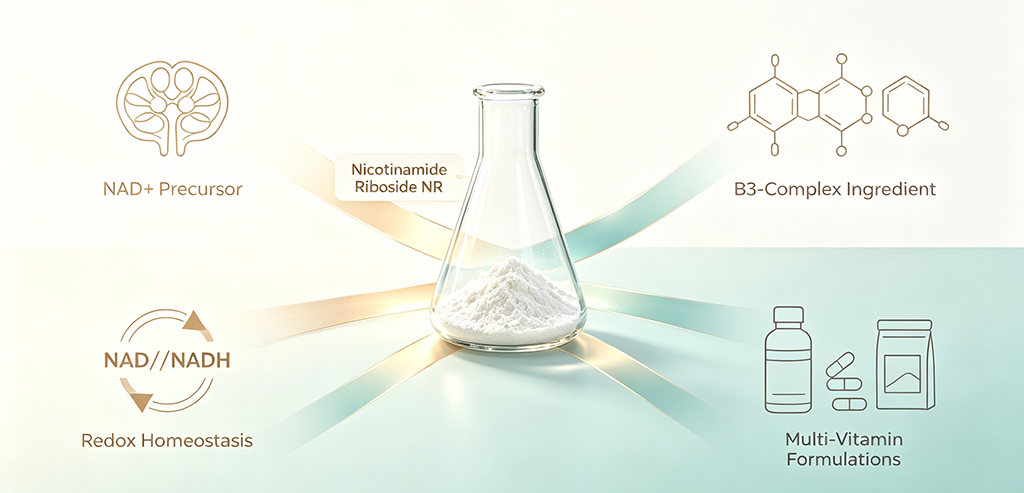
NR is a dietary NAD+ precursor, feeding into the same coenzyme system that drives mitochondrial oxidative phosphorylation — the primary ATP-generating pathway. A foundational ingredient in energy-support and metabolic-wellness supplement lines for active-lifestyle consumers.
2. Premium B3-Complex Differentiation
Within the Vitamin B3 family, NR’s pyridine-nucleoside structure sets it apart from nicotinic acid and nicotinamide. A differentiated, premium-positioned ingredient for B3-complex and NAD+ precursor supplement formulations targeting informed wellness consumers.
3. Cellular Redox Balance
NAD+ and NADH constitute a fundamental redox couple in cellular biochemistry, participating in hundreds of oxidoreductase reactions. By contributing as a dietary NAD+ precursor, NR supports the body’s endogenous NAD+/NADH balance mechanisms.
4. Daily Wellness & General Nutrition
As a recognized Vitamin B3-family member with a clear NAD+ precursor identity, NR fits naturally into broad-spectrum multivitamins, B-complex blends, and general-wellness supplement formulations. Science-grounded narrative supports consumer-facing product communication.
1. B-Complex & Multivitamin Capsules
50% grade integrates into multi-component B-complex and NAD+ precursor blend capsules. 200–450 mg fill weights; compatible with high-speed capsule filling lines.
2. High-Potency Single-Active NR
70% grade enables 100–300 mg active NR per compact capsule — optimizing capsule dimensions and packaging-to-active ratios for single-active NR supplement SKUs.
3. Functional Beverage Premixes
Both grades compatible with stick packs, sachets, and powdered drink mixes. The liposomal carrier supports more uniform dispersion and rehydration in multi-phase beverage powder systems.
4. Premium Multivitamin & Wellness Stacks
NR as a differentiated B3-family ingredient in comprehensive multivitamin and wellness-stack formulations. Compatible with capsule, tablet, and powder formats. Non-GMO phospholipid sourcing supports clean-label positioning.
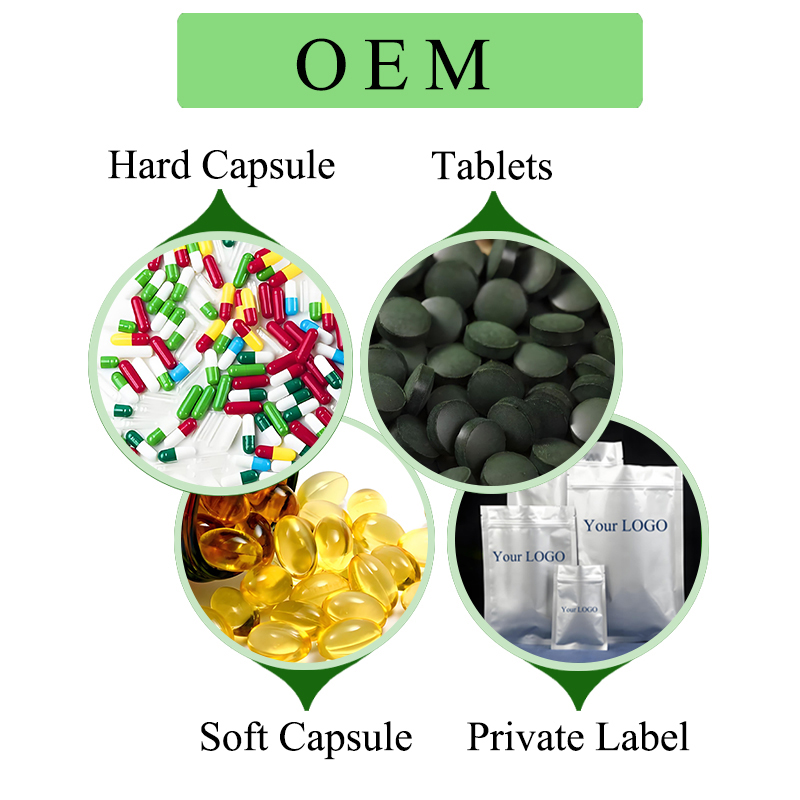
OEM & CUSTOM FORMULATION
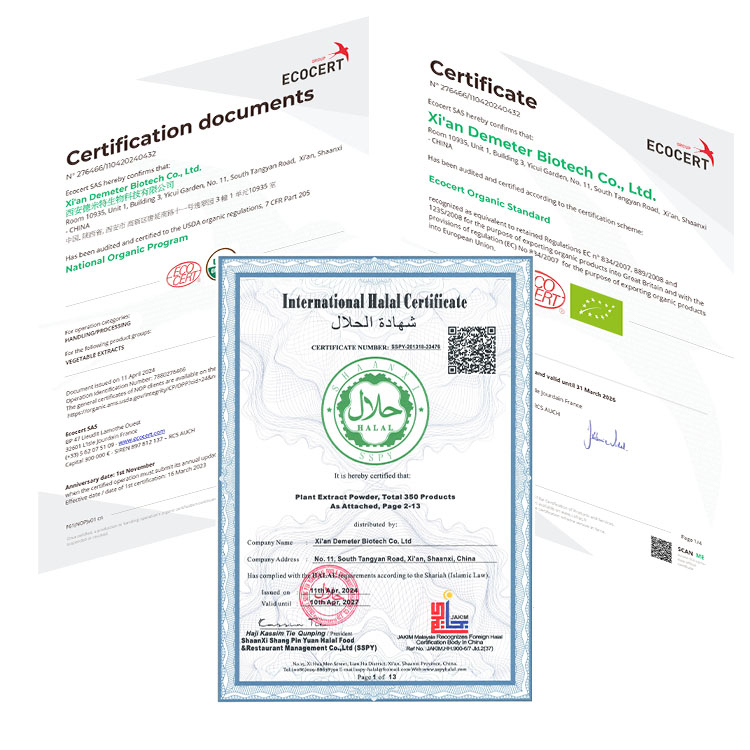
CERTIFICATIONS

TRANSPORTATION
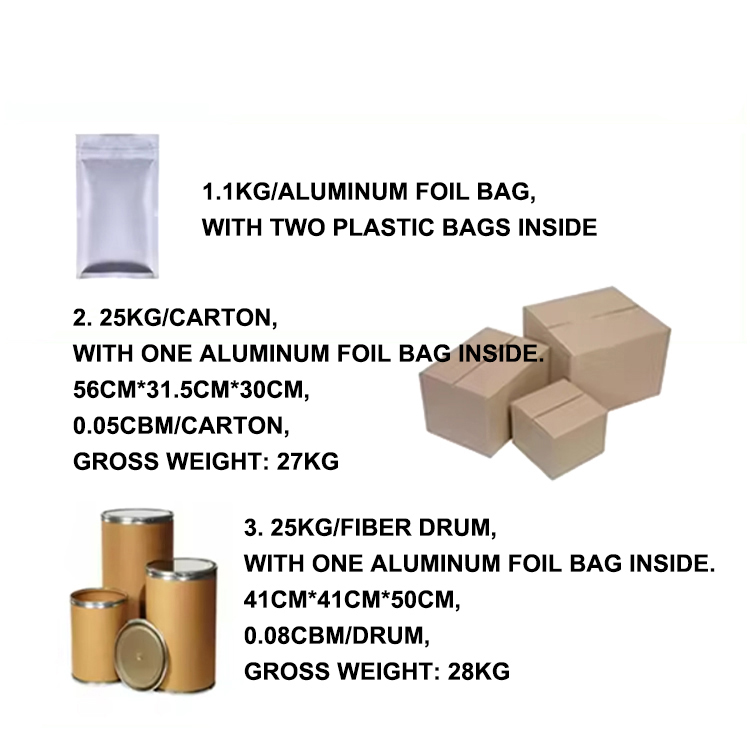
PACKAGING
+
+
+
-

High Absorption Liposomal Resveratrol Powder 50...
-

Cosmetic Grade Liposomal Urolithin A 50% Powder...
-

High Absorption Liposomal NMN Powder 50% 70% Lo...
-

High Absorption Liposomal NMN Powder Beta-Nicot...
-

High Absorption Liposomal PQQ Powder Pyrroloqui...
-

Food Grade High Absorption Liposomal Coenzyme Q...


