


Products


Food Grade Liposomal PQQ Pyrroloquinoline Quinone 50% Powder Advanced Encapsulation Clean Label Wellness CAS 72909-34-3
LIPOSOMAL PYRROLOQUINOLINE QUINONE
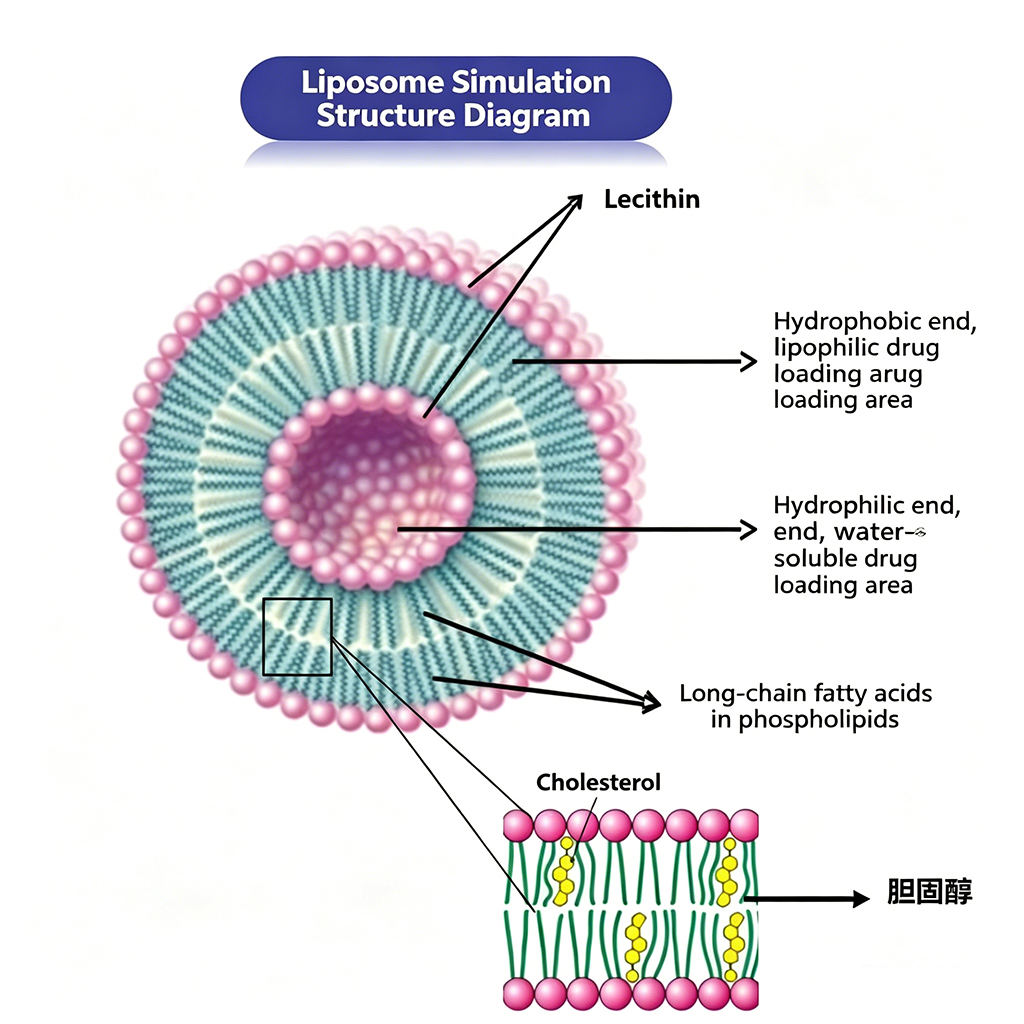
Pyrroloquinoline Quinone (PQQ) stands apart from most dietary ingredients as a redox cofactor capable of thousands of catalytic cycles without structural degradation. This extraordinary stability is central to PQQ’s role in cellular energy metabolism. However, the same quinone structure that enables this redox behavior also makes PQQ highly sensitive to light, oxygen, and moisture — environmental factors that degrade active content during manufacturing. Liposomal encapsulation places PQQ (CAS 72909-34-3) inside phospholipid bilayer vesicles, creating a protective barrier that shields the quinone core while preserving molecular integrity. The result: PQQ powder engineered for real-world manufacturing — from production line to consumer. Available at 50% and 70% loading.
50% & 70% Loading
Liposomal Delivery
Clean Label Ready
The Chemistry — A Redox Cofactor Unlike Any Other
Pyrroloquinoline Quinone is an aromatic tricyclic ortho-quinone — a molecular architecture that enables it to accept and donate electrons through repeated oxidation-reduction cycles. While most cofactors degrade after a few catalytic events, PQQ’s structure supports thousands of cycles without losing function. This exceptional catalytic stability is what makes PQQ biologically significant: it participates in cellular redox networks involved in mitochondrial energy metabolism.
The Vulnerability — Why PQQ Needs Protection
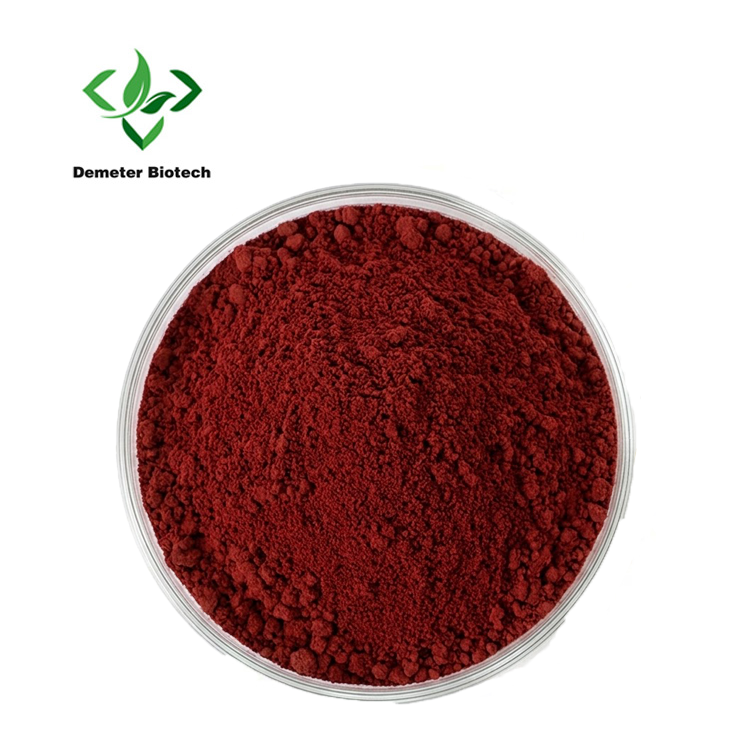
The same quinone structure that enables redox cycling is also PQQ’s manufacturing vulnerability. Quinones are electron-rich and reactive — they readily interact with light (photo-oxidation), dissolved oxygen (auto-oxidation), and ambient moisture. In practical production terms, unencapsulated PQQ can show visible color shifts from reddish-brown toward darker tones, accompanied by measurable active-content decline during routine blending, capsule filling, and warehouse storage.
The Solution — Liposomal Encapsulation
(1) Light & Oxygen Shield. The phospholipid bilayer acts as a physical barrier between encapsulated PQQ and environmental light/oxygen — the primary drivers of quinone degradation. This shielding reduces photo-oxidative damage during blending and capsule filling.
(2) Controlled Rehydration. Upon contact with water, liposomal vesicles swell gradually rather than bursting instantly. This modulated release supports uniform blend distribution in wet-granulation and beverage premix manufacturing.
(3) QC-Verified Quality. EE% ≥ 80% (dialysis/HPLC) confirms genuine encapsulation — distinguishing liposomal PQQ from simple physical blends with phospholipids. DLS sizing verifies 80–300 nm vesicles per batch. These are not one-off claims — they are routine QC data on every CoA.
1. Stability Where It Matters — Real-World Manufacturing
PQQ’s sensitivity to light is a production-floor reality — not a laboratory curiosity. Unencapsulated PQQ exposed to ambient light during blending shows visible color shifts and active-content drift. The phospholipid bilayer delays photo-oxidative degradation, helping maintain the active content your label declares from blending to finished product on shelf.
2. Two Loading Grades — One Platform
50% suits multi-ingredient mitochondrial blends and CoQ10 combinations. 70% enables compact high-potency capsules with fewer pills per serving. Both grades share identical QC: same EE% thresholds, same DLS particle size ranges, same microbial and heavy metal screening.
3. Verified Encapsulation — EE% on Every CoA
EE% ≥ 80% (dialysis/HPLC) distinguishes genuine liposomal PQQ from simple blends. DLS sizing confirms consistent nano-scale vesicles batch to batch. This analytical distinction — whether PQQ is merely mixed with phospholipids or genuinely enclosed — is documented on every shipment CoA.
4. Clean Label Profile
Phospholipids from non-GMO plant sources (sunflower or soy). PQQ produced via controlled fermentation — a nature-identical compound, chemically indistinguishable from PQQ found in trace amounts in soil and dietary sources. No synthetic surfactants or organic solvent residues above pharmacopeia limits.
1. HPLC Active Assay
Full HPLC quantification confirms exact 50% or 70% PQQ loading for every production batch. CoA issued with shipment-specific results — not a certificate of typical values.
2. EE% by Dialysis/HPLC
Encapsulation Efficiency ≥ 80% confirms genuine liposomal encapsulation — the analytical distinction between a liposomal product and a PQQ-phospholipid physical blend.
3. DLS Particle Sizing
Dynamic Light Scattering verifies uniform 80–300 nm vesicle dimensions across production lots. Consistent particle size is essential for reproducible dissolution and content uniformity.
4. Heavy Metals & Microbial Panel
Heavy metals ≤ 10 ppm (as Pb), USP microbial screening. Third-party ISO 17025 accredited laboratory testing available upon request.
These statements use structure/function language to describe established nutritional roles of PQQ. Not evaluated by regulatory authorities. Not intended to diagnose, treat, cure, or prevent any disease.
1. Redox Cofactor Activity
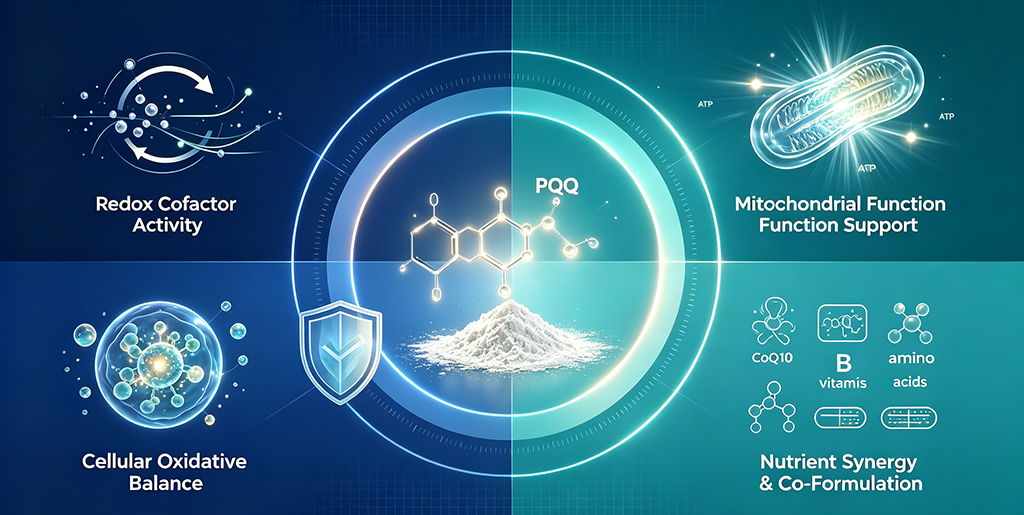
PQQ functions as a quinone cofactor capable of thousands of oxidation-reduction cycles. This catalytic efficiency enables participation in cellular redox networks that support normal energy metabolism.
2. Mitochondrial Support
Mitochondria depend on redox-active molecules to maintain their electron transport chain. PQQ’s quinone structure allows interaction with mitochondrial components involved in cellular energy production.
3. Cellular Oxidative Balance
Cells maintain sophisticated endogenous antioxidant systems. PQQ’s repeated redox cycling is believed to contribute to these networks — not by replacing cellular defenses, but by participating in their normal function.
4. Nutrient Synergy
PQQ is commonly formulated alongside CoQ10 / ubiquinol, B vitamins, and amino acids. The liposomal format protects all co-formulated actives from mutual oxidative interactions during blending and storage.
1. Mitochondrial Health Formulations
PQQ combined with CoQ10 and B vitamins. Liposomal encapsulation protects both quinone actives (PQQ, CoQ10) from mutual oxidative interactions during co-processing.
2. NAD+ Precursor Stacks
PQQ paired with NR or NMN. Liposomal format stabilizes both ingredients — PQQ against oxidation, NR against moisture — during co-blending and storage.
3. High-Potency Single-Active Capsules
70% grade enables compact 20–40 mg PQQ capsules — fewer pills per serving. Premium positioning for single-active PQQ dietary supplement SKUs.
4. Sports & Active Nutrition
PQQ in pre-workout and energy formulations alongside creatine, amino acids, and electrolytes. Free-flowing liposomal powder ensures homogeneous dry-blend distribution.
OEM & CUSTOM FORMULATION
CERTIFICATIONS

TRANSPORTATION
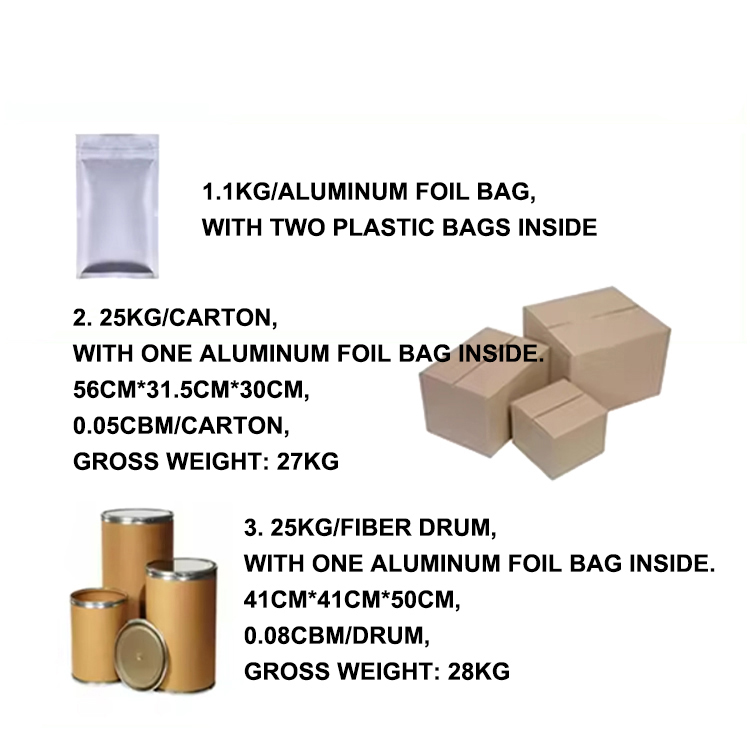
PACKAGING
-

High Absorption Liposomal PQQ Powder Pyrroloqui...
-

Food Grade Liposomal Nicotinamide Riboside NR 5...
-

High Absorption Liposomal Resveratrol Powder 50...
-

High Absorption Liposomal NMN Powder 50% 70% Lo...
-

High Absorption Liposomal Spermidine Powder Pur...
-

High Absorption Liposomal Apigenin Powder Pure ...


