


Why Yabukita Is Everywhere (but Rarely Your Best Ceremonial Leaf)
A single tea clone covers roughly three-quarters of Japan’s planted tea area. Here is what that dominance means for the matcha you specify — and why “Yabukita” on a quote is a volume signal, not a quality verdict.
When a Japanese garden names Yabukita on a quote, it is naming the most planted tea clone in the country. Yabukita was selected in 1908 and registered as a recommended cultivar in 1953, and it now accounts for about 74% of Japan’s total tea cultivation area (Ikeda, 2020). That single figure explains most of what a purchasing team meets in the market: the leaf is reliable, high-yielding, frost-hardy and uniform enough for mechanical harvest, so it became the backbone of everyday sencha and of countless matcha blends. The useful reading is not “Yabukita is good or bad” — it is that Yabukita is a genetic floor, and that floor sits at a moderate amino-acid, higher-catechin point which makes it a superb blending base and an unlikely candidate for a top single-cultivar ceremonial leaf. At Demeter Biotech we mill from our own gardens and report the full composition panel on every lot, so the cultivar mix is always a chemistry decision, never a guess.
1. The one cultivar you have already met
Yabukita’s share of Japanese tea land is not a rounding error — it is the dominant variety by a wide margin. Across national cultivation area, the leading cultivar ‘Yabukita’ is grown in 74% of the total tea production area (Ikeda, 2020). Because virtually every commodity sencha and most blended matcha pass through a Yabukita base, the odds are high that the first Japanese matcha a brand ever tasted was Yabukita-dominant. That familiarity is exactly why the name shows up on so many quotes.
2. Why it is everywhere: the agronomy of a workhorse
Yabukita earned its dominance through traits a commercial farm can bank on, not through flavour prestige. It buds uniformly, resists frost, yields steadily and tolerates mechanical plucking — so a large garden can harvest it at scale with predictable shoot length and timing. Those are the properties that let Japanese green tea hold consistent volume and price through decades of labour shortage. In plain terms, Yabukita is the dependable base note of the industry: present in most blends because it is the safest way to build volume and uniformity, not because it is the most expressive leaf.
| Cultivar | Why it is common | Why it is rarely the top ceremonial single leaf |
|---|---|---|
| Yabukita | High yield, frost-hardy, uniform budding, machine-harvest friendly; ~74% of Japan’s area | Moderate amino-acid ceiling with higher catechins; solid but not the sweet-umami peak |
| Samidori | Prized in Uji; smaller planted area, lower yield | Naturally amino-acid-leaning and low-astringency — a frequent single-cultivar ceremonial choice |
| Asahi | Demanding to grow, low yield, narrow window | Very high umami and sweetness; competition-grade when it succeeds |
| Okumidori | Strong shading response, widely used for high grade | Deep colour and delicate sweetness make it a common premium single-cultivar pick |
3. Why it is rarely your best ceremonial leaf: the genetic ceiling
A cultivar sets the genetic baseline of the leaf before shading, milling or grading ever enter the picture. As we covered in our cultivar map, genetics alone shift the amino-acid-to-catechin balance: a study comparing two green-tea clones by NMR found that ‘Yabukita’ carried higher epicatechin while ‘Yutakamidori’ carried higher theanine and caffeine (Santos et al., 2022). A metabolomics survey adds the mechanism — the baseline concentrations of theanine, epicatechin, epigallocatechin, EGCG and caffeine in green tea vary with the plant’s genetics and growing climate, so a cultivar’s starting point is a real, measurable trait rather than a farming accident (Lee et al., 2010).
The practical consequence: Yabukita starts at a moderate amino-acid, higher-catechin point. Shading (the separate lever we describe elsewhere) can lift its theanine and trim its catechins, but it cannot move the leaf past the genetic ceiling it was bred for. The cultivars that make the most expressive single-name ceremonial powders — Samidori, Asahi, Okumidori — begin higher in free amino acids and respond strongly to shade, so they reach the sweet, low-astringency profile more readily. Yabukita can absolutely make good matcha; it simply is not the genetic peak for that particular sweet-umami target, which is why the finest single-cultivar lots are built from the character clones instead.
4. Blend base vs single-cultivar: the B2B reality
Most commercial matcha is a blend, and Yabukita is frequently the base that gives that blend volume, consistency and year-round stability. A mill will often build the base from a high-yield, hardy cultivar such as Yabukita and layer in a smaller proportion of a character cultivar to set colour and sweetness. This is normal and not a quality problem; it is how consistent profile and certifiable numbers are achieved at scale. A single-cultivar matcha is the premium, traceable exception: one named clone, one predictable profile, and a higher price that reflects lower yield and tighter farm control. Neither is “better” in the abstract — they serve different jobs on a specification.
If your product needs a specific, repeatable amino-acid-to-catechin balance and you want to name the source plant, a single-cultivar lot with a COA is the right call. If your product needs consistent, certifiable numbers at volume, a well-controlled Yabukita-based blend specified by chemistry is the more reliable path — and the cultivar name stops mattering the moment every lot is certified against the same numbers.
5. Writing Yabukita intent into a purchase order
Three lines capture cultivar intent on a specification, whether or not Yabukita is in the mix:
| Parameter | What to write | Why |
|---|---|---|
| Chemistry target | Specify the amino-acid / catechin balance and the analytical method | This is the part genetics and shading actually deliver; verify it per lot |
| Cultivar declaration | Require a named cultivar only if traceability is the point | A declared cultivar is verifiable; an undeclared blend is fine if the COA carries the numbers |
| Lot verification | Request the full panel — EGCG, EGC, total catechins, L-theanine, colour, residues — on every lot | The only figures that bind a lot are those on its COA, whatever the plant’s name |
If cultivar traceability is part of your brand story, say so in the order and we will declare it and certify the lot against your chemistry target. If it is not, we will hold the same numbers on a controlled blend and save you the single-cultivar premium.
6. How Demeter supplies matcha you can verify
At Demeter Biotech we grow and mill matcha from our own gardens in China and pack in light-shielded barrier bags to hold the green. We classify each lot by how it was shaded, milled and certified — our internal RM / EM / OM system — and we report the full composition panel on every batch COA. Whether a given lot leans on a workhorse cultivar or a character clone, the figures you approve are the figures you receive, so the cultivar name becomes a traceability option, not a guessing game. Tell us the chemistry target, the certification you need — USDA Organic, EU Organic or Halal — and whether cultivar traceability matters, and we will confirm the batch figures before the container leaves.
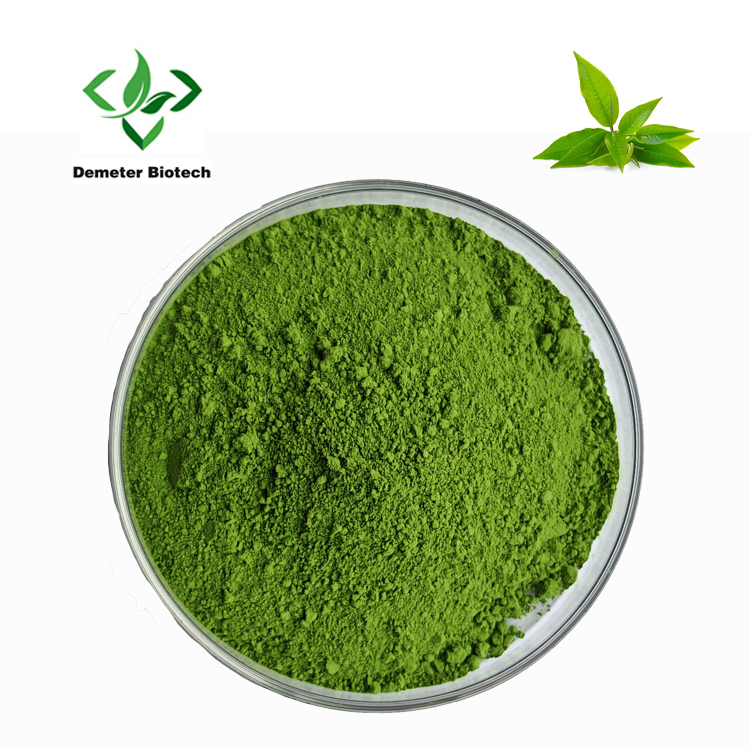
USDA & EU Organic Certified Ceremonial Matcha — A-10A
Shaded first-flush tencha from our own gardens, stone-milled below 40 °C, dual-certified USDA and EU Organic. Batch COA covers EGCG, the catechin profile, L-theanine, colour, residue screen and particle size. Halal available; OEM and private label supported.
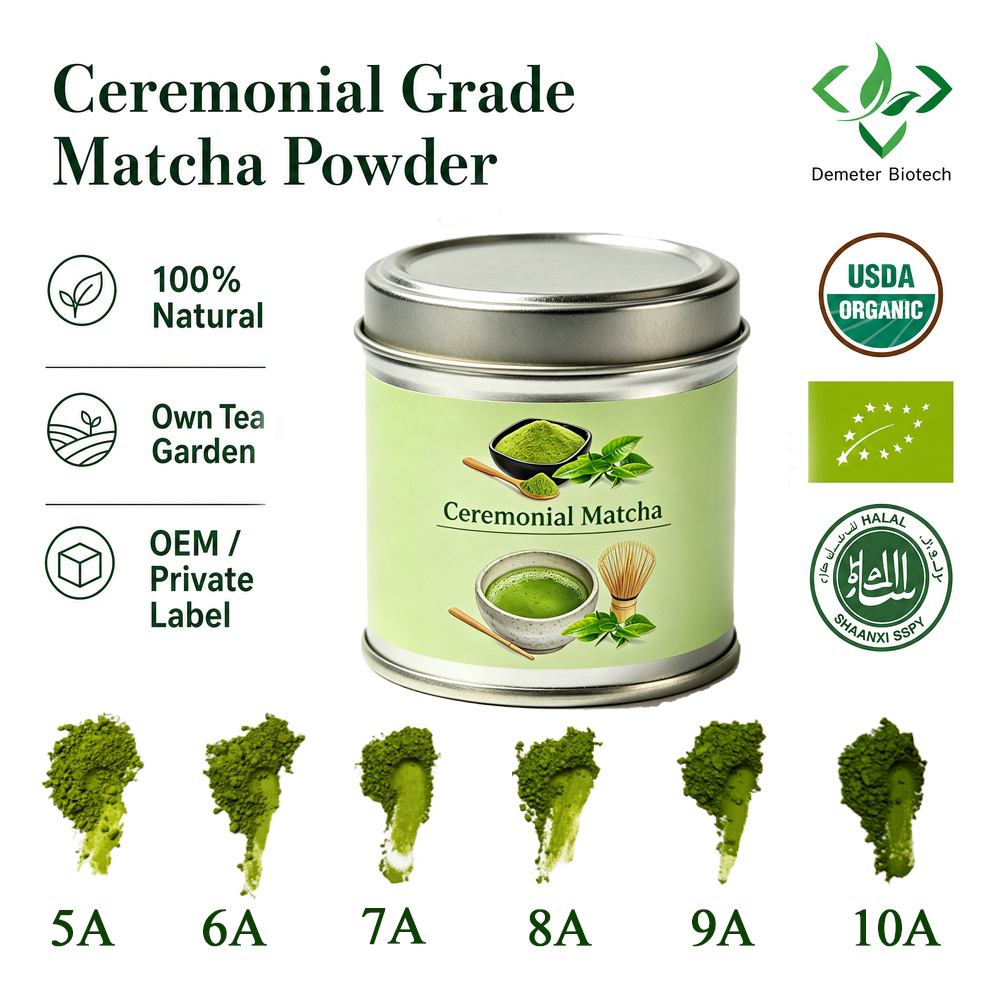
500–1500 Mesh Fine Ceremonial Matcha — Bulk Supply
The fine, free-flowing cut for RTD lines, blending and large-format repacking: 500–1500 mesh (roughly 10–25 µm) in the same organic specification, with the catechin profile and L-theanine reported on every lot for your composition work.
Send us your chemistry target, your certification list and your cultivar question, and we will map the right lot and confirm the numbers on the COA before you commit — so the leaf you specify is the leaf you receive.
References
- Ikeda N. Tea production in Japan and in the world. IOP Conference Series: Earth and Environmental Science. 2020;418:012008. doi:10.1088/1755-1315/418/1/012008
- Lee J-E, Lee B-J, Chung J-O, Hwang J-A, Lee S-J, Lee C-H, Hong Y-S. Geographical and climatic dependencies of green tea (Camellia sinensis) metabolites: a 1H NMR-based metabolomics study. Journal of Agricultural and Food Chemistry. 2010;58(19):10582-10589. doi:10.1021/jf102415m
This article describes plant genetics, ingredient composition and specification only. It is not a statement of efficacy or medical advice. Cultivar trade descriptions summarise common Japanese tencha industry usage and are not measured values; the only figures that bind a lot are those on its batch COA. Composition varies with cultivar, origin, shading, harvest timing, grade and processing.
Post time: Oct-20-2026


