


The Shading Paradox: More EGCG, Less L-Theanine in Culinary
The same 20–30 days of shade that makes ceremonial matcha taste sweet and brothy is exactly what suppresses the bitter catechins. “More shade equals better matcha” is only half the story — and for a B2B specification it is the wrong half to stop at.
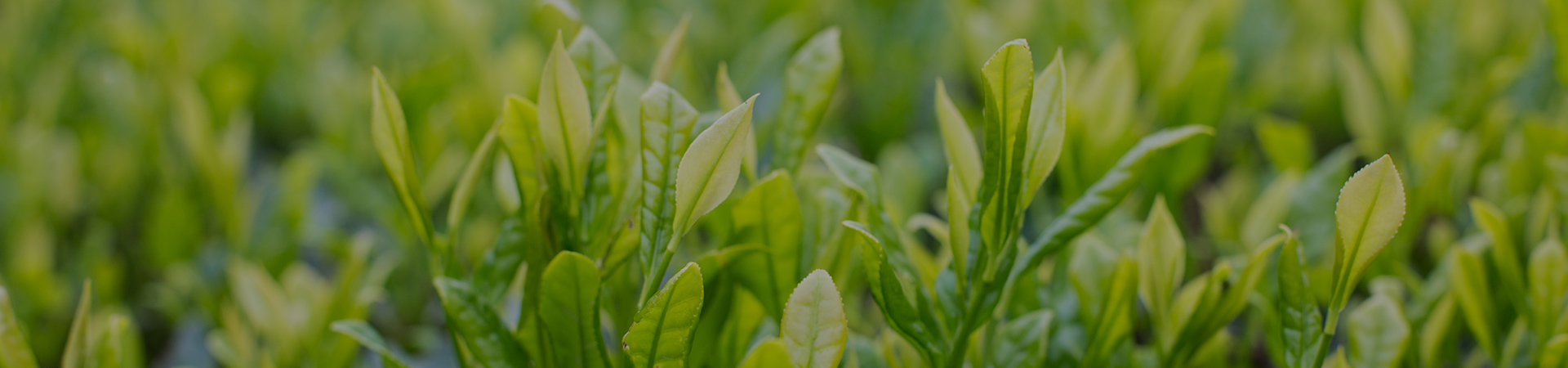
Before harvest, tencha fields are covered for roughly 20–30 days, cutting 70–90% of the sunlight that would otherwise reach the leaf. That single agronomic step rewires the leaf’s chemistry: it builds the amino acids behind umami and it thins out the catechins behind astringency — at the same time, not one after the other. So the intuitive ranking (“more shading must mean a better, more concentrated leaf”) breaks down: the two halves of matcha quality move in opposite directions. At Demeter Biotech we grow and mill both shaded and lightly shaded leaf from our own China tea gardens, and we report L-theanine and catechins on every batch COA. Below is the mechanism, the seesaw it creates between grades, and how to turn that trade-off into a purchase specification.
1. What shading actually does to the leaf
The shaded plant is, in effect, farming for amino acids. Multiple published studies converge on the direction. A 2025 multi-omics study of shaded tea found that covering the plants up-regulates the genes behind L-theanine biosynthesis and transport while dialling down the pathways that build catechins, so free amino acids — led by L-theanine — rise and the catechin pool falls (Niu et al., 2025, Food Chemistry: Molecular Sciences). A separate 2018 study tracking tea buds through a full shading period found the major catechins — catechin, epicatechin, gallocatechin and epigallocatechin — all decreased significantly the longer the leaf stayed covered (Liu et al., 2018, BMC Plant Biology). The leaf also accumulates more chlorophyll under shade, which is why shaded matcha reads a deeper, more vivid green.
In plain terms: shade is what gives ceremonial matcha its round, sweet, marine umami, and it is the same mechanism that takes the edge off the bitter, astringent notes. You cannot maximise both at once. That is the paradox.
2. The seesaw, drawn by grade
Ceremonial-type matcha is made from heavily shaded first-flush leaf: high L-theanine, a lower total catechin load, and extra chlorophyll. Culinary-type comes from less-shaded leaf: lower L-theanine and a heavier catechin load, which is exactly what gives baked goods, chocolates and dry blends their assertive colour and bite. The numbers below are planning ranges — origin, cultivar and exact shading all move them — but the direction is the robust part.
| Trait | Heavily shaded (ceremonial-type) | Lightly shaded (culinary-type) | What it means for your specification |
|---|---|---|---|
| L-theanine | High, commonly 15–25 mg/g | Lower, commonly 6–15 mg/g | The umami/sweet driver; lives at the ceremonial end of the spectrum |
| Total catechins / astringency | Lower | Higher | The bitterness and colour-strength driver; lives at the culinary end |
| Chlorophyll (colour) | Higher, vivid green | Lower | Deeper green comes from more shade, not from a different plant |
| Caffeine | Roughly stable, slight increase | Roughly stable | Not a reliable grade divider; confirm per batch on the COA |
| Best product fit | Unsweetened drinks, lattes, functional shots | Baking, blends, vivid green colour | Match the grade to the flavour and colour target, not to a price tier |
3. Why EGCG is a trap to grade on
EGCG is the best-known individual catechin, and it does sit in the catechin class that rises as shading falls — so the word “more EGCG” in culinary-type leaf is directionally fair. But a single EGCG number is a poor grade divider, because reported values overlap heavily across grades. They depend on the analytical method (HPLC versus spectrophotometric) and on whether you measure the leaf or the infusion, and the result can swing by tens of percent for the same leaf. We cover EGCG and its measurement in a dedicated article; the point here is narrower and more useful for buying: choose the grade by the L-theanine-versus-catechin trade-off and by your flavour target, and read any lone EGCG figure as one line of a composition, not as proof of grade.
4. Turning the paradox into a specification
Three lines are enough to capture the trade-off on a purchase order:
| Parameter | What to write | Why |
|---|---|---|
| L-theanine, per gram | State a band and request the batch value | Lets you model umami intensity and confirms shading level |
| Total catechins (or EGCG + EGC) | Request the panel and the method | Confirms astringency and colour strength for your application |
| Chlorophyll / CIELAB a* | Request greenness if colour is on the label | Shade-driven green is a measurable, spec-able property |
| Method | HPLC for both amino acids and catechins | So two lots’ numbers are directly comparable |
If your product is an unsweetened beverage, a latte or a functional shot where a clean, sweet, umami cup is the goal, lean ceremonial-type (high L-theanine, low astringency). If you are baking, blending into chocolate or building a vivid green colour where bitterness and pigment help, culinary-type (higher catechins, more robust) is the better fit. Either way, request L-theanine and total catechins on the COA and state the method so two shipments are comparable.
One note on our own labels: Demeter’s RM / EM / OM tiers are our internal classification of how a given lot was shaded, milled and certified — they are not an industry-standard grade. We will map them to your specific application and certify the lot against your specification on request, rather than asking you to read our internal shorthand.
5. How Demeter supplies the full seesaw
At Demeter Biotech we mill both ends of the shading spectrum from our own tea gardens in China and pack in light-shielded barrier bags to hold the green. Tell us your flavour target, your colour requirement and your certification needs — USDA Organic, EU Organic or Halal — and we will point you to the right lot and confirm L-theanine and catechin figures on the COA before the container leaves. Whether you need the sweet, shaded ceremonial cut or the robust culinary cut, the number that binds your shipment is the one on its own certificate.
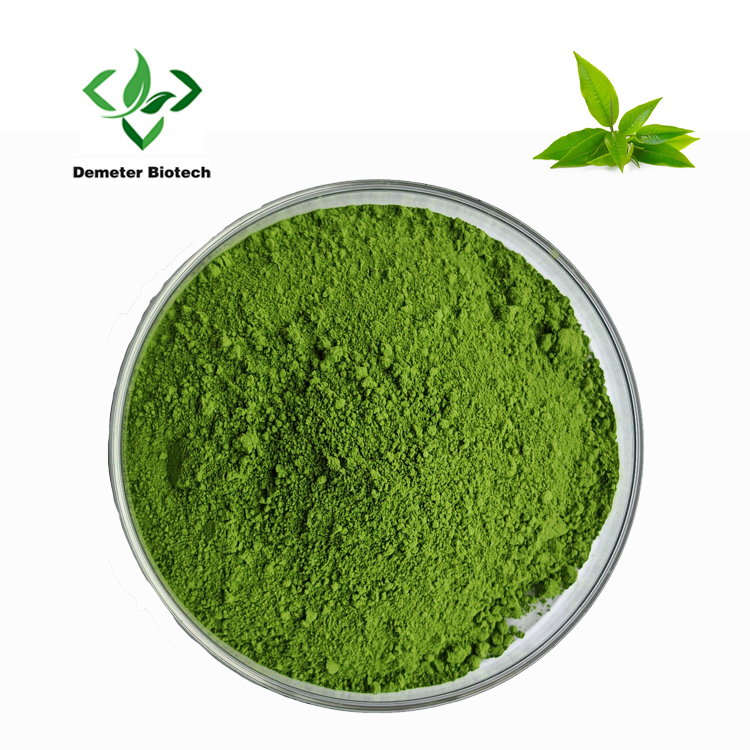
USDA & EU Organic Certified Ceremonial Matcha — A-10A
Shaded first-flush tencha from our own gardens, stone-milled below 40 °C, dual-certified USDA and EU Organic. Batch COA covers L-theanine, catechins, residue screen and particle size. Halal available; OEM and private label supported.
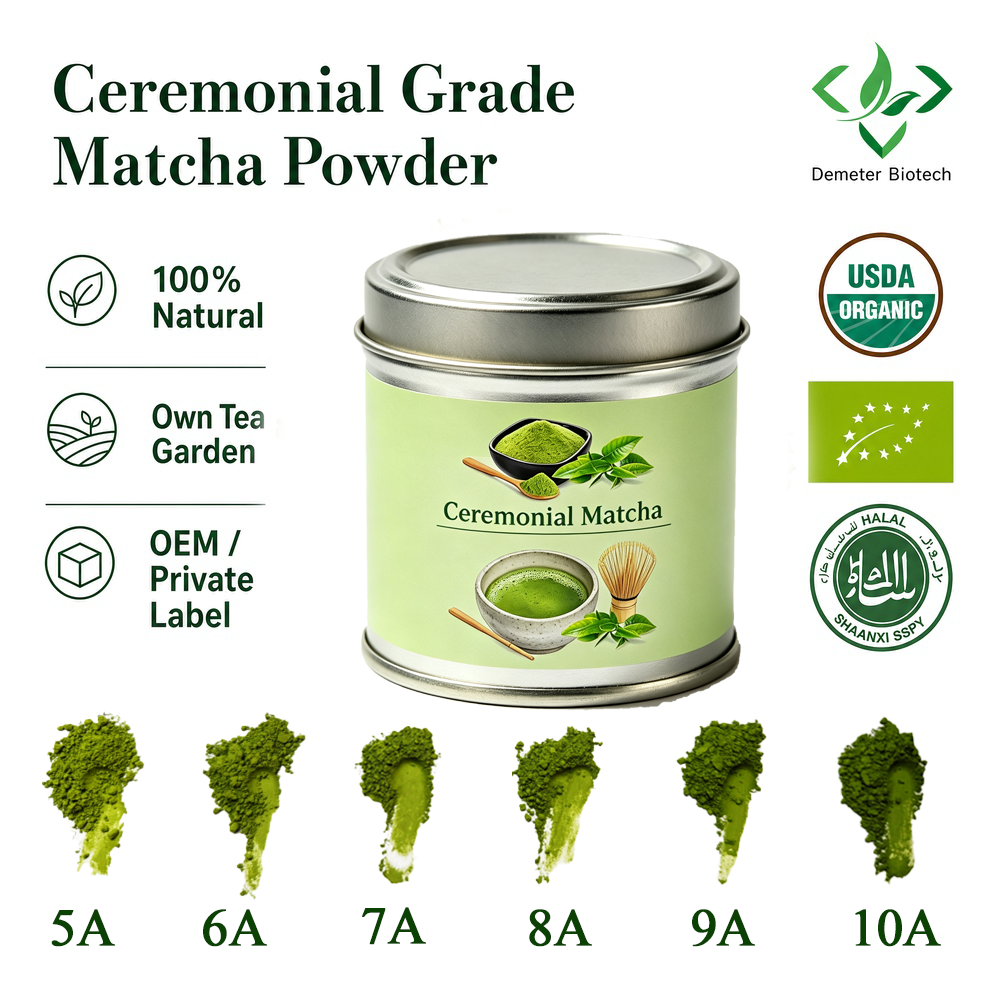
500–1500 Mesh Fine Ceremonial Matcha — Bulk Supply
The fine, free-flowing cut for RTD lines, blending and large-format repacking: 500–1500 mesh (roughly 10–25 µm) in the same organic specification, with L-theanine and catechins reported on every lot for your specification work.
Send us your flavour target and your certification list, and we will map the right lot and confirm the numbers on the COA before you commit — so the leaf you specify is the leaf you receive.
References
- Niu X, Ao C, Teng R, Li H, Zhao Y, Yu J, Huang H. Multi-omics analysis reveals the regulatory mechanism of shading on quality-related metabolites in Camellia sinensis cv. Lifeng. Food Chemistry: Molecular Sciences. 2025;11:100314. doi:10.1016/j.fochms.2025.100314
- Liu L, Li Y, She G, Zhang X, Jordan B, Chen Q, Zhao J, Wan X. Metabolite profiling and transcriptomic analyses reveal an essential role of UVR8-mediated signal transduction pathway in regulating flavonoid biosynthesis in tea plants (Camellia sinensis) in response to shading. BMC Plant Biology. 2018. doi:10.1186/s12870-018-1440-0
This article describes ingredient composition and specification only. It is not a statement of efficacy or medical advice. L-theanine, catechin and caffeine values cited come from the published analytical work referenced above and from common B2B specifications; they vary with cultivar, origin, grade and milling, and the only figures that bind a lot are those on its batch COA.
Post time: Oct-15-2026


