


Matcha Particle Size & Mesh: Stone-Ground vs Jet vs Ball Mill
What mesh and microns mean, how the grinding method changes the powder your product receives, and how to put real numbers on your specification.
When two matcha specifications both say “fine powder,” the figure that actually decides your result is particle size — usually reported as D50 (median diameter) and D90 (ninety percent of the mass is finer). It governs how the powder disperses in liquid, how it feels on the tongue, how evenly it colors your batch, and how smoothly it runs through your line. At Demeter Biotech we manage particle size as a measured lot specification, not a marketing word — and this article explains what the numbers mean, how stone, jet, and ball milling differ in the powder they produce, and what to write on your request so your team receives the right grade instead of a guess.
1. What “mesh” and “micron” actually mean
Particle size is most often quoted two ways. “Mesh” counts the number of screen openings per linear inch: the higher the mesh, the finer the powder. The trouble is mesh is an approximate, standard-dependent scale, so two “800-mesh” claims from different mills can mean different things. Microns (μm, one thousandth of a millimeter) are absolute, which is why a certificate should state size in microns. The two figures you read on a certificate are D50 — the median diameter where half the mass is finer and half coarser — and D90, the diameter below which ninety percent of the mass sits. These are measured by laser diffraction (ISO 13320). For matcha, a stone-ground ceremonial lot is commonly cited around 5–10 μm D50, a jet-milled lot typically falls under 5 μm, and a ball-milled lot lands near 10–20 μm — though published measurements show the same method can span a range depending on mill setting. As a rough bridge, 800-mesh corresponds to about 18 μm.
2. Why particle size matters for your product
Four things move with size. Dispersion: a finer, narrower distribution stays suspended longer and settles less, which matters for ready-to-drink and latte formats. Mouthfeel: the tongue reads particles above roughly 25 μm as grit, so a finer grind feels silky rather than sandy. Color uniformity: a fine, even powder colors a batch consistently; coarse material leaves speckle. Flowability: this is the counter-intuitive one — finer is not automatically better on the line. Published work on matcha flow found stone-milled powder flows poorly because of static charge, while ball-milled powder flows noticeably better. For automated dosing and bulk handling, flow can outweigh fineness. The job should pick the size, not the other way around.
3. Three grinding methods compared
Stone milling (ishiusu) shears leaf between granite stones at low speed, staying gently warm rather than hot; it produces irregular, torn flakes that whisk into a stable foam and is the traditional choice for ceremonial and whisked formats. Jet milling accelerates particles in a high-velocity air stream so they shatter against each other, running cool and yielding very fine, uniform, rounded particles with good flow — ideal where a smooth, consistent dispersion is the priority. Ball milling tumbles the leaf with grinding media; it is fast and industrial, but friction generates heat, so temperature control matters, and it gives good flow for bulk use. A published study comparing the three reported median diameters of about 15–20 μm for stone- and ball-milled samples and under 5 μm for jet-milled samples, with jet-milled powder showing the roundest particles and the best flow (Sawamura et al., 2010).
| Method | Typical D50 | Heat in grinding | Particle shape | Flow on the line | Best fit |
|---|---|---|---|---|---|
| Stone mill | ~5–20 μm (setting-dependent) | Gentle, mostly <40 °C | Irregular, torn flakes | Lower (static charge) | Whisked, ceremonial, premium |
| Jet mill | <5 μm | Cool (gas expansion) | Rounded, angular-shattered | Good | Premium RTD, fine blends |
| Ball mill | ~10–20 μm | Needs cooling (friction) | Rounded | Good | Bulk, bakery, beverage at volume |
4. The 800-mesh benchmark and “500–1500 mesh”
Because mesh is loose, always convert it to microns on a certificate. The bulk fine grade we supply is specified at 500–1500 mesh, which maps to roughly 10–25 μm — a fine, free-flowing powder built for consistent blending rather than for whisking bowls. If your spec is written only as “mesh,” ask for the equivalent D50/D90 so any two quotes are compared on the same ruler.
5. Reading particle size on a COA
Request three things: D50 and D90 from laser diffraction (ISO 13320), the mesh pass rate, and a note on grinding method and temperature control. A “typical values” sheet describes a grade; the batch COA describes the lot in your warehouse. For a stone-ground claim, the useful detail is the milling temperature (gentle, below roughly 40 °C, protects color and aroma) and the lot’s measured D50 — not the method name alone.
6. Mapping size to your application
Whisked drinks and premium RTD want a low D50 from stone or carefully cooled jet milling, where suspension and mouthfeel lead. Bakery and confectionery can absorb a coarser, lower-cost grind, since dairy, sugar, and baking carry the profile. Bulk blends want a consistent fine mesh with a batch COA so every tote matches. Tell us the end format and we will point to the right specification rather than a generic grade word.
7. How Demeter supplies it
Our USDA + EU Organic ceremonial matcha is built from shaded first-flush tencha from our own tea gardens, stone-milled below 40 °C, and tested batch by batch with D50/D90 reported on the COA. For volume users who need a fine, free-flowing bulk powder, we also supply a 500–1500 mesh ceremonial-grade matcha in the same organic specification, with particle-size data on every lot.
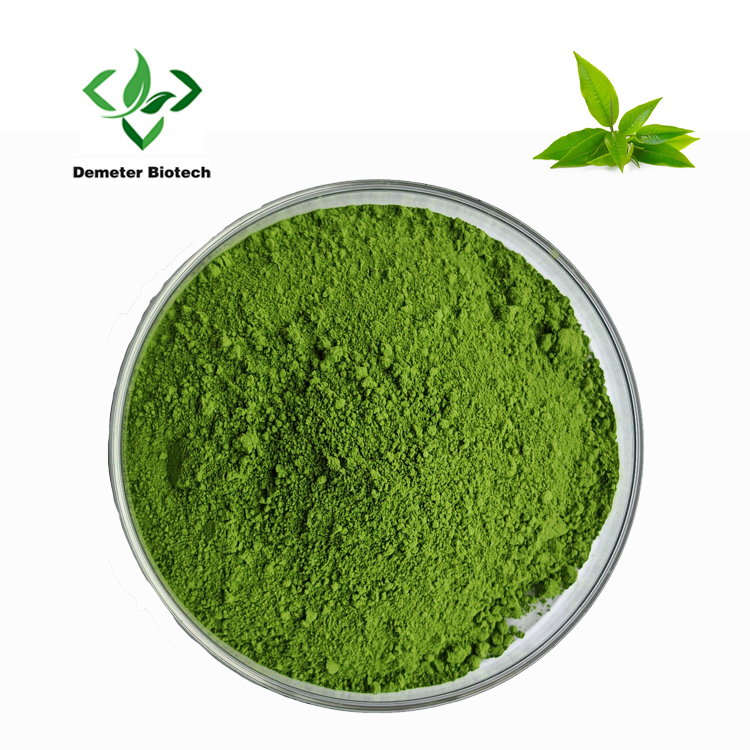
Demeter Ceremonial Grade Matcha (A-10A)
Shaded first-flush tencha, stone-milled below 40 °C, Eurofins-tested. Batch COA reports D50/D90 and residue screening so your formulation team works from real numbers.
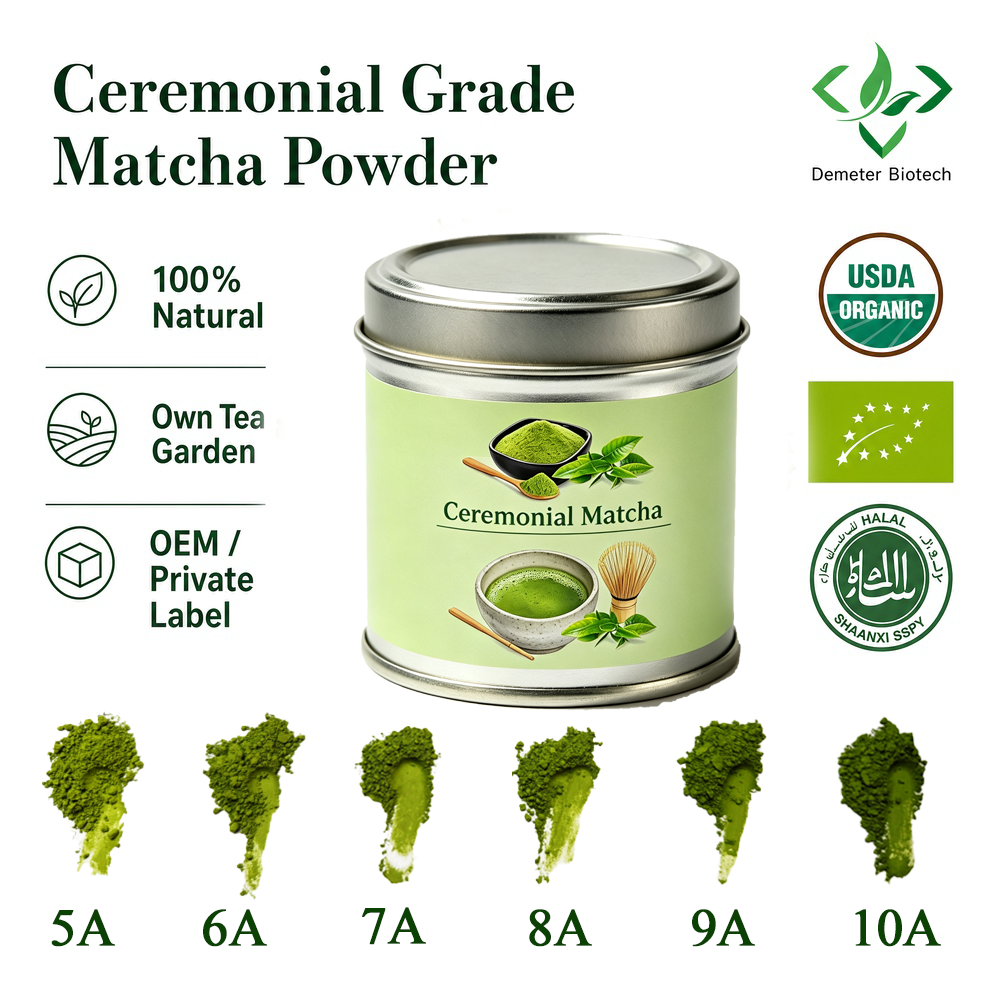
Ceremonial Grade Matcha — 500–1500 Mesh Fine, Bulk Supply
Organic fine-mesh bulk powder for consistent blending. Batch COA with D50/D90 and mesh pass rate; private-label and custom packaging available.
8. When you inquire, three things we ask
- 1Application — whisked drink, latte base, bakery, or supplement blend? This sets the D50 range you need.
- 2Target size & certifications — desired D50/D90, plus USDA, EU Organic, or Halal requirements.
- 3Volume & pack — drum, tin, or sachet, so the sample and the COA match the commercial lot you will receive.
References
- Sawamura S, Haraguchi Y, Ikeda H, Sonoda J. Properties and shapes of matcha with various milling method. Nippon Shokuhin Kagaku Kogaku Kaishi. 2010;57(7):304–309. doi:10.3136/nskkk.57.304.
- Yasuda M, Sawamura S, Matsusaka S, Haraguchi Y. Flowability properties of matcha varying with particle size and milling method. Nippon Shokuhin Kagaku Kogaku Kaishi. 2009;56(2):103–107. doi:10.3136/nskkk.56.103.
This article describes ingredient composition and processing only. It is not a statement of efficacy or medical advice. Particle-size values cited are from published literature and common B2B specifications and vary with mill setting, cultivar, and method; actual values for any lot are confirmed only by its batch COA.
Post time: Oct-09-2026


