


Matcha Moisture, Ash & Water Activity: The Three Numbers That Decide What Arrives
Why a lot that passed every test at the factory can land clumped, dull and marine-tasting — and how to write the specification that stops it.
A matcha specification is usually written around the glamorous numbers: color, L-theanine, mesh. Then the container arrives, and the problems are never about those. They are about water. Moisture content, water activity and ash are the three lines that decide whether the powder you approved is still the powder you receive — after four weeks at sea, a hot port, and a warehouse that is not air-conditioned. At Demeter Biotech we report all three on every batch COA, because they are the numbers that let you plan storage instead of hoping for it. Below is what each one measures, what to write, and where a lot is actually won or lost.
1. Moisture content: the 5% working line
Moisture content is the total water in the powder, measured as loss in mass when a ground sample is dried at 103 °C (the ISO 1573 method, and the number you will see reported as a percentage on a green tea or matcha COA). Good export matcha is typically packed in the range of about 2.5–5%, and 5% is the working ceiling we see written into most purchase specifications.
The reason is not that water is harmful by itself but that it is mobile. Free water lets particles bridge into lumps, softens the powder so it cakes under its own pallet weight, feeds browning reactions that push the green toward olive, and gives any surviving microorganism a route back to activity. A lot packed at 3% has a margin. A lot packed at 6.5% spends the voyage already degrading, and no amount of cold storage on your side rewinds it.
2. Water activity: the number that governs chemistry, not just lumps
Water activity (Aw) is the fraction of that water which is actually available for reactions, on a scale from 0 to 1. It is why two powders can carry the same moisture content and age at completely different speeds: composition decides how tightly the water is held. Aw is the number you want if your concern is shelf life rather than yield.
The matcha-specific evidence here is recent and clear. Kim and colleagues stored matcha powder across controlled water activities from Aw 0.11 to 0.93, half of the samples shielded from light and half under ordinary laboratory lighting of roughly 450–500 lx, and tracked the powder over time. Higher Aw loosened the powder structure and sped up the decline of the compounds they measured; light added a second, independent hit. In their kinetic analysis the gallated catechins EGCG and ECG showed half-lives of only about 30–40 days under continuous light, while the samples held at low water activity (Aw ≤ 0.53) and kept dark retained the most (Kim et al., 2026).
Two practical readings follow. First, Aw 0.6 is the practical ceiling most food specifications use, and premium matcha is often packed nearer 0.3–0.45; the gap between those two numbers is the difference between a two-year claim and a twelve-month reality. Second, humidity and light are separate variables. Foil that blocks light still fails if it is not also a moisture barrier, and a moisture barrier still fails in a clear pack.
3. Ash: the cheapest purity check on the sheet
Total ash is what remains when the organic material is burned away — the mineral fraction of the leaf. For tea it usually falls in a band of roughly 5–7% (determined by the ISO 1575 method), and it is a useful fingerprint because different parts of the plant ash differently: a leaf-heavy, de-stemmed tencha sits differently from a product bulked out with stem, lower leaf or older material.
The more discriminating line is acid-insoluble ash (ISO 1577), normally specified at no more than about 1%. That fraction is largely sand, soil and silica, so it is the number that catches grit and hygiene problems at the field or drying stage — the same grit your own customer will feel as sandiness in the cup. Ask for both figures, not just “ash”.
4. Why the same grade behaves differently in your silo
Powders do not have a single moisture limit; they have a moisture curve. Stępień and colleagues measured water adsorption isotherms and glass transition temperatures across commercial matcha powders and found sigmoidal sorption behaviour at 25 °C, a monolayer moisture content of about 0.045–0.053 g water per g of powder — the point of maximum stability — and glass transition temperatures for the anhydrous powders between 106 and 139 °C, with color parameters that also differed between samples (Stępień et al., 2025).
The takeaway for a specification is simple: that monolayer figure is your storage target, not a theoretical curiosity. Below it, the powder is in its most stable state; above it, every additional fraction of a percent of water shortens the time you have to use the lot. It is also why a single “max 5%” line tells you less than a packed moisture and an Aw figure reported together.
5. The two bands, at a glance
6. The specification that protects the lot
Copy this into your own purchase specification and you have closed the gaps that most quality complaints come through:
| Parameter | Practical target | Method | What it protects |
|---|---|---|---|
| Moisture content | ≤5.0% at packing (2.5–4.5% preferred) | ISO 1573, loss in mass at 103 °C | Caking, browning, short shelf life |
| Water activity | ≤0.60, target 0.30–0.45 | Aw meter, chilled-mirror or capacitive | Rate of colour and aroma decline |
| Total ash | 5–7% | ISO 1575 | Leaf quality versus stem-heavy bulk |
| Acid-insoluble ash | ≤1% | ISO 1577 | Sand, soil, grit — what your customer tastes |
| Pack barrier | Foil or EVOH laminate, light-shielded, nitrogen-flushed | Pack data sheet + COA | Water and oxygen pickup in transit |
| Storage and transit | ≤25 °C, dry, out of light; 10–15 °C for premium lots | Route and container plan | Heat-driven colour loss, container rain |
| Retest on arrival | Moisture + Aw, one sample per pallet | Your own lab or a third-party lab | Proves or disproves a transit claim |
7. Packaging and transit: where the specification is actually won
Moisture and Aw are decided twice — once at the mill, once in the container. A barrier laminate with a light-shielding layer and a nitrogen flush holds the packed numbers; desiccant in the cartons matters on humid routes, and container rain (condensation forming on the ceiling and dripping onto pallets) is the single most common cause of arrival moisture that has nothing to do with the factory. Premium lots travel best at 10–15 °C, and every lot travels better away from hot deck stow and direct sunlight on the quay.
If you buy in large totes and repack, remember that the clock restarts each time the powder meets humid air. Repack under dry conditions, into the same barrier specification, and close the bag the same day.
8. What degradation looks like before you open the bag
Three of the classic matcha defects on a tasting sheet are storage stories, not leaf stories. Aroma drifting toward seaweed or a marine, fishy edge is oxidation developing. Green flattening toward olive or khaki is chlorophyll loss, driven by heat and light. Lumps and a gritty feel are water. None of them can be judged from a stylized product photo, and all three are readable from the packed moisture, the Aw, and the age of the lot.
9. How Demeter supplies matcha for long routes
At Demeter Biotech we manage these three numbers as part of the product, not as paperwork. Our A-10A ceremonial line and our 500–1500 mesh bulk fine powder both ship with moisture, total ash and acid-insoluble ash reported on the batch COA, in barrier packaging that is light-shielded and moisture-resistant, from our own tea gardens in China and milled under temperature control.
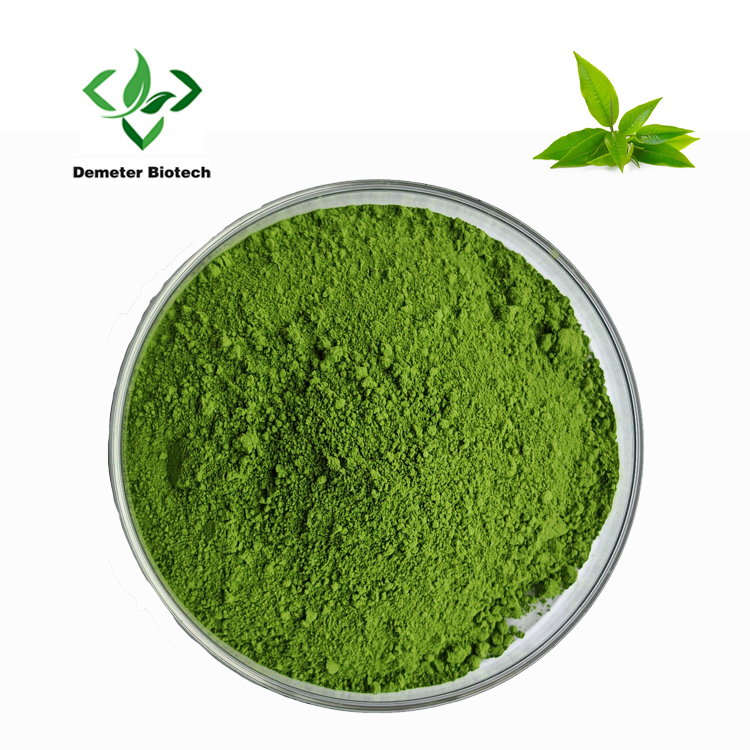
USDA & EU Organic Certified Ceremonial Matcha — A-10A
Shaded first-flush tencha from our own gardens, stone-milled below 40 °C, dual-certified USDA and EU Organic, with batch COA covering moisture, ash, residue screen and particle size. Halal available; OEM and private label supported.
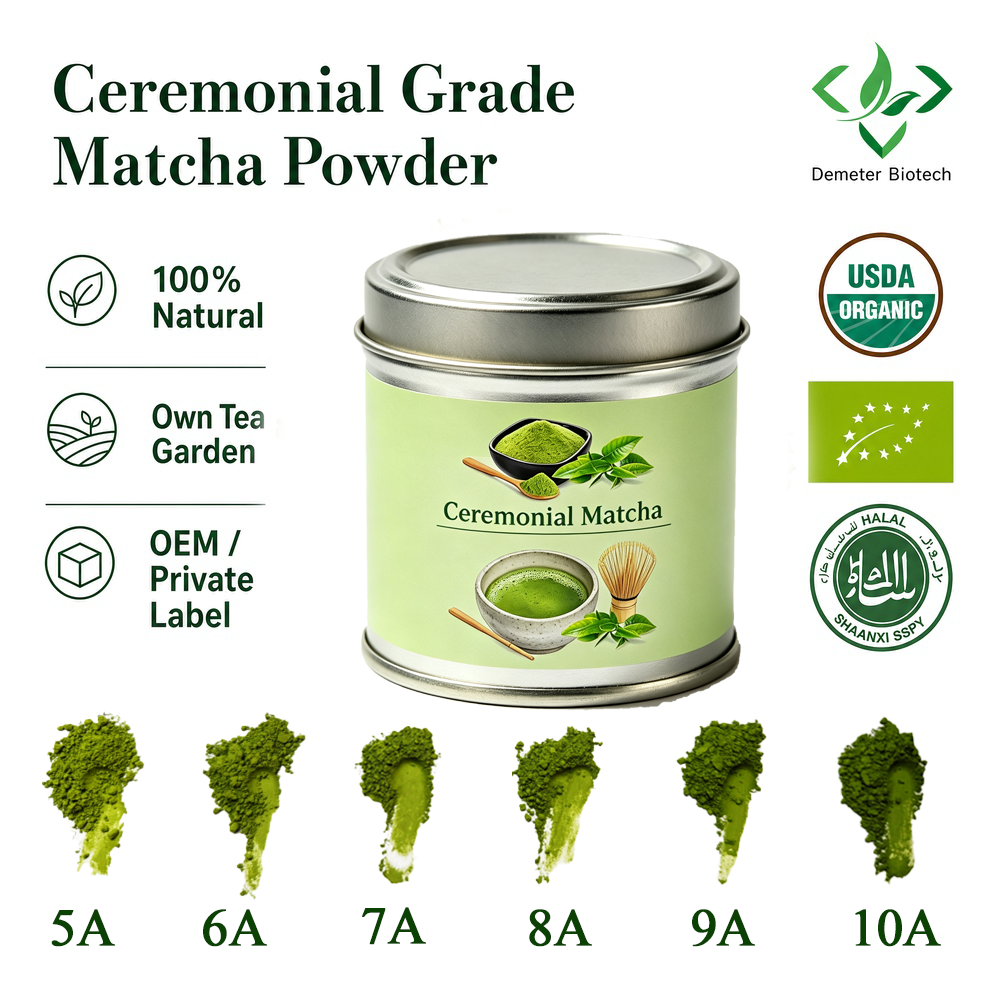
500–1500 Mesh Fine Ceremonial Matcha — Bulk Supply
The fine, free-flowing cut for RTD lines, blending and large-format repacking: 500–1500 mesh (roughly 10–25 µm) in the same organic specification, packed in light-shielded barrier bags for long routes, with D50/D90 and the stability numbers on every lot.
Send us your target moisture, Aw limit, pack format and route, and we will match the lot to it and confirm the numbers on the COA before the container leaves — so what you approve is what arrives.
References
- Kim JM, Lee K-Y, Choi S-G, Heo HJ. Effect of water activity and light exposure on the stability of bioactive compounds in matcha (Camellia sinensis) powder during storage periods. Food Chemistry. 2026;510:148655. doi:10.1016/j.foodchem.2026.148655
- Stępień A, Liszka-Skoczylas M, Gwóźdź G. Comparison of technological and physical properties of matcha powders of different geographical origins. Journal of the Science of Food and Agriculture. 2025;105(4):2569–2577. doi:10.1002/jsfa.14030
This article describes ingredient composition, physical specifications and storage behaviour only. It is not a statement of efficacy or medical advice. Values cited come from the published laboratory work referenced above and from common B2B specifications; they vary with cultivar, origin, milling and packing, and the only figures that bind a lot are those on its batch COA.
Post time: Oct-10-2026


