


Matcha Caffeine vs Coffee: Why the Energy Feels Different
The arithmetic is counter-intuitive: gram for gram, matcha powder carries more caffeine than roasted coffee bean — yet a bowl gives you less than a cup. Here is what actually drives the difference.
Two claims travel together on the internet and both are half true. The first: matcha has “more caffeine than coffee.” The second: matcha gives you “calmer energy.” Neither is useful as stated, because they measure different things — one is per gram of dry product, the other is per serving, and the “calmer” part is a composition story, not a promise. For a B2B purchaser the practical questions are simpler: how much caffeine is in the powder you are buying, how much lands in the serving your customer drinks, and what else travels with it. At Demeter Biotech we report caffeine on the batch COA and we can map it to your dose. Below is the comparison, the numbers behind it, and how to write it into a specification.
1. Per gram vs per serving: the arithmetic that settles the argument
The confusion starts because the two drinks are used in completely different amounts. A bowl of matcha is roughly 1–2 g of powder whisked into water. A cup of coffee is a 240 mL infusion of 8–12 g of ground bean, most of which you discard. So “more caffeine per gram” and “more caffeine per cup” point in opposite directions, and both are correct.
On a dry-weight basis, matcha sits high among caffeinated plant products. One 2025 analysis quantified caffeine in matcha powder by HPLC at about 41.8 mg per gram of dry powder (PLOS ONE, 2025), consistent with the commonly reported matcha band of roughly 18–45 mg/g. Roasted coffee bean, by comparison, runs about 10–12 mg per gram of bean — roughly half to a third of matcha on a like-for-like weight. So per gram, matcha does carry more caffeine than coffee.
Now flip to the serving. A 2 g bowl of matcha at ~30 mg/g delivers on the order of 50–70 mg of caffeine. An 8 fl oz (240 mL) cup of brewed coffee, per the USDA FoodData Central reference, delivers about 95 mg. So per serving, coffee usually gives more — purely because you use more material. The takeaway for a formulator: dose, not the printed name, decides the caffeine your finished product carries.
| Basis | Matcha | Coffee | What it means for you |
|---|---|---|---|
| Per gram, dry product | ~18–45 mg/g (measured 41.8 mg/g, PLOS ONE 2025) | ~10–12 mg/g bean | Gram for gram, matcha is the denser source |
| Per typical serving | ~50–70 mg from a 2 g bowl | ~95 mg from 240 mL brewed | Per cup, coffee usually delivers more |
| What you discard | Nothing — you drink the whole leaf | Most of the ground bean (spent puck) | Matcha’s dose is the full powder weight |
| L-theanine alongside | Yes, characteristic of the leaf | None | Distinct compositional fingerprint (see §3) |
2. You drink the whole leaf — coffee discards most of it
This is the structural reason the arithmetic above holds. Brewed coffee and brewed tea are infusions: water passes through ground bean or leaf, and you throw the solids away, which puts a natural ceiling on what reaches the cup. Matcha is the whole leaf, stone-milled to a powder and whisked in, so everything in the powder is consumed. A 2024 composition study of dry matcha powder reported 56.1 g/100 g dietary fibre and 17.3 g/100 g protein — figures that only exist because the entire leaf is eaten, not steeped (Kika et al., 2024). For a product developer this matters: a matcha RTD or bar carries the leaf’s fibre and protein, while a coffee drink does not.
3. What rides alongside the caffeine
Coffee delivers caffeine together with its own companion compounds — chiefly chlorogenic acids, a family of polyphenols matcha carries only in trace amounts. Matcha delivers caffeine together with L-theanine, an amino acid characteristic of the tea leaf that coffee does not contain (we cover L-theanine and its shading-driven accumulation in a separate article). The two drinks therefore have different compositional fingerprints, and the caffeine-plus-theanine pair is specifically the one studied for its distinct effects on alertness — a research question, not a property we assert your product delivers. We keep the discussion to composition: what is in the powder, not what it does in the body.
For specification purposes the point is operational. If the question comes up — “is matcha like coffee for energy?” — the honest answer is that they are different compositions: same stimulant molecule, different companions and a different dosing model, and the only number that binds a given lot is the one on its COA.
4. Caffeine by grade, and why it is a COA number
Caffeine tracks with the leaf, and it varies by grade and origin in roughly the band below. These are planning ranges, not guarantees — origin, harvest and cultivar all move the result, which is exactly why we report it per batch.
5. Writing caffeine into a specification
Caffeine is a declared value in most food markets, so it belongs on the specification whether or not you feature it. Three lines are enough:
| Parameter | What to write | Why |
|---|---|---|
| Caffeine, per gram | State a band, e.g. 18–45 mg/g, and request the batch value | Lets you model caffeine per serving from your own dose |
| Caffeine, per serving | Define your serving (g of powder) and the resulting mg | The number your label and your customer’s label must show |
| L-theanine (optional but useful) | Request it alongside caffeine if “whole-leaf” is part of the story | Distinguishes matcha’s fingerprint from coffee’s |
| Method | HPLC (caffeine) and HPLC or amino-acid analysis (L-theanine) | So two lots’ numbers are directly comparable |
Ask for the caffeine figure on the same COA that carries moisture, ash and particle size, and you can model your finished-product caffeine before you order rather than after.
6. How Demeter supplies matcha for a known dose
At Demeter Biotech we report caffeine and L-theanine on the batch COA for both of our main matcha lines, milled from our own tea gardens in China and packed in light-shielded barrier bags. Tell us your target serving size and your label ceiling, and we will confirm the batch figure before the container leaves.
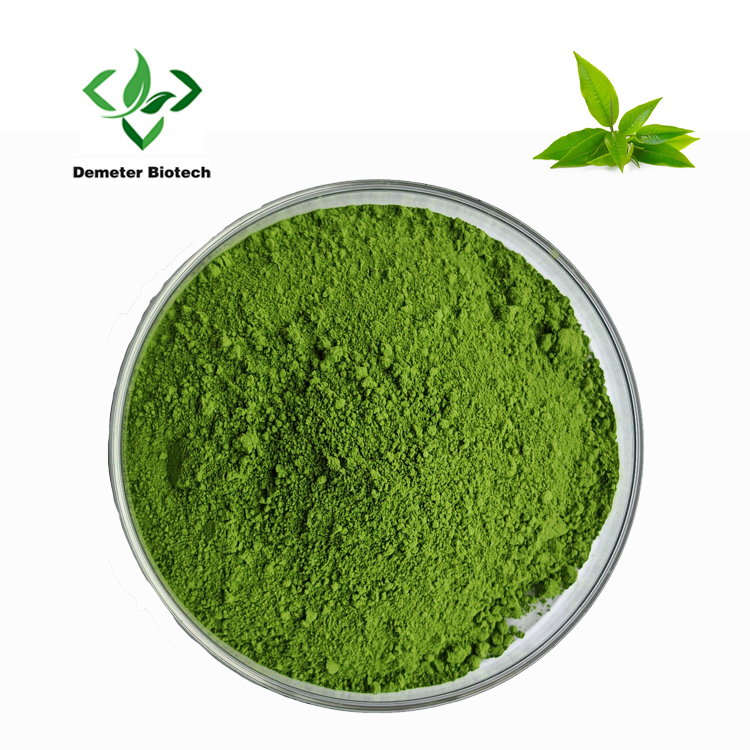
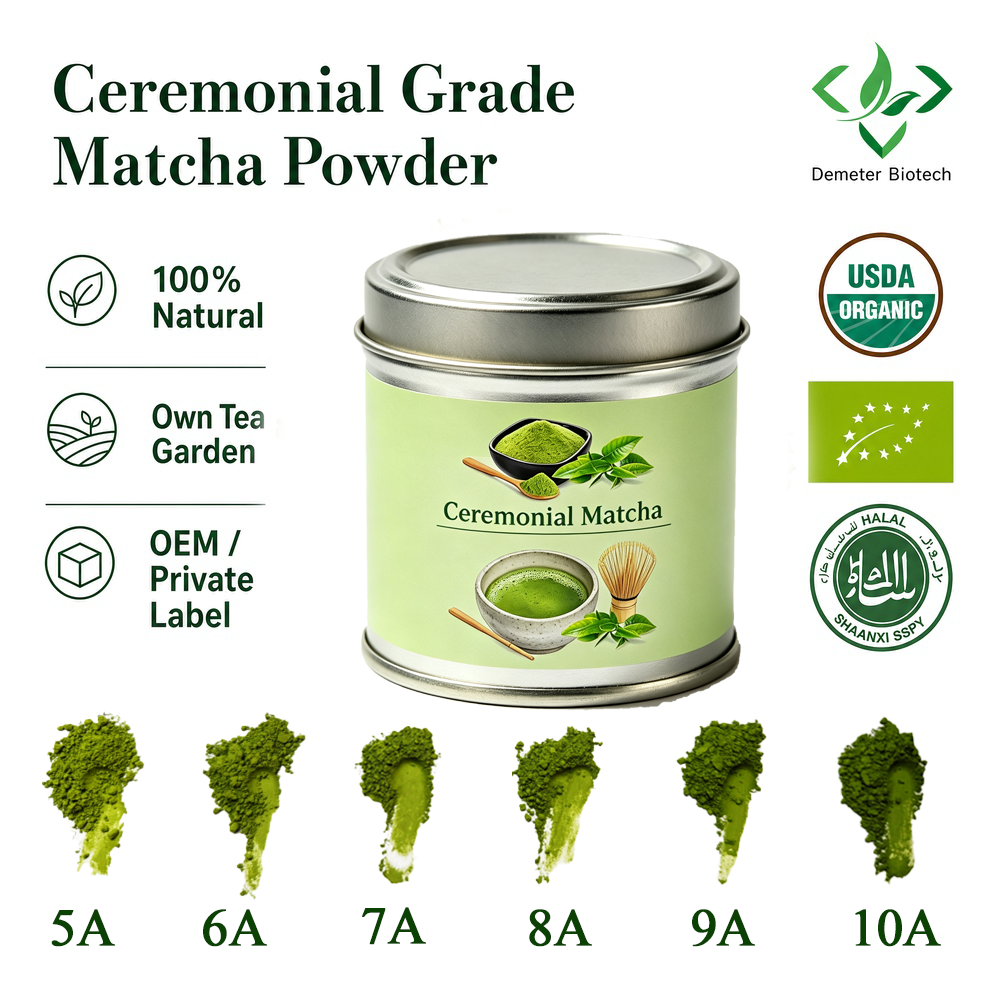
USDA & EU Organic Certified Ceremonial Matcha — A-10A
Shaded first-flush tencha from our own gardens, stone-milled below 40 °C, dual-certified USDA and EU Organic. Batch COA covers caffeine, L-theanine, residue screen and particle size. Halal available; OEM and private label supported.
500–1500 Mesh Fine Ceremonial Matcha — Bulk Supply
The fine, free-flowing cut for RTD lines, blending and large-format repacking: 500–1500 mesh (roughly 10–25 µm) in the same organic specification, with caffeine and L-theanine reported on every lot for your label modelling.
Send us your serving definition, your caffeine ceiling and your certification needs, and we will map the right lot and confirm the numbers on the COA before you commit — so the label you print matches the powder you receive.
References
- Effects of matcha green tea on the pharmacokinetics of nadolol in rats — phytochemical analysis reports caffeine in dry matcha powder at 4.18 ± 0.44% w/w (41.8 ± 4.4 mg/g) by HPLC-UV. PLoS ONE. 2025. doi:10.1371/journal.pone.0342857
- Kika J, Jakubczyk K, Ligenza A, Maciejewska-Markiewicz D, Szymczykowska K, Janda-Milczarek K. Matcha Green Tea: Chemical Composition, Phenolic Acids, Caffeine and Fatty Acid Profile. Foods. 2024;13(8):1167. doi:10.3390/foods13081167
This article describes ingredient composition and specification only. It is not a statement of efficacy or medical advice, and it does not claim effects on alertness, energy, mood or sleep. Caffeine and L-theanine values cited come from the published analytical work referenced above and from common B2B specifications; they vary with cultivar, origin, grade and milling, and the only figures that bind a lot are those on its batch COA. Coffee caffeine and serving figures are drawn from the USDA FoodData Central reference values.
Post time: Oct-14-2026


