


Matcha Quality Reference
First Flush vs Later Harvest: How Picking Time Defines Matcha Quality
When you source matcha, the single factor that shapes cup quality more than any label is the day the leaf was picked. First-flush leaf (一番茶, ichibancha) and later harvests are not marketing categories — they are physically different raw materials. Here is what changes leaf by leaf, how to read it on a specification sheet, and how Demeter’s first-flush matcha is built for your application.
1. Why the harvest date outranks the grade word
“Ceremonial,” “latte,” and “culinary” are useful trade shorthand, but none is a legal standard. What those words try to describe is rooted in agronomy, and the first variable is picking time. The first flush is the spring harvest taken from shoots that grew after winter dormancy: the youngest, most tender leaves on the plant. Later flushes — a second cut taken roughly 45–50 days after the first, and an autumn cut — come from leaves that have matured through warmer, faster-growing conditions. The grade label is a summary; the flush is the cause.
That distinction matters for you because it changes what you can promise in your own product. A vivid-green, umami-forward whisked drink and a cost-efficient bakery colorant can both be “matcha,” but they start from different leaves picked at different times. Specifying by flush is how you stop paying ceremonial prices for later-harvest material — or, just as badly, shipping ceremonial-spec leaf into an application that cannot tell the difference.
2. What actually changes in the leaf as the season moves on
Two compound families move in opposite directions through the year. Amino acids — above all L-theanine, the compound behind matcha’s savory (umami) note — accumulate in young spring leaf and run highest in the first flush. Catechins, the compounds that give tea its astringency and much of its color stability, build through summer and peak in the hottest months. A 2026 review of Japanese green tea reports that matcha made from first-flush leaf carries the highest amino-acid and caffeine load built up over winter, while matcha from second-flush or autumn leaf shows significantly lower theanine and higher catechins, because rapid growth outpaces the root’s theanine supply and warmer temperatures accelerate theanine breakdown (Unno, Kameoka & Nakamura, 2026). A separate study quantifying green-tea constituents across different plucking periods found the same direction of change: composition shifts measurably with the timing of the harvest (Lee et al., 2014).
First-flush leaf is also the leaf most often taken through the long pre-harvest shade period, so shading and flush reinforce each other — the most-shaded, youngest leaf is normally the first one picked. In plain terms: first-flush powder tends to read umami-forward and vivid green; later-harvest powder reads more astringent and duller, and it is cheaper to produce. Neither is “bad.” They are different ingredients for different jobs, and the job should decide which one you buy.
3. A side-by-side: first flush vs second flush vs autumn
| Property | First flush (一番茶) | Second flush | Autumn harvest |
|---|---|---|---|
| Typical picking window | Early spring, first harvest after winter dormancy | ~45–50 days later, late spring to early summer | Late September to late October |
| Leaf condition | Youngest, most tender shoots | Matured leaves, faster growth | Hardened, mature leaves |
| Amino acids / L-theanine | Highest | Moderate | Lowest |
| Catechins / astringency | Lowest | Rising | Highest (peaks in summer) |
| Ground color | Brightest, vivid green | Good green | Duller, tending yellow |
| Best product fit | Whisked drinks, premium RTD, private-label tins | Latte, blended beverages | Bakery, confectionery, cost-sensitive blends |
L-theanine content by harvest quality (from Unno, Kameoka & Nakamura, 2026)
4. What this means when you write a specification
Grade should follow function. If your product needs vivid green color and a clean umami profile — a whisked drink, a premium RTD, or a private-label tin — first-flush tencha is the right raw material, and you should ask for it by name. If you are coloring a biscuit line or building a cost-sensitive blend, later-harvest material is a legitimate, lower-cost choice; it simply should be labeled honestly rather than sold as ceremonial.
Before you commit to a matcha lot, check two numbers on the specification: which flush the tencha comes from, and what the current lot COA shows for total amino acids (or L-theanine) and CIELAB a*. At Demeter, every A-10A ceremonial lot ships with exactly that data — harvest flush, amino-acid profile, and measured color — so you can verify the grade before you order, not after. That is how we turn flush from a marketing word into a number you can check batch to batch.
5. How Demeter supplies first-flush matcha
At Demeter we source first-flush ceremonial matcha under our A-10A line — USDA & EU Organic certified, from our own tea gardens, stone-milled and residue-screened batch by batch. The tencha is first-flush, shaded before harvest, and milled at a controlled temperature below 40 °C to protect color and aroma. For bulk orders that need a fine, free-flowing powder, we also supply a 500–1500 mesh ceremonial-grade matcha in the same organic specification.
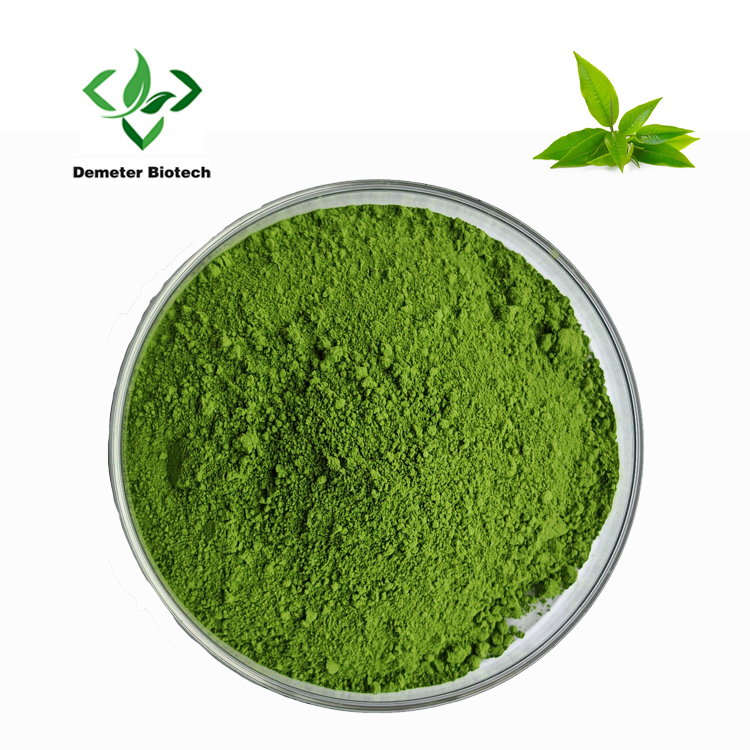
USDA & EU Organic Certified Matcha Powder — Ceremonial Grade
- USDA + EU Organic dual certification, from our own tea gardens
- First-flush tencha, shaded before harvest
- Stone-ground below 40 °C; Eurofins residue screen, 600+ parameters, batch by batch
- Halal certification available
- OEM / private-label & custom packaging available
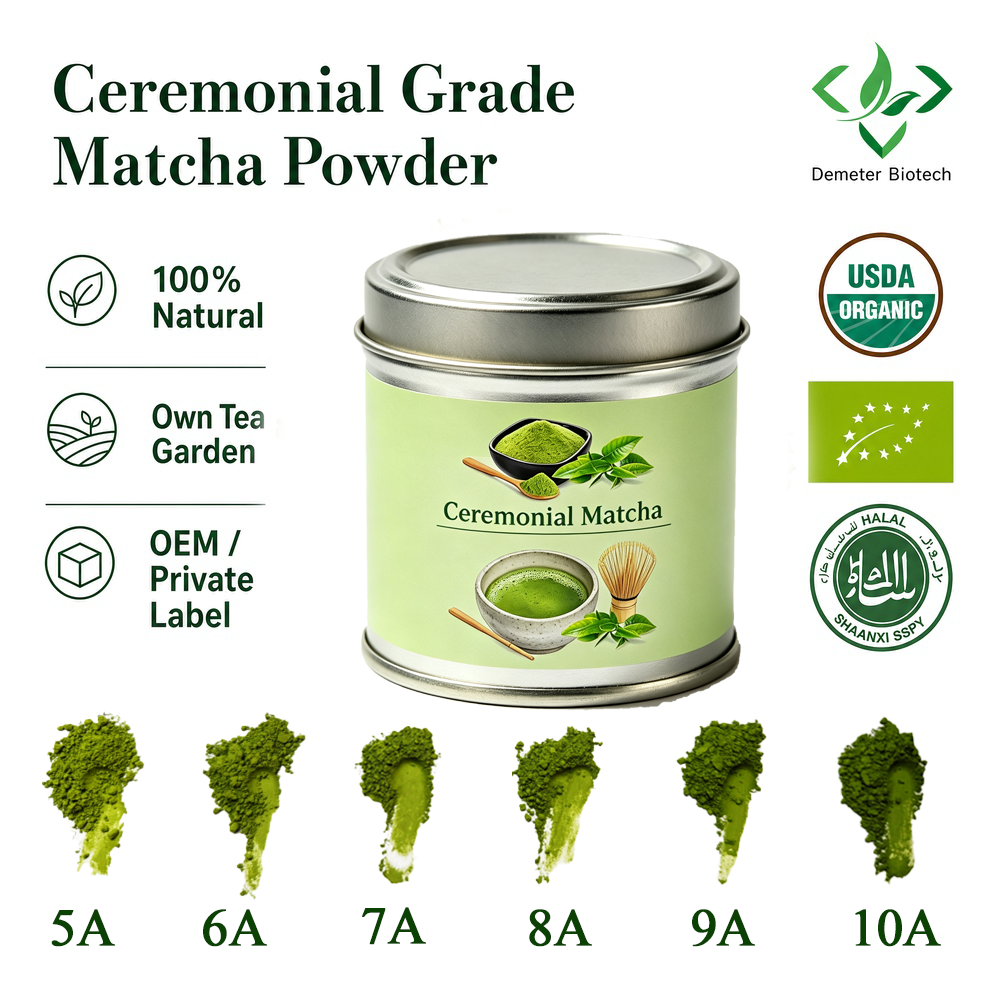
Ceremonial Grade Matcha Powder — Organic, 500–1500 Mesh Fine, Bulk Supply
- USDA + EU Organic certified, first-flush tencha
- Fine 500–1500 mesh grind for smooth, free-flowing bulk use
- Batch COA with amino-acid / L-theanine and CIELAB a* data
- Private-label & custom packaging available
Tell us your application, your certification needs, and your color / particle-size target, and we will map you to the right supply. Explore Demeter’s A-10A first-flush ceremonial matcha →
References
- Unno K, Kameoka Y, Nakamura Y. Compositional Diversity and Functional Interactions of Bioactive Compounds in Japanese Green Tea: Focus on Matcha, Sencha, and Gyokuro. Molecules. 2026;31(16):2934. doi:10.3390/molecules31162934.
- Lee LS, Kim SH, Kim YB, Kim YC. Quantitative analysis of major constituents in green tea with different plucking periods and their antioxidant activity. Molecules. 2014;19(7):9173–9186. doi:10.3390/molecules19079173.
This article describes agronomic and compositional properties of matcha as an ingredient for formulators and B2B sourcing, and presents Demeter’s own supply. It does not make claims about effects on the human body. Composition benchmarks cited in the text reflect published B2B sourcing references (Unno, Kameoka & Nakamura, 2026; Lee et al., 2014) and should be confirmed against the lot-specific COA.
Post time: Oct-08-2026


