


Products


Phytosterol Ester Powder 50% That Disperses Without Melting
Spray-Dried Plant Sterol Ester
Phytosterol Ester Powder 50%
Take the sterols out of soybean oil, join them to food-grade fatty acids, and what comes out is a fat-soluble ester rather than a crystalline sterol. On its own that ester is a paste, and a paste is awkward on a dry line. Spray drying it into sodium octenyl succinate starch and maltodextrin solves the handling problem and leaves a pale yellow powder that wets out in cold water. The label reads 50% esters by GC, which is 29% total sterols once the fatty acid is discounted. Three grams of powder, more or less, is what a daily serving of this grade works out to.
29% Total Sterols
Starch Carrier
1 kg Sample

Product Specification
| Parameter | Detail |
|---|---|
| Product Name | Phytosterol Ester Powder 50% |
| Chemical Nature | Plant sterols esterified with food-grade fatty acids, spray dried on starch |
| Sterol Source | Soybean oil deodoriser distillate |
| Sterol Profile | β-Sitosterol 70% min of total sterols; campesterol, stigmasterol and brassicasterol present |
| Molecular Formula | None — several sterols and several fatty acids, so the mixture has no single formula |
| Assay | 50.0% min esters plus sterols, by GC |
| Total Sterols | 29% min |
| Carrier | Sodium octenyl succinate starch and maltodextrin |
| Appearance | Pale yellow powder, free flowing |
| Behaviour in Water | Disperses in cold water; melts not required before blending |
| Moisture | 3.0% max |
| Ash | 0.5% max |
| Peroxide Value | 5.0 meq/kg max |
| Benzo[a]pyrene | 10 µg/kg max |
| Particle Size | 80 mesh pass standard, other cuts to order |
| Heavy Metals | Pb 2.0 / As 1.0 / Cd 1.0 / Hg 0.1 ppm max, ICP-MS |
| Microbiology | TPC 1,000 max; Yeast & Mould 50 max; E. coli absent per g; Salmonella absent in 25 g |
| Allergens | No Annex II allergen in the carrier; sterols are soybean derived |
| Regulatory | EU novel food ingredient 2004/333/EC; China new food raw material 2010 No. 3 |
| Claim Basis | The EU register holds a claim for plant sterols and stanols on maintenance of normal blood cholesterol at 0.8 g a day, subject to your food category and dose |
| Packaging | 25 kg fibre drum, PE liner; 1 kg foil bag |
| Storage | Closed, under 25 °C, dry, away from light; 24 months |
| Certificates | ISO 9001 and Halal papers with the shipment |

Product Highlights
01
Both Numbers on the Sheet
The assay and the sterol content are reported side by side, so the dose is written from data rather than from a sales claim.
02
No Melting Kettle Needed
Free sterol is crystalline and will not dissolve in water; the neat ester is a paste that wants heat. This powder skips both problems.
03
Starch, Not Caseinate
Some 50% powders are encapsulated on milk protein. This one is not, so a dairy declaration does not appear on your label.
04
Ester Chemistry, Unchanged
Esterification is what makes the sterol oil soluble, and that property survives the drying step, which is why emulsions hold it evenly.
05
Dose Figures Worked Out
About 2.6 g covers the 1.3 g ester mark used in the US; about 2.8 g covers the 0.8 g sterol mark used in the EU.
06
Trial Pack Before the Drum
A 1 kg foil bag is enough to run dispersion trials and a small supplement batch before any volume commitment.
Certificate of Analysis
| Test Item | Method | Specification | Result |
|---|---|---|---|
| Identity and Assay | |||
| Appearance | Visual | Pale yellow powder | Complies |
| Odour | Organoleptic | Characteristic, no off note | Complies |
| Phytosterol Esters + Sterols | GC | 50.0% min | Complies |
| Total Sterols | GC | 29% min | Complies |
| β-Sitosterol | GC | 70% min of sterols | Complies |
| Physical and Chemical | |||
| Moisture | GB 5009.3 | 3.0% max | Complies |
| Ash | GB 5009.4 | 0.5% max | Complies |
| Peroxide Value | GB 5009.227 | 5.0 meq/kg max | Complies |
| Benzo[a]pyrene | GB 5009.27 | 10 µg/kg max | Complies |
| Particle Size | 80 mesh screen | 80 mesh pass | Complies |
| Contaminants | |||
| Lead (Pb) | ICP-MS | 2.0 ppm max | Complies |
| Arsenic (As) | ICP-MS | 1.0 ppm max | Complies |
| Cadmium (Cd) | ICP-MS | 1.0 ppm max | Complies |
| Mercury (Hg) | ICP-MS | 0.1 ppm max | Complies |
| Microbiology | |||
| Total Plate Count | GB 4789.2 | 1,000 cfu/g max | Complies |
| Yeast & Mould | GB 4789.15 | 50 cfu/g max | Complies |
| E. coli | GB 4789.3 | Absent per g | Complies |
| Salmonella | GB 4789.4 | Absent in 25 g | Complies |
| Labelling | |||
| Carrier | Declaration | OSA starch, maltodextrin | Declared |
| Annex II Allergens | Declaration | None from the carrier | Declared |
Formulation Performance
Wetting Out Cold
The starch shell hydrates before the ester is released, which is why the powder goes into cold water without a high shear head or a heating stage.
Holding an Emulsion
Because the sterol is carried as an ester, it partitions into the fat phase and stays spread through the product rather than settling to the bottom of the tank.
Flowing Through a Premix
Free flowing, low dust, and heavy enough not to float off the top of a blender. It meters through the same auger as your sugars and carriers.
Holding the Peroxide Value
The ester sits inside a matrix rather than on the surface of a crystal, which slows the oxidation that turns an exposed ester rancid.
Where It Is Added
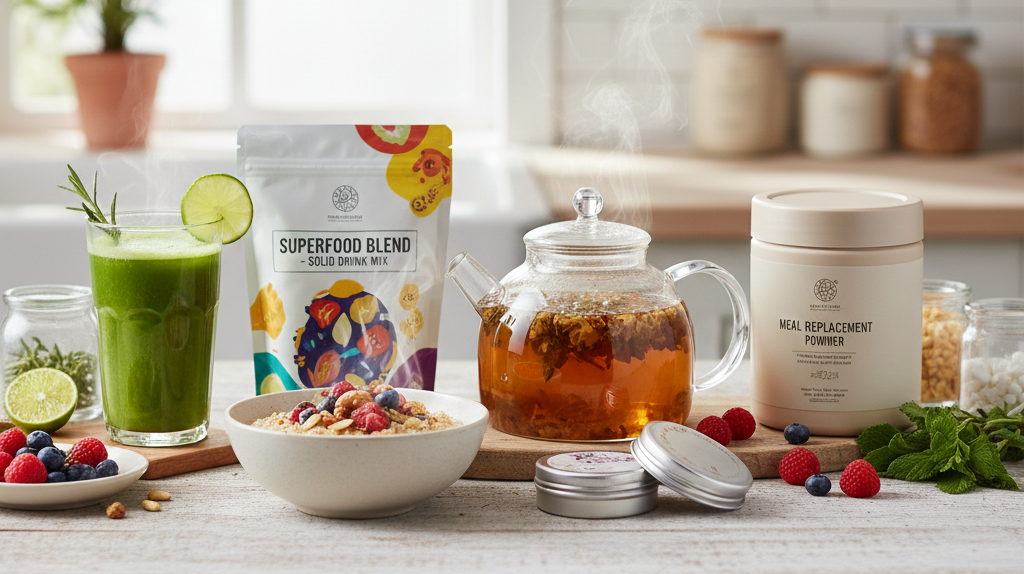

Yoghurt Drinks and Milk Beverages
Added to the water phase at the premix stage, or blended dry into a reconstitution base. Homogenisation distributes it with the milk fat.
Stick Packs and Instant Bases
Mixes into a powder blend and disperses when the pack is stirred into cold water, which is the difference a customer notices first.
Capsules, Tablets and Chewables
Straight run through a capsule filler, or compressed after a light granulation. The dose is large, so most buyers split it across two units.
Spreads, Creams and Bars
Fat continuous systems need no dispersion step: the ester dissolves into the oil phase while the carrier is wetted out by the water phase.
Bakery and Cereal Coatings
Dusted into a fat-based coating or a biscuit cream, where a per-portion dose can be hit without reformulating the base.