



Where Bulk Matcha Actually Comes From: China’s Matcha Map Is an Industrial Map
The place on the carton is often where the powder was consolidated, not where the leaves grew. In China’s matcha trade those are increasingly two different places — and the difference belongs in your specification more than the province name does.
At Demeter Biotech we mill shaded tencha in China and ship it in bulk foil bags, pouches, tins and cap format. A previous note in this series compared the two origins on a common basis and showed why the headline tonnages do not measure the same thing. This one stays inside China and asks a different question: once the leaf has been turned into tencha, where does the rest of the chain happen, and what does a single line on a certificate actually certify? The answer is that China’s matcha map is drawn by factories, steam lines and consolidation hubs, and that a province name is the least precise field you could choose to specify.
1. The map is made at the factory, not in the garden
Start with the one national figure that is repeated everywhere: China’s 2025 matcha output above 12,000 tonnes, close to seventy per cent of the world total, from the China Tea Marketing Association’s industry report. The previous note took that number apart, so it is not taken apart again here. What matters for this question is not the total but its distribution. The same association puts Zhejiang’s 2025 output above 8,800 tonnes, with Hangzhou, Jinhua, Ningbo and Shaoxing together accounting for ninety-seven per cent of the provincial total and a provincial output value above 1.1 billion yuan. Guizhou’s Tongren recorded 1,200 tonnes of matcha output in 2024 and reported a doubling the following year. Hubei’s Xiaogan is described in the same industry account as operating a different model entirely: buying from across the country and selling onward.
Those three shapes do not fit an agricultural map. They fit an industrial one. Growing, fixing the leaf into tencha, milling it into powder, blending and packing, and consolidating export lots are five steps whose locations do not have to coincide. Fresh leaf must reach a steaming line quickly, so the first two steps stay close together. Tencha is a dried, stable semi-finished material, and milling does not have to happen beside the field. Once powder exists, it can be combined, packed and shipped from almost anywhere with the right warehouse and paperwork.
That is the structural reason why an origin line on a bulk certificate is ambiguous. It may be telling you about any one of those five steps, and it will usually be correct about whichever one it names.
| Step in the chain | What pins down its location | Can it be separated from the field? | What a certificate naming this step tells you |
|---|---|---|---|
| Cultivation and shading | Soil, climate, water, shading infrastructure | No | Where the leaf grew, which is what an origin fingerprint can confirm |
| Steaming and drying into tencha | Fresh-leaf delivery time, steam line, dryer | Barely — it follows the leaf | Which line set the process parameters that decide the grade |
| Milling | Mills, particle-size control, blending policy | Yes | How fine the powder is, and whether more than one tencha went into it |
| Packing | Filling line, pack format, labelling | Yes | Who put it in the bag, which is not the same question |
| Export consolidation | Warehouse, documentation, freight | Yes | Where the shipment left from, which is the weakest claim of the five |
2. The scarce thing was line time, not acreage
The most useful detail in the industry reporting is not a tonnage figure. It is a capacity complaint. China News Service reported that Jinhua city had thirty-five matcha projects in production and had built forty-nine tencha lines. In the same report, a processor that had spent more than twenty years making black and green tea described switching to tencha: two lines went into operation, there was no stock left, autumn orders were already full, and the constraint was stated plainly — processing capacity was far short of demand, so two further lines were being prepared, which would bring the plant to roughly forty thousand jin of fresh leaf a day. The company put the improvement in its own economic return at above thirty per cent.
Read that alongside Guizhou: the Guicha operation in Jiangkou is described by China News Service as the world’s largest single matcha refining workshop, with annual capacity above four thousand tonnes; its 2025 sales were reported at 2,500 tonnes against 1,200 tonnes in 2024, with 1,300 tonnes exported and a thirty-two-tonne European-specification consignment sent to Sweden. Two different provinces, one common story: what limited output was steaming, drying and milling hours.
This is why acreage is a poor predictor of what can actually be delivered in a given quarter, and why a question about capacity should be asked at the level of a line, not a region. It is also where the process literature becomes commercially relevant. Zeng and co-workers tested shading method and duration, steam flow rate through the fixing machine, and drying temperature on tencha quality (Zeng et al., 2023). Mixed covering gave the best overall result; direct covering for six days and shed covering for fifteen days each produced good tencha. A steam flow of 120 kg/h gave the highest theanine content and the smallest polyphenol-to-amino-acid ratio. Drying at 220 °C gave the highest sensory score together with the highest chlorophyll and amino-acid contents. Sensory score corresponded with chlorophyll a at r = 0.741, chlorophyll b at r = 0.767 and total chlorophyll at r = 0.754, while infusion concentration ran against the colour value L* at r = −0.817.
Those are machine settings and measured outcomes. They are not properties of a province. A lot that was shaded under one regime, steamed at one flow and dried at one temperature is a different material from a lot made a few kilometres away under another set, and no map boundary will tell you which one you have. The practical reading is that the grade is made in the plant after the leaf arrives, and the only way to know which plant settings were used is to ask for them.
The three settings in that study are not independent levers. Shading changes what arrives at the steamer: the cover alters the balance of amino acids and pigments in the leaf. Steaming then stops the enzymes that would otherwise keep changing that balance, and the flow rate governs how quickly and how completely it happens. Drying decides how much of the measured chlorophyll and amino-acid content survives into the dried leaf. Read together, the result is not a recipe of six days of shade or 220 degrees of heat in isolation; it is a chain in which each stage fixes what the next one has to work with. That is also why a mill cannot rescue a poor tencha. Milling changes the particle-size distribution and the colour you measure on the powder, but it cannot restore pigment lost at the dryer. A specification that names only the final mesh is controlling the last step and leaving the three that mattered unwritten.
3. Three regions are running three different businesses
It is tempting to read a production map as though every entry on it were the same kind of operation. It is not. The three models described in the trade reporting differ in what they are good at, in what they can promise, and in the questions you should ask before writing a specification against them.
| Region | Role in the published accounts | What that role tends to give you | The question to ask |
|---|---|---|---|
| Zhejiang | Industrialised and standardised production; output above 8,800 tonnes in 2025, four cities at ninety-seven per cent of the province | Repeatable standardised bulk, with a dense cluster of tencha lines and a long processing history | Which line milled this lot, and does the mesh distribution stay inside the agreed band from lot to lot? |
| Guizhou, Tongren | Raw-material base with the largest single refining workshop; sales doubling to 2,500 tonnes, exports at 1,300 tonnes | Very large single-site capacity and documented European-specification shipments | Is the quoted capacity one plant or a group total, and is this lot entirely from that plant? |
| Hubei, Xiaogan | Consolidation and distribution hub — described as buying nationally and selling onward | Flexible lot assembly, mixed origins, freight and documentation handled in one place | Which growing areas are in this lot, in what shares, and does one certificate cover all of them? |
None of these is better in the abstract. A single-site lot is easier to document; a consolidated lot may be the only way to assemble the volume and the delivery window you need. The mistake is to regard them as interchangeable because all three end up in a bag labelled matcha powder. The specification has to say which structure it is buying.
4. Why the origin line is not the answer to the question you asked
There are three separate questions that get folded into the word origin. Where did the leaf grow? Where was it turned into tencha? Where was it milled, blended and packed? A document can answer any one of them truthfully while leaving the other two unstated.
The first of these is not a matter of opinion. Liu and co-workers analysed green teas from Guizhou, Hubei and Guangdong, and from three counties inside Guizhou, using four stable-isotope signatures and thirty-one mineral elements (Liu et al., 2021). Deuterium and oxygen-18 values were significantly higher in the Hubei samples, which the authors connect to stronger secondary evaporation under lower relative humidity. Mineral content differed by region, including iron, manganese, copper and rare-earth elements, which they relate to soil properties and geological background. Combined with principal-component, discriminant and projection methods, classification exceeded ninety-seven per cent in both cross-validation and external validation. At province scale the useful discriminating variables included deuterium and potassium, vanadium, cobalt, copper, zinc and cerium; at county scale the rare-earth elements did much of the work.
Pilgrim and co-workers had already shown the same principle at a wider scale, classifying Asian tea samples to country and plantation with 97.6 per cent correct assignments using isotope ratios and trace-element concentrations together (Pilgrim et al., 2010). So the growing site leaves a signature that survives drying, milling and packing, and it can be resolved far below the level of a country. If the only origin information attached to a lot stops at a province, that is a decision about what was documented, not a limitation of what can be measured.
What the origin fingerprint cannot tell you is anything about the factory. It will not say how long the leaf was shaded, what steam flow was used, at what temperature it was dried, or how finely it was milled. Those are the Zeng parameters, and they are at least as decisive for the material in your vessel. The two tools answer complementary questions, and substituting one for the other is a category error.
| The question you actually have | The right instrument | The field that looks like an answer but is not |
|---|---|---|
| Where did the leaf grow? | Documented plantation chain, or isotope and mineral fingerprinting against a reference set | The city printed on the shipping documents |
| How was the tencha made? | Shading record, steam flow and drying temperature from the fixing line | A tasting note written after the fact |
| Is this the grade contracted for? | Particle-size distribution, colour readings, moisture and ash on the lot | A grade word borrowed from another production system |
| Is this lot the same as the last one? | Retained sample plus lot-level certificate, compared across deliveries | The product name on the carton |
5. What consolidation does to a specification
The hub model deserves a closer look, because it is the one most likely to produce a document that is technically true and practically useless. When powder from several growing areas is assembled into one lot, the measured origin signature becomes a combination of the constituents. The published classification studies were built on single-origin samples; nothing in them establishes that a blended powder would classify cleanly against those same models. That is an inference from the study design rather than a result reported by the authors, and it is stated as such.
What follows for documentation is more straightforward. A certificate bearing one place name cannot describe several constituent origins. If your lot is assembled, the paperwork needs to name each growing area and its share, then name the fixing site, the milling site and the packing site separately. If it is not assembled, say so. The point is not to make the document longer; it is to make each line answer exactly one of the three questions.
Write the origin as a chain, not a noun:
Cultivation: area A (share) and area B (share) · Tencha fixing: site C · Milling and packing: site D
Then attach the process fields that the origin cannot carry: shading regime, fineness distribution, colour readings, moisture and ash, each tied to the lot number.
Retained samples are the other half of this. A written chain tells you what was supposed to happen; a retained sample from the delivered lot tells you what did happen, and it is the only thing that lets you adjudicate a difference between two shipments. Keep one from every accepted lot under the same conditions you use for the material itself, and compare the next lot against it with the same particle-size method and the same colour instrument. Two laboratories using different mills or different optical geometries will not produce comparable colour numbers, so the instrument and its measuring geometry belong in the specification alongside the number. The same point applies to fineness: a mesh designation and a laser-diffraction distribution describe the same powder in two different languages, and you need to say which one you are quoting before anyone compares two lots.
6. The figures deliberately left out
Three numbers could have been used to open this article, and all three were set aside. They are worth naming briefly, because they will appear in other material you see and you should know how they were handled here.
The familiar export growth figure of seventy-two per cent comes with a qualifier that is usually dropped: it describes the first half of 2025 and a volume of 230 tonnes, not a full year. A separate, widely reposted set gives national exports of 12,100 tonnes for 2025 and national output of 32,000 tonnes, both of which conflict with the association’s own 12,000-tonne output figure and, in the export case, with arithmetic. A third figure reports a 443.8 per cent rise in the value of Hangzhou’s matcha exports over the first five months of 2026; that is a city-level value series, not a national volume series, and it cannot be compared with either of the others.
None of these supports a statement about where capacity sits or what a certificate means, which is what this note is about. They are mentioned only as examples of how a qualifier can fall off a number between its source and its use. If a commercial decision depends on a growth rate, ask for the customs line item and the commodity code in writing rather than accepting a percentage from a secondary article.
7. How we supply, and what goes on our certificate
At Demeter Biotech we mill shaded tencha in China and supply the powder in bulk aluminium-foil bags, in pouches, in tins and in cap format. Our bulk range covers fine powders in the 500-to-1500-mesh band, and we describe lots by the fields that can be checked on the material in front of you: particle size, colour values, moisture and ash, alongside the origin at the level we can document for that lot.
We would rather answer a question about fineness distribution or colour readings than about a province name, because those are the numbers that let you repeat a formulation. If your programme needs a particular shade regime or a particular milling band, tell us which one and for which application, and we will state what the lot certificate carries before you place a repeating order. What we do not do is attach a grade word from a different production system to a Chinese powder and leave you to discover what it meant.
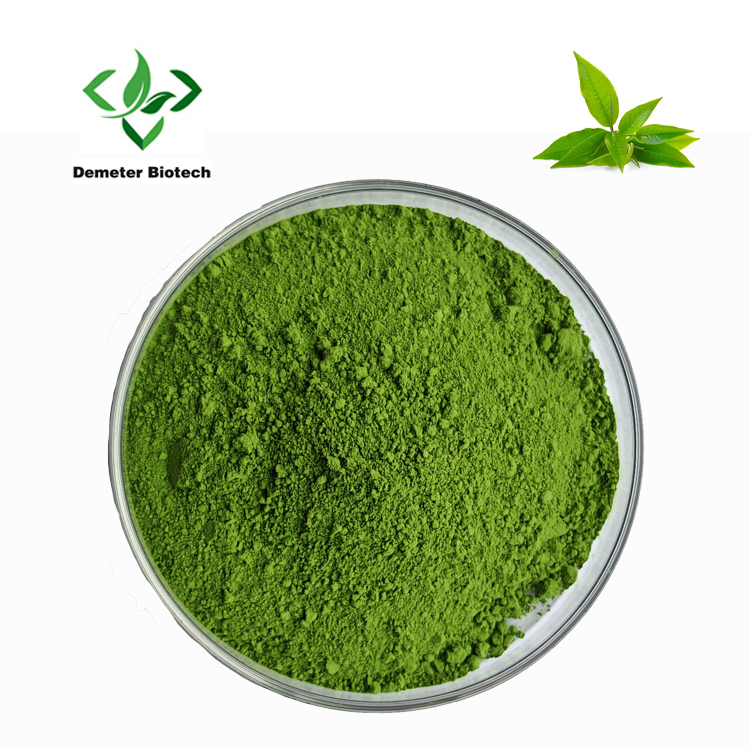
A-10A Ceremonial Grade — USDA / EU Organic Matcha
A certified organic matcha milled from shaded tencha, supplied for programmes that need an organic chain documented alongside the lot’s particle size and colour readings.
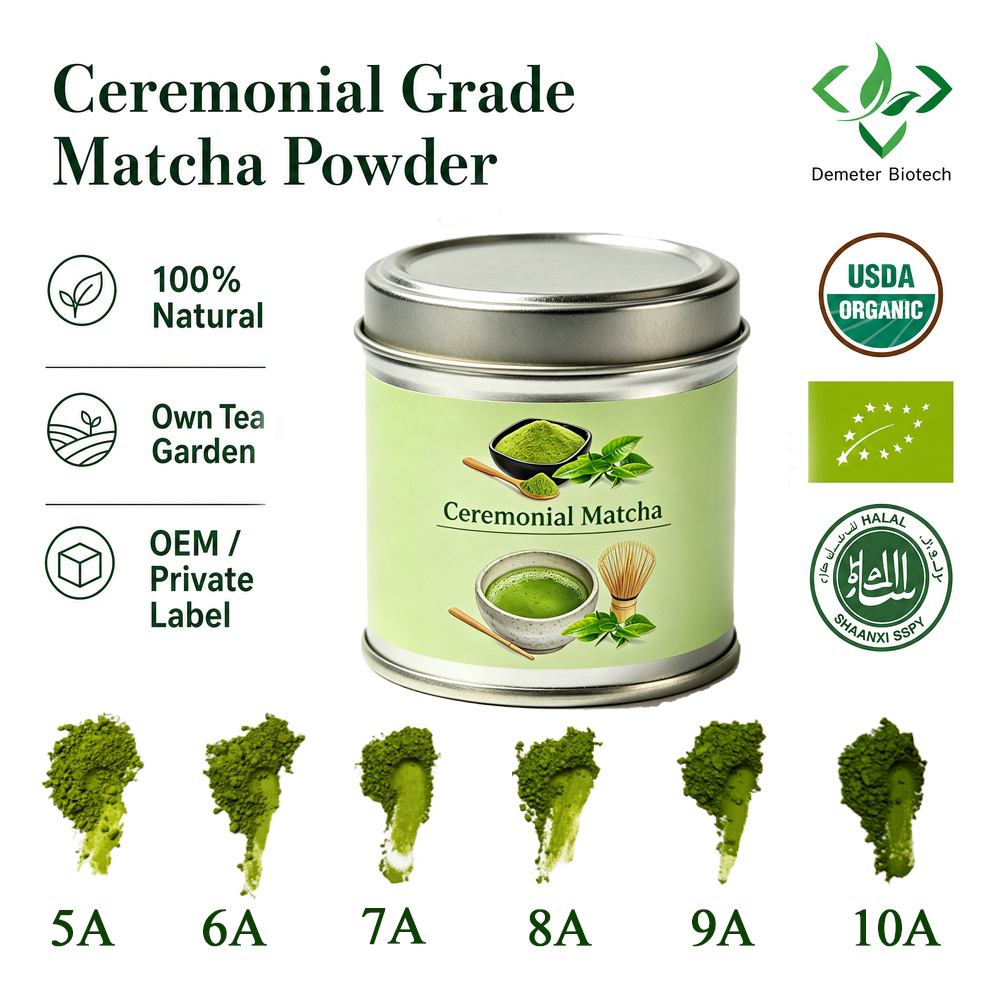
500–1500 Mesh Fine Matcha Powder — Bulk Supply
The bulk format for formulation work: a defined fineness band in a one-kilogram foil bag, with the specification written on measurable fields rather than on a place name.
8. Five lines to put in an enquiry
The whole argument can be reduced to a short list. Send these five lines and the answer you get back will be usable.
1. Which origin do you mean? Cultivation, tencha fixing, or milling and packing. Ask for all three if the chain crosses a province boundary.
2. Is the lot single-source or consolidated? If consolidated, ask for the constituent growing areas and their shares, and say whether one certificate is expected to cover all of them.
3. What shading regime and which documented fixing line? Shading duration and method, steam flow and drying temperature are process facts that a regional name cannot imply.
4. What fineness and what colour? Mesh or particle-size distribution, and colour readings with the method stated. These are the fields that let a second lot match the first.
5. Which of these are actually on the lot certificate? Ask for a retained sample as well. A field that is discussed but not documented is not part of the specification.
9. What this note does not claim
It does not rank the three regions, and it does not say that one production model is superior to another. It makes no statement about what the powder does once it is in a finished product, and it does not assign a grade equivalence between different systems. The regional figures are reported as they were published, with the caveat already noted; the three export figures named in section six were not used as evidence for anything.
The previous note in this series compared China and Japan on common ground. This one argues that inside China, the useful unit of analysis is the line and the lot, not the province. If you take one thing from it, take the inversion in section four: the growing site is the part of a matcha’s identity that is hardest to change and easiest to verify, while the place printed on the shipping papers is the part most likely to be true and least likely to be useful.
References
- Zeng L, Mao Y, Wang F, Zheng Z, Hu M, Fu Y, Jin S, Yuan M, Xu Y. Effects of Different Shading Treatments and Processing Techniques on the Quality of Tencha. Food Research and Development. 2023;44(15):118-126. doi:10.12161/j.issn.1005-6521.2023.15.018
- Liu W, Chen Y, Liao R, Zhao J, Yang H, Wang F. Authentication of the geographical origin of Guizhou green tea using stable isotope and mineral element signatures combined with chemometric analysis. Food Control. 2021;125:107954. doi:10.1016/j.foodcont.2021.107954
- Pilgrim TS, Watling RJ, Grice K. Application of trace element and stable isotope signatures to determine the provenance of tea (Camellia sinensis) samples. Food Chemistry. 2010;118(4):921-926. doi:10.1016/j.foodchem.2008.08.077
Industry and news sources cited for regional figures: China Tea Marketing Association, industry article on China’s matcha sector and its production regions; China Tea Marketing Association / Xinhua, report on China’s matcha production and export position, 2026; China News Service, report on Jinhua’s tencha lines and processor capacity, and on Tongren matcha sales and exports, January 2026. These are trade and news sources, not refereed research, and are identified as such wherever they are used.
This article describes published processing research, published origin-authentication research and figures reported by industry and news organisations. It reports no measurement on any commercial lot, states no grade equivalence and makes no statement about the use of the material. The machine settings and correlation coefficients quoted from the tencha study were obtained on experimental lots under the conditions described in that paper and are not a specification for any commercial shipment. The classification accuracies quoted from the provenance studies apply to the sample sets and methods validated there; their behaviour on blended powders was not tested in those works, and the comment in this article on that point is explicitly an inference. Regional and export figures are reported with the qualifiers attached and have not been independently audited. Every process field and origin claim has to be established for the lot under discussion.
Post time: Nov-24-2026


