


Terroir in Matcha: How Origin Shapes Flavor
Origin is not a flavor you can taste off a label, and it is not a ranking. It is a bundle of measurable inputs — temperature, altitude, mist, harvest date, and whatever practice a region happens to default to. Here is what those inputs actually move in the powder, and where the famous place names stop telling you anything useful.
Every origin claim in this category rests on an assumption that no one states out loud: that where a leaf grew changes what is in the powder. That assumption is correct, and it is testable. But the phrase matcha origin terroir is used in two completely different senses, and mixing them is where purchasing decisions go wrong. In the first sense it means a place — a prefecture, a valley, a slope. In the second it means a set of environmental variables that happen to be found in that place, plus the local default for how the leaf is handled. The first sense you cannot verify from a document. The second you can, at least partly, and it is the one that predicts what will arrive in the drum. At Demeter Biotech we grow, shade, steam, de-stem and stone-mill our own tencha in China, so we have a commercial interest in this question and also an unusually direct view of it. What follows is what the research actually shows, region by region, and what we think a specification should record instead of chasing a postcode.
1. What “origin” is actually measuring
A tea plant does not have a soil-linked flavour any more than a grape does. What it has is a growth rate, and growth rate is set by temperature and light during the weeks the shoot is forming. A cool, high, misty site slows the shoot down; a warm, low, bright site speeds it up. Everything else that people describe as terroir — the thickness of the leaf, the depth of colour, the balance between savoury and astringent — follows from that single variable and from how long the leaf was allowed to sit on the bush before it was picked.
Two practical consequences follow, and they are the ones worth carrying into a purchase conversation. First, altitude and latitude are partly interchangeable: a warm southern site at 600 metres and a cooler northern site at 200 metres can land in a similar growth window, which is why origin names correlate with composition without determining it. Second, and more useful: because the mechanism is a growth rate rather than a place, the composition differences between regions are gradients, not categories. A region does not produce a flavour. It produces a bias.
2. The altitude evidence: the balance moves, the totals barely do
The cleanest data on this comes from a Chinese green tea study that sampled five sites on one mountain — Lushan in Jiangxi — across an altitude range of 212 to 1,020 metres. As cultivation altitude rose, total tea polyphenols fell and total free amino acids rose, so the polyphenol-to-amino-acid ratio dropped markedly; within the amino acid fraction, theanine, glutamic acid, arginine, serine, GABA and aspartic acid all increased with elevation (Han et al., 2017). Read plainly: higher, cooler sites produced leaf with more of the savoury amino acid pool and less of the polyphenol pool, which is the compositional direction the whole category calls “deep umami”.
The second half of that same result is the part that matters commercially, and it is routinely left out of marketing copy. Individual catechins did not move together. As altitude increased, EGCG and ECG decreased, while EGC and gallocatechin gallate increased — with the net effect that total catechins showed no significant variation across the sites. Origin reshuffled the profile while leaving the headline number roughly where it started.
| Measured at higher altitude | Direction | What it means on a spec sheet |
|---|---|---|
| Total polyphenols | Decrease | A lower polyphenol figure can be a site effect, not a weaker leaf |
| Total free amino acids, incl. theanine | Increase | The figure most directly tied to the savoury side of the cup |
| Polyphenol / amino acid ratio | Falls markedly | A single ratio that tracks the balance better than either figure alone |
| EGCG and ECG | Decrease | A lower EGCG number is not automatically a worse lot |
| EGC and gallocatechin gallate | Increase | The catechin fraction redistributes toward the non-gallated side |
| Total catechins | No significant change | The headline catechin figure tells you almost nothing about origin |
That last row is worth pausing on. If your origin comparison is built on total catechins or on a single EGCG figure, the study above says the comparison will not separate the sites. If it is built on the polyphenol-to-amino-acid ratio together with the individual catechin distribution, it will. This is the same lesson that the catechin and shading notes in this series arrive at from other directions: the number a quotation leads with tends to be the number that moves least.
3. Cultivar, site, and process — ranked by what they explain
A 2021 metabolomic study did the comparison that the category usually avoids. Sixty-six samples of Xinyang Maojian green tea were analysed across four cultivars, several elevations and two processing routes, with 1,912 ion features detected and 95 metabolites tentatively identified. Cultivar explained the largest share of the variation, with 54 metabolites responsible for separating the four cultivars. Twenty-seven metabolites correlated closely with elevation, including EGCG, ECG, theanine and theogallin, and that set drove the enhanced savoury character of the high-elevation samples. And the finding that should end an argument: the differences between manually and mechanically processed tea were not significant (Wang et al., 2021).
Sit with that for a moment. In a category that sells hand-craft as a quality axis, a chemometric comparison of hand-made against machine-made leaf from the same cultivar and region could not separate them on metabolite composition. That does not mean processing is irrelevant — it means the processing route mattered far less than the genetic identity of the bush and the environment it grew in. Which, for anyone drafting a brief, reorders the priorities: cultivar and site first, then the specific process decisions that are genuinely irreversible, and the hand-versus-machine story last.
The shading and steaming decisions covered elsewhere in this series still matter enormously, and they are not the same thing as “manual processing”. Shading days, shade percentage, steam depth and milling temperature change the composition directly. Who held the basket does not.
4. The three Japanese names, and what each one actually is
If you buy Japanese matcha, three place names will appear in every conversation. They are not three quality levels, and they no longer rank the way the marketing implies. Japanese tencha output has been reorganised over the past decade: as reported in national production statistics for the 2023 crop, Kagoshima produced roughly 1,600 tonnes of tencha, Kyoto roughly 970 tonnes, Shizuoka roughly 500 tonnes and Aichi roughly 430 tonnes. Kagoshima became the largest tencha origin and has been widening the gap, while Kyoto retained the price premium and the brand. The three names now describe three different business models.
| Origin | What it is structurally | What you are really buying |
|---|---|---|
| Uji (Kyoto) | Hillside plots, small holdings, high land cost, an ageing grower base, limited tonnage; the historic centre of shaded cultivation and the source of several prized cultivars | Prestige, consistency of style, and scarcity priced in. Excellent for a halo product; hard to build an everyday line on |
| Nishio (Aichi) | The most specialised tencha district in the country: the great majority of its tea area is given over to tencha, worked by a small number of growers at high density | Repeatability. A lot that matches the last lot, which is exactly what a blending or food-service programme needs |
| Kagoshima | Flat, expansive fields built for mechanised harvest; warmer and earlier, with lower frost exposure; large-volume tencha and a growing share of organic acreage | Volume, availability and organic supply at a workable price. Less prestige per kilo, far more kilos |
The useful reading is not that one is better. It is that the three origins solve three different problems, and a purchasing brief that does not state which problem it is solving will be quoted all three and compare them on price per kilogram, which is the only axis on which they are directly comparable and the least informative one.
5. “Uji” is a finishing tradition as much as a field
One structural detail is worth knowing before you pay a premium for a place name. The registered geographical indication for Uji tea covers leaf grown across a group of four prefectures and finished in the Uji tradition; it is a regional and method designation, not a single hillside. That is normal practice in geographical indications the world over — the same logic governs many European wine appellations — and it is not a trick. It does mean, though, that a lot labelled Uji tells you which tradition and region finished the leaf, not necessarily which slope grew it.
So when an origin premium is on the table, the question to ask is not “is this Uji?” but “where was the leaf grown, and where was it finished?” A serious party will answer both without hesitation. A party who conflates the two has either not thought about it or would rather you did not.
6. China’s position, stated honestly
China is now the largest producing country for matcha-grade powder by volume, and the segment it dominates is the one that does not appear in ceremony photography: ingredient supply, food service, beverage bases and private label. Guizhou and Zhejiang are the two names most often attached to Chinese matcha, with substantial production also in Hubei and Sichuan. One honest caveat on the numbers: China does not publish matcha tonnage on a statistical series comparable to Japan’s, so the capacity figures quoted in trade articles are largely self-reported and vary widely between sources. Read any single Chinese volume number with suspicion, including ours.
What has changed on the ground is more interesting than the tonnage. Over the past decade the better Chinese producers have adopted actual shade cultivation rather than unshaded leaf, planted Japanese cultivars alongside domestic ones, installed stone and micro-mills, added de-stemming and colour sorting, and brought in technical help. The result is not one Chinese product but two very different ones: commodity powder made from unshaded leaf with an industrial mill, and properly shaded, de-stemmed, cold-milled tencha that will sit comfortably against mid-grade Japanese material. Both exist, both are sold as “matcha”, and the price gap between them is not an origin premium — it is the cost of three weeks of shade, a de-stemming line and a slow mill.
Which produces the most useful conclusion in this whole article: origin is a prior, not a verdict. A good specification beats a good postcode, in China and in Japan. The origins differ in what they make easy — Kyoto makes prestige easy, Kagoshima makes volume easy, China makes ingredient-scale supply easy — but none of them makes a specific cup inevitable.
7. Six origin fields to write into a specification
These are origin fields, not process fields — the process side is set out in a separate note in this series. Together they convert “terroir” from an adjective into six lines a lot can be held to.
| Field | What to record | What it rules out |
|---|---|---|
| Growing country and region | Country, first-level region, and the district where the leaf was actually grown | A national label standing in for a much smaller growing area |
| Growing versus finishing location | Both, separately, whenever they differ | Paying a field premium for a finishing tradition |
| Altitude band | Approximate elevation of the plots, as a band rather than a single figure | Comparisons between lots grown under quite different thermal conditions |
| Cultivar | Named cultivar or blend of cultivars, stated as such | Attributing to origin what is really a genetic difference |
| Harvest date and flush | Calendar date window plus first or later flush | Comparing an early spring lot with a summer lot as if they were matched grades |
| Shade days at that location | Days of cover for this lot, given that the same practice means different things at different temperatures | Assuming a shade regime from one climate transfers to another |
8. How Demeter grows and supplies matcha
At Demeter Biotech we grow our own tencha in China, shade it before harvest, steam it, dry it flat without rolling, de-stem and de-vein it, and stone-mill it below 40 °C. We are not going to sell you a hillside story, because a hillside story is the one thing you cannot check. What we will do is answer the six fields above for any lot you are considering — growing region, altitude band, cultivar, harvest window, shade days and the processing record — alongside a full composition panel covering particle size, colour, L-theanine, the catechin profile, moisture, ash and crude fibre. Every lot is classified within our internal RM / EM / OM system and is available under USDA Organic, EU Organic and Halal certification, with OEM and private label supported. If your programme needs a consistent mid-tier powder all year, or a tighter ceremonial cut for a specific product, tell us which problem you are solving and we will quote the lot that solves it rather than the most flattering origin name we could print on the bag.
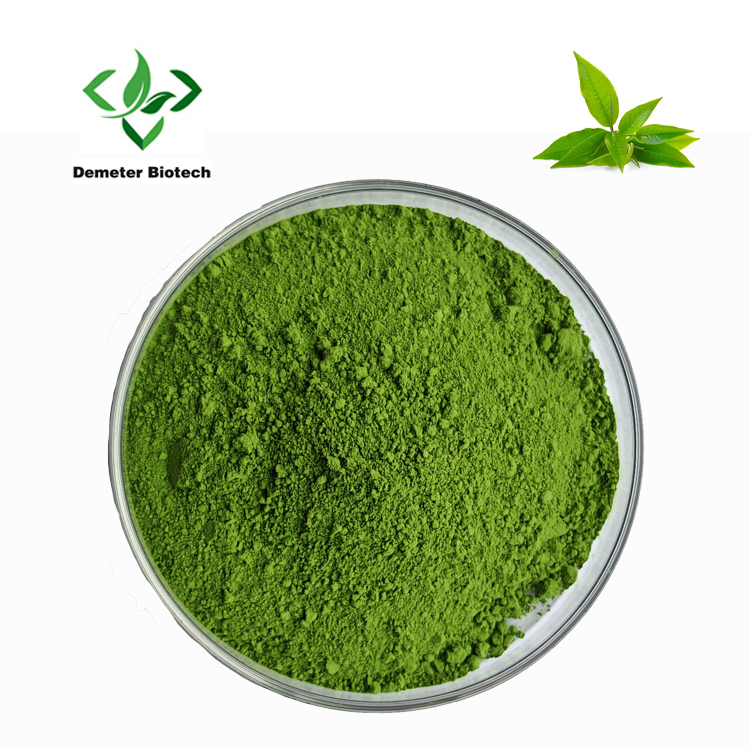
USDA & EU Organic Certified Ceremonial Matcha — A-10A
Shaded first-flush tencha from our own gardens, de-stemmed and de-veined, stone-milled below 40 °C, dual-certified USDA and EU Organic. Batch COA covers EGCG, the catechin profile, L-theanine, colour, crude fibre, residue screen and particle size. Halal available; OEM and private label supported.
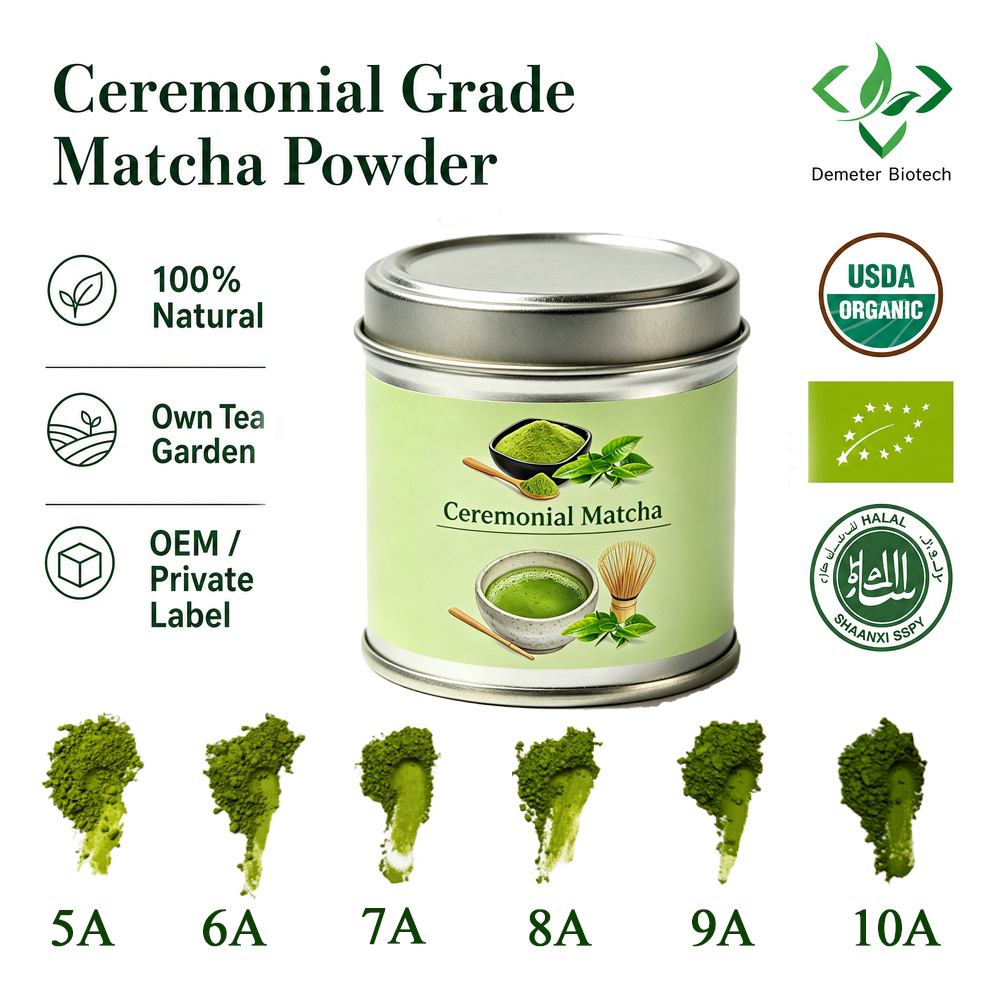
500–1500 Mesh Fine Ceremonial Matcha — Bulk Supply
The fine, free-flowing cut for RTD lines, blending and large-format repacking: 500–1500 mesh (roughly 10–25 µm) in the same organic specification, milled from de-stemmed tencha with the catechin profile and L-theanine reported on every lot for your composition work.
Send us the six origin fields and the composition panel your product needs, and we will confirm the actual lot figures on the certificate of analysis before the order is packed. An origin you can verify is worth more than an origin you have to admire.
References
- Han WY, Huang JG, Li X, Li ZX, Ahammed GJ, Yan P, Stepp JR. Altitudinal effects on the quality of green tea in east China: a climate change perspective. European Food Research and Technology. 2017;243(2):323-330. doi:10.1007/s00217-016-2746-5
- Wang H, Cao X, Yuan Z, Guo G. Untargeted metabolomics coupled with chemometrics approach for Xinyang Maojian green tea with cultivar, elevation and processing variations. Food Chemistry. 2021;352:129359. doi:10.1016/j.foodchem.2021.129359
This article describes growing conditions, composition and sourcing documentation only. It is not a statement of efficacy or medical advice. Altitude and processing effects cited above are findings from the named studies on the tea samples they examined, and are reported as directions of change rather than as values for any specific lot. Regional production volumes are quoted from national agricultural statistics as reported for the 2023 crop year and shift annually; capacity figures for Chinese matcha production are not compiled on a comparable statistical basis and should be read as indicative. The only figures that bind a lot are those on its batch certificate of analysis. Composition varies with cultivar, origin, shading, harvest timing, grade and processing.
Post time: Oct-29-2026


