


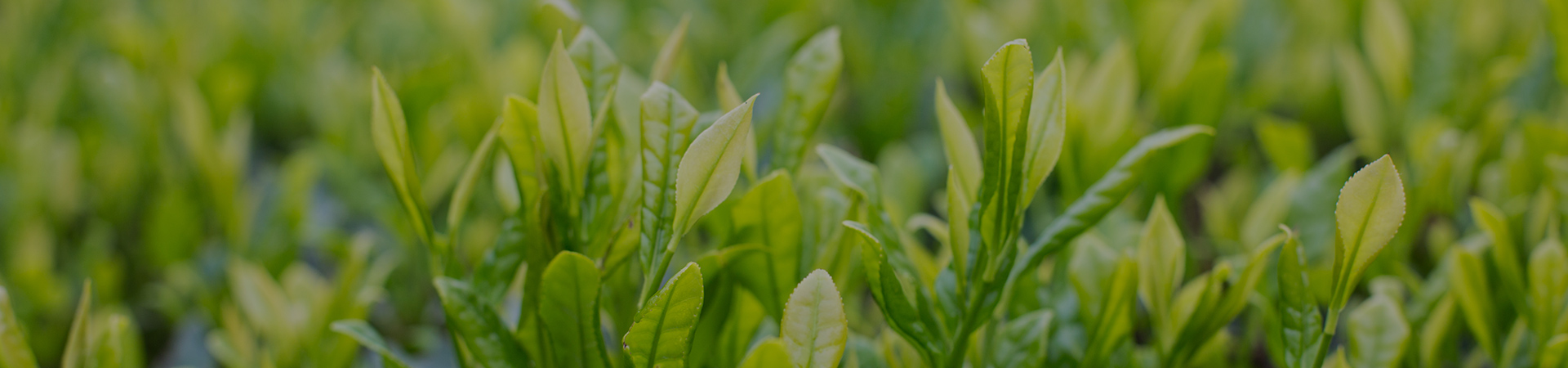
Shading in Matcha: How 20–30 Days of Darkness Builds Umami
Every bag of matcha says the leaf was shaded. Almost none says how. Here is what the three weeks before harvest actually look like on the farm, what the shade percentage really changes, and what the leaf gives up in return.
Shading is the single most expensive step in matcha production, and the least visible on a specification. Two powders can both say “shade-grown” while one spent 14 days under a single black net laid on the bush and the other spent 27 days under a double layer of reed screen and straw — different labour, different material cost, different leaf anatomy, different colour. For a team writing a purchase order, the useful questions are not “was it shaded” but “how deep, for how long, in what structure, and on which flush”. This article covers the farm operation and its cost. The chemistry of why shade moves the amino-acid and catechin balance is a separate topic we cover elsewhere; here we stay on what a grower actually builds, and what it costs. At Demeter Biotech we mill tencha from our own gardens in China and report the composition panel on every lot, so a shading claim can always be checked against the numbers.
1. What “shading” means on the farm, in one definition
Covered cultivation — kabuse, or ooishita saibai in Japanese — means putting a physical cover over the tea bushes for the final weeks before plucking. The cover is not a tarpaulin thrown on the day of harvest. It is a structure or a cloth that stays up for days or weeks, cuts out most of the incoming light, and changes how the shoot develops before any processing begins.
The Japanese tea industry’s labelling standard defines matcha as powdered tencha from covered plants, and since April 2020 autumn tencha grown in open fields no longer counts as a matcha ingredient under that standard — a reminder that shading is not a marketing adjective but the entry condition for the category. In practice the first spring flush of tencha is covered for roughly 20 days or more, while a second-flush tencha is usually covered for about 14 days. Three to four weeks is the normal working range for a premium lot, and it moves with weather, cultivar, shoot growth and cover density.
2. Three ways to build the roof
All shading is not equal. The same headline shade figure can be produced by three quite different builds, and the build — not just the percentage — is what changes leaf thickness and airflow.
| Method | How it is built | What it does to the leaf | Cost and constraint |
|---|---|---|---|
| Honzu reed screen + straw |
Frame roughly 2 m above the rows; reed screens (yoshizu) for the first ~10 days, then rice straw spread on top for the remaining ~10 days | Gradual, two-stage deepening; continuous airflow; no material touching the shoots, so leaves stay thin and soft | Highest labour and material cost; reed screens need periodic replacement; now practised by only a small number of gardens |
| Tana overhead frame, black cloth |
Poles and wire over the field, black shade cloth hung over top and sides; single or double layer, around 90% block per layer | Good airflow, no contact with shoots; a second layer can be added late to deepen the shade | Capital spend on the frame; the fixed structure blocks ride-on harvesters |
| Direct covering net laid on the bush |
Cloth draped straight over the rows, no frame; works on any terrain and with any harvesting method | Can only go on once shoots have grown enough to carry it, so the shaded window starts later; material rests on the leaf | Cheapest and fastest to apply, but cloth traps heat in warm weather and can mark or damage leaves |
3. The dial: shade percentage is a dose, not a badge
Read a shade figure the way you would read an ingredient percentage in a formula: more is not automatically better, and the number has to be read together with what it costs. A published trial on Camellia sinensis var. assamica ran matcha through four shade intensities — 0%, 50%, 70% and 90% — and measured the resulting powder (Manikharda et al., 2023). The direction was consistent and the magnitudes were not small.
Going from no shade to 90% shade, lightness L* fell from 61.43 to 53.64 (a darker, denser green), moisture fell from 9.26% to 8.64%, and the solubility index fell from 17.10% to 15.37%. On the phenolic side, total phenolics dropped from 50.78 to 46.09 mg GAE/g and total flavonoids fell from 41.89 to 15.15 mg QE/g. In other words, deep shade buys colour and a softer mouthfeel, and it is paid for out of the phenolic load.
Read that as a formulation decision rather than a quality ladder. If your product sells on colour and a rounded, less astringent mouthfeel, the deep end of the dial is doing real work for you. If your specification is built around a phenolic or catechin figure, deep shade works against that number — and no amount of “premium shading” language will move the COA. The two ends of the dial serve different products, which is why we would rather quote you a measured panel than an adjective.
4. What the leaf gives up: thinner leaves, less weight per area
The most commercially important effect of shading is anatomical, and it rarely appears in marketing copy. In a covering-cultivation trial series run with Japanese national research teams, shaded new shoots had lower leaf thickness, lower leaf mass per area and lower leaf density than open-field leaves, while SPAD readings and chlorophyll content were higher; epicatechin and epigallocatechin contents fell, and theanine and caffeine contents rose (Sano et al., 2018). A principal-component analysis in the same work tied the shading response most strongly to leaf mass per area, chlorophyll, epicatechin and epigallocatechin — the anatomy and the chemistry move together.
Lower leaf mass per area is the quiet cost. The same volume of fresh leaf carries less dry matter, so a shaded field converts into less tencha per hectare than an open one, before any of the cover material and installation labour is counted. Add the structure cost and the loss of ride-on harvesting under a fixed frame, and the premium on a properly shaded lot stops looking arbitrary. It is not a marketing margin on a colour; it is a yield and labour bill.
This is also the argument against “maximum shade” as a buying rule. Pushed too far, or applied at the wrong moment with cloth resting on the leaf, shading can trap heat and cost you both weight and grade. The reference points below are the depth ladder that Japanese tencha practice actually works within — not a target to beat.
5. Why good shading deepens gradually
Traditional practice did not arrive at the two-stage honzu schedule by accident. Covering lightly first and then adding straw lets the shoot adjust as it grows, holds the temperature under the canopy in a workable band, and keeps a continuous exchange of air. A double-layer tana build reproduces the same idea with cloth: one layer early, a second layer as harvest approaches.
Direct covering struggles to copy this because of its own timing constraint — the net can only go on after the shoots are long enough to carry it, so the shaded window opens later and the light drop arrives as a step rather than a ramp. That single physical fact explains most of the quality gap between an inexpensive covered field and a proper tencha garden, and it is invisible on a certificate. If you want to know how a lot was shaded, the structural question — frame or direct cover, one layer or two — gets you further than the percentage alone.
6. Four shading facts to write into a specification
“Shade-grown” cannot be verified. These four fields can be, and together they describe a lot far better than the word ceremonial will.
| Field | What to record | Why it matters |
|---|---|---|
| Shade depth | Percent of incoming light blocked, and whether one layer or two | Sets the colour and phenolic band the lot can land in |
| Duration | Days of cover before plucking, and whether depth changed mid-period | 20 days and 30 days are two different products, not one grade |
| Structure | Honzu, overhead frame, or direct cover | Airflow and leaf contact change leaf thickness and handling behaviour |
| Flush | First or second harvest, with the actual cover window | A second flush is normally covered for about half as long |
Ask for those four alongside the panel you already require — particle size, colour, L-theanine, catechins, moisture, residue screen — and the shading conversation stops being a story about darkness and becomes a specification you can hold a lot to.
7. How Demeter supplies matcha you can verify
At Demeter Biotech we grow and mill matcha from our own gardens in China, and we pack in light-shielded barrier bags to hold the green through shipping. Each lot is classified by how it was shaded, milled and certified — our internal RM / EM / OM system — and every batch ships with a full composition panel: particle size, colour, L-theanine, the catechin profile, moisture, ash and a residue screen. If the shading record on a specific lot matters to your specification, ask for it before you commit and we will confirm what was applied to that batch rather than describing the category in general. Tell us the panel you need, the certification you require — USDA Organic, EU Organic or Halal — and the structure question you care about, and we will match the lot to the numbers you approve.
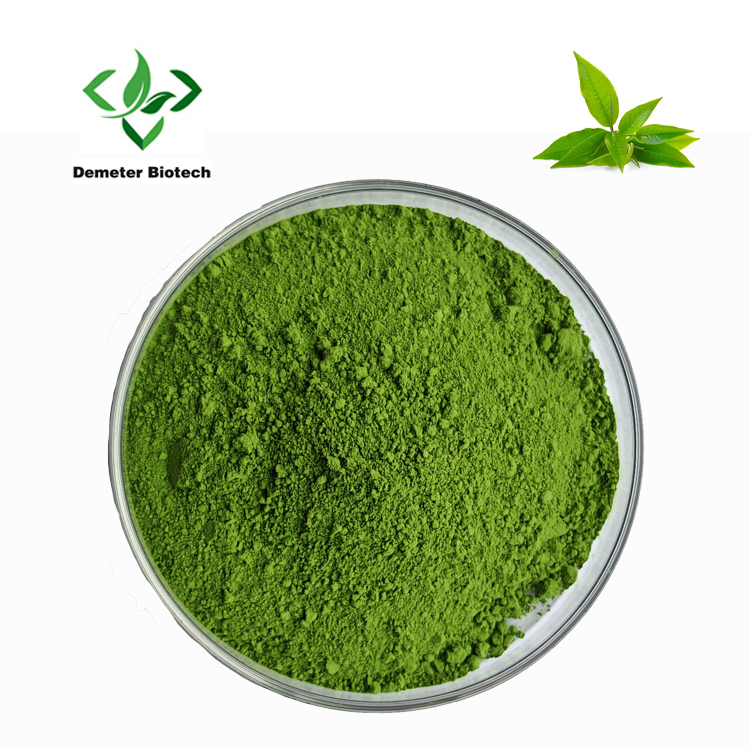
USDA & EU Organic Certified Ceremonial Matcha — A-10A
Shaded first-flush tencha from our own gardens, stone-milled below 40 °C, dual-certified USDA and EU Organic. Batch COA covers EGCG, the catechin profile, L-theanine, colour, residue screen and particle size. Halal available; OEM and private label supported.
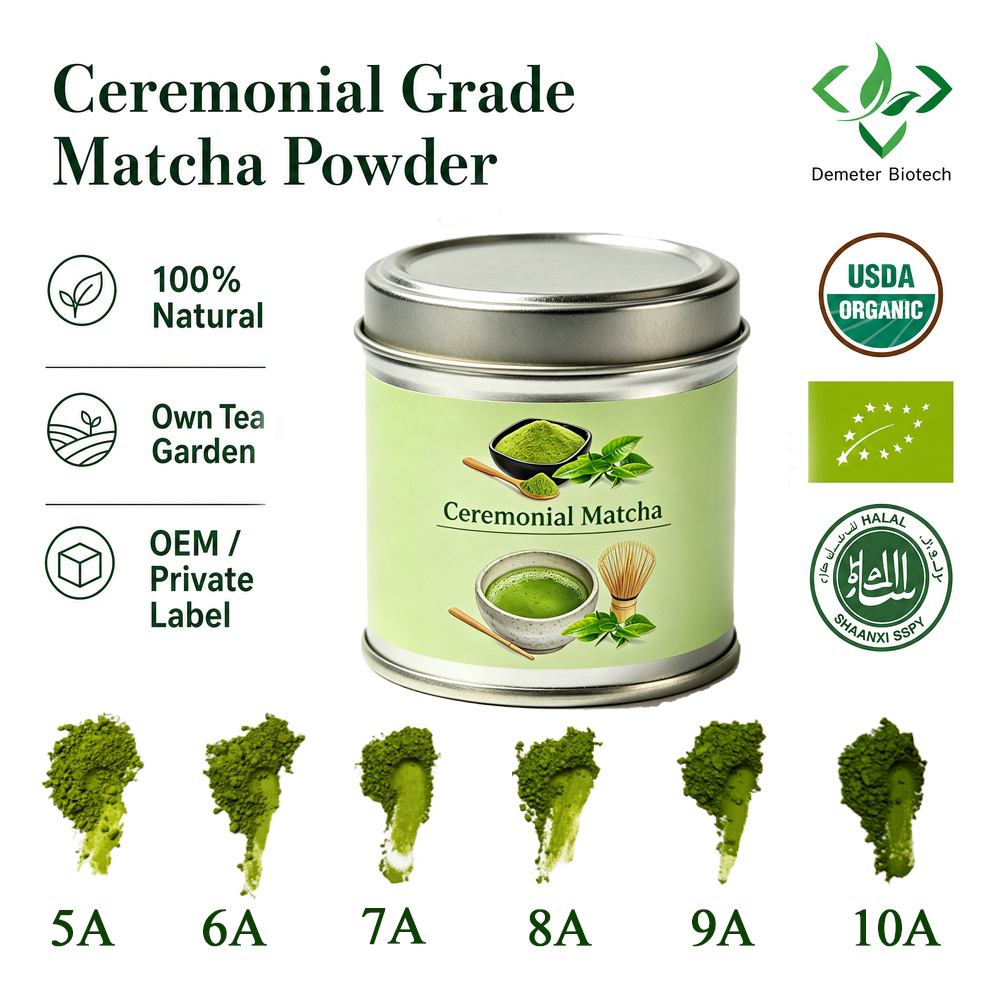
500–1500 Mesh Fine Ceremonial Matcha — Bulk Supply
The fine, free-flowing cut for RTD lines, blending and large-format repacking: 500–1500 mesh (roughly 10–25 µm) in the same organic specification, with the catechin profile and L-theanine reported on every lot for your composition work.
Send us the shading questions you want answered — depth, days, structure, flush — together with the composition panel your product needs, and we will confirm the lot figures on the COA before the order is packed. The leaf you specify should be the leaf you receive, and shading should be a line you can read, not a word you have to trust.
References
- Sano T, Horie H, Matsunaga A, Hirono Y. Effect of shading intensity on morphological and color traits and on chemical components of new tea (Camellia sinensis L.) shoots under direct covering cultivation. Journal of the Science of Food and Agriculture. 2018;98(15):5666-5676. doi:10.1002/jsfa.9112
- Manikharda, Shofi VE, Betari BK, Supriyadi. Effect of shading intensity on color, chemical composition, and sensory evaluation of green tea (Camellia sinensis var. assamica). Journal of the Saudi Society of Agricultural Sciences. 2023;22(7):407-412. doi:10.1016/j.jssas.2023.03.006
This article describes cultivation practice, leaf anatomy and ingredient composition only. It is not a statement of efficacy or medical advice. Shading depths and durations quoted for commercial practice are industry ranges, not measured values for any specific lot; the only figures that bind a lot are those on its batch COA. Composition varies with cultivar, origin, shading, harvest timing, grade and processing.
Post time: Oct-22-2026


