


Same Ancestor, Different Standard: What the China–Japan Tea Lineage Actually Tells You on a Spec Sheet
The two matcha traditions share a Song-dynasty origin and a name. That makes the word on the carton less precise, not more. Here is where the lineages diverged, and which fields carry the difference instead.
At Demeter Biotech we mill shaded tencha in China and supply it in bulk, and we have no interest in arguing that a shared ancestry makes two materials interchangeable. An earlier note in this series took the Chinese and Japanese output figures apart and showed why the headline tonnages do not measure the same thing. A second stayed inside China and mapped the factories, mills and consolidation hubs that actually decide what can be delivered. This one goes further back, to the transfers that formed both traditions, for one narrow reason: the common story is routinely offered as a substitute for a specification, and it cannot do that job. It also contains a date that is simply wrong.
1. The 1191 date joins two different journeys
A date repeated across popular accounts pairs the monk Nanpu Shomyo with the year 1191 and with the carrying of tea seed and the ceremony that became matcha. That sentence joins two separate events and gives the wrong person the credit for the seed. The year 1191 belongs to Eisai, who returned from Song China with tea seed and with the powdered-leaf preparation described in his own writing. Nanpu Shomyo belonged to the next generation. He travelled to Song China in 1259, studied first in Hangzhou and then at Jingshan, and returned in 1267 with a tea stand, tea utensils and a set of tea texts — not with the original introduction of the seed.
There is a third monk whose cargo matters more to the seed story than either of those two. Enni Ben’en went to Song in 1235, studied at Jingshan, and came back in 1241 with tea seed that was planted in his home district of Shizuoka, together with a copy of the Zen’en Shingi, the rule text whose tea procedures he used as a model for his own monastery’s code. Accounts published by Xinhua and Guangming Daily describe this chain in some detail, including the planting at Shizuoka and the continuation of the tea observance at the monastery he founded.
The correction is not a game of assigning credit. It is the hinge of this article. If the seed arrived with one monk in 1191, the ceremony with another in 1267, and the rule text with a third in 1241, then what crossed the sea was not a finished product. It was a bundle of separate things — plant material, implements, written procedure and a way of preparing powder — that were reassembled over decades into something the receiving culture then changed deliberately. Any claim that a modern powder is authentic because it descends from a single moment of transmission is claiming an event that did not happen.
2. Three cargoes and a gap of two centuries
Put the anchored dates in one place and a shape appears. The first transfer carries a plant and a preparation method. The second carries a rule book and seed into a specific growing district. The third carries the material culture of the tea gathering — the stand, the utensils, the texts — after the plant was already established. None of these is a specification for a dried powder, and none of them fixes particle size, pigment retention or moisture. They are the prehistory of those fields, not substitutes for them.
| Date | Figure or event | What the accounts say was carried or built | Status of the account |
|---|---|---|---|
| 1191 | Eisai returns from Song | Tea seed and the practice of whisking a powdered leaf; described in his own writing | Widely reported; the year is attached to Eisai, not to Nanpu Shomyo |
| 1235–1241 | Enni Ben’en at Jingshan, then home to Shizuoka | Tea seed planted in Shizuoka; the Zen’en Shingi rule text used as a model for a monastery tea code | Reported by Xinhua and Guangming Daily, among others |
| 1259–1267 | Nanpu Shomyo at Jingshan, then home | Tea stand, drinking utensils and tea texts; the staged gathering | Widely reported; the 2018 symposium recorded scholarly disagreement |
| 1973 | Six steam-fixing lines brought in after normalisation | Industrial steam fixing, distributed across Zhejiang, Anhui, Jiangxi and Fujian; most later stood idle | China Tea Marketing Association industry report |
| 1986 | Sino-Japanese joint venture at Sanming | The first commercially workable steam-fixed green tea line, with the Japanese party taking output | Same association report |
| c. 2001 | Dedicated tencha line at Wuyi | A line built for tencha rather than for steam-fixed leaf tea generally | Same association report, reported as approximate |
The gap between 1267 and 1973 is doing quiet work in the argument. Seven centuries is long enough for a preparation to become a local convention in one place and a different local convention in the other, which is precisely what happened.
3. One branch turned toward the pan, the other toward the shade
In China the leaf-fixing craft moved away from steam. Pan firing became the dominant way to stop oxidation, and the leaf was rolled and shaped rather than dried flat and then milled. By the time modern green tea was being classified industrially, the inherited powdered-leaf line had largely faded from everyday use, and a steamed unrolled leaf was an exception rather than the rule. The historical accounts of Jingshan itself make the break visible: when the tea was revived in the late 1970s, the process that was reconstructed used pan heating, rolling and baking — a different sequence from the one that produced a powder.
In Japan the opposite happened. The unrolled, steamed leaf was not abandoned; it was refined. Shading the field before harvest became a deliberate input, changing the composition of the leaf before it ever reached the steamer. The stems and veins were removed after drying. The prepared leaf was milled slowly. Each of those steps is a decision that can be written down and checked, and together they turned a borrowed preparation into a distinct material with its own definition.
That divergence matters more than the shared origin. An ancestor tells you where a technique came from. It does not tell you which of the two branches a given lot came out of, because both branches still use the word that descends from the ancestor. The Chinese line kept the name through a period when the product was uncommon; the Japanese line kept the name while rebuilding the process underneath it.
4. The modern re-convergence failed before it worked
When Chinese producers went back to steam fixing in the 1970s, the equipment arrived before the market did. Six lines were installed across four provinces after diplomatic normalisation. Most of them stopped, with the machinery standing unused, because there was no established demand for the steam-fixed leaf they produced. The 1986 joint venture at Sanming is described in the same industry report as the point at which the model became commercially viable: a partner on the Japanese side took the output, which gave the line a destination for what it made. That is a market fact, not a technological one.
The next distinction is easy to miss and commercially important. The 1986 investment was a steam-fixing line for green tea in general, not a line dedicated to tencha. The association report places the first purpose-built tencha line around 2001 at Wuyi in Zhejiang. So even after the re-convergence began, there were two different things being built: equipment that could make a steamed, rolled or unrolled leaf tea, and equipment designed for the unrolled shaded leaf that is milled into matcha. A claim that a factory has a steam line therefore says nothing about whether it can make the input that the definition requires.
5. Same word, different object
ISO 20715:2023, Tea — Classification of tea types, establishes a classification for teas produced from Camellia sinensis and is intended for production, research, teaching, trade and inspection. The important point for a contract is that a classification standard of this kind defines categories by documented criteria; it does not certify that a commercial lot meets them. The published definitions attributed to the Japanese green tea labelling standard go further on this specific product: matcha is the powder of shaded, steamed, unrolled leaf that has been ground finely, while the leaf after the shading, steaming and drying steps but before milling is called tencha. The same published framework separates funmatsucha — any tea ground to a powder — from matcha, which is why a cheap green powder can sit on a shelf near the real thing without being the same category.
The two frameworks are close but not identical. Public summaries of ISO 20715:2023 describe it as allowing tender leaves, buds or shoots within the matcha category, while the Japanese labelling definition is reported as admitting leaves only. If that difference is real in the source texts, then a powder can satisfy one framework and not the other while still being sold under the same word in both markets. For this article the distinction is illustrative rather than a legal opinion: the standard texts themselves were not consulted for these sentences, so read the comparison as a reason to ask which framework a certificate is using, not as a ruling on either.
| Term on the carton | What the shared word suggests | What has to be established instead | Field that settles it |
|---|---|---|---|
| Matcha | A shaded, steamed, unrolled leaf ground to powder | Which definition is being claimed, and on what evidence for this lot | Shading record plus the fixing and milling record, tied to a lot number |
| Tencha | The prepared leaf before milling | Whether the leaf was shaded, steamed and dried without rolling | Process sheet from the line, not a name borrowed from the finished powder |
| Steam-fixed green tea | Similar to tencha because both use steam | Whether it was rolled, and whether it was shaded at all | Leaf form after fixing, plus the shading record |
| Green tea powder | Similar to matcha because both are fine and green | Whether the starting material ever met the tencha definition | Input material declaration and a particle-size distribution on the lot |
6. Why a shared ancestor is more dangerous than a different one
If two materials had unrelated names, nobody would expect a specification written for one to cover the other. The shared word removes that warning. If you know that matcha began in Song China, you can reasonably conclude that a Chinese matcha and a Japanese matcha are variants of one article, differing, if at all, in reputation. That conclusion is understandable and wrong. It is wrong because the two branches selected different fixing methods, different leaf handling before milling and, in the Japanese branch, a shading input that was developed locally centuries after the transmissions listed in section two.
The same reasoning runs inside China. A steam-fixed leaf from a 1986-derived line, a purpose-made tencha from a post-2001 line and a powdered green tea milled from ordinary leaf can all be offered under a matcha label. The lineage does not resolve which one is in the vessel, because all three can point to some part of the same history. Only the measured fields resolve it, and those fields are the ones that the historical story never mentions.
This is also why the ancestry argument tends to collapse into an argument about authenticity. Authenticity is a claim about a story. A specification is a claim about a lot. They use different evidence and they fail in different ways: a story can be true while the lot is wrong, and a lot can be well documented while the story is incomplete. Writing one into the space reserved for the other is the actual cost of the name.
7. The difference is measurable, and the measurements are not interchangeable
The compositional literature gives substance to what the words are hiding. Ku and co-workers compared shade-cultured tencha with ordinary green tea using liquid and gas chromatography with mass spectrometric detection, and separated the two with multivariate analysis (Ku et al., 2010). The discriminating metabolites were not a single marker: green tea showed higher levels of galloylquinic acid, epigallocatechin, epicatechin, succinic acid and fructose, together with lower levels of gallocatechin, strictinin and several flavonoid glycosides, than the shaded leaf. The authors also saw seasonal variation in amino and organic acids. The practical reading is narrow but useful: shading changes a profile of many compounds, and the change survives into a measurement. It is not a single number that can be asserted from a place name.
Fixing method leaves a separate signature. Wang and co-workers took seven batches of leaf, processed some by steaming and some by pan frying across two harvest seasons, and followed what baking did to nonvolatile and volatile composition (Wang et al., 2022). Because the two fixing methods were applied to the same experimental framework, the study separates an effect of the method from an effect of the season — the distinction that a historical argument about branches is trying to make. Han and co-workers went further into flavour determinants and their changes across manufacture, reporting that, compared with pan firing, steaming reduced catechins and the proportion of geraniol, linalool and their derivatives (Han et al., 2016). Those are process effects, not origin effects, and they are reported here only to show that the branch a lot came from is observable in the material.
Colour adds a fourth field. pigment retention depends on the drying conditions after fixing, so a colour reading on the powder integrates the shading and the fixing and the drying into one number. It does not tell you which of them caused a result, and it cannot be replaced by a particle-size result. Fine milling changes the reading and the mouthfeel; it does not restore pigment lost earlier in the chain. This is the same point the factory-map note made from the other direction, and it applies across both countries.
8. Ask for the lineage in numbers
The way to use a shared history in a purchase decision is to translate it. Ask which branch a lot came from in terms that can be answered with a document, and the ancestry becomes useful instead of decorative.
| What the history says | The field to write instead | What the answer rules out |
|---|---|---|
| The leaf was shaded | Days of covering, method of covering, and the lot those records belong to | Ordinary leaf milled and labelled under the same word |
| The leaf was steamed, not pan fired | Fixing method and the line record for this lot | A steam-fixed leaf tea that was rolled, or a pan-fired leaf |
| The prepared leaf is tencha | Removal of stems and veins, plus the drying record before milling | A green powder made from whole leaf |
| It is ground finely | Particle-size distribution with the method stated, plus a colour reading on the same lot | A mesh number asserted without a distribution, or a colour implied by the name |
| It follows the traditional line | A retained sample and a lot certificate that carry all of the above together | A story that is true while the delivered lot is a different material |
At Demeter Biotech we supply certified organic matcha and a 500-to-1500-mesh bulk powder, and we answer these five lines at the lot level. We would rather state a shading record, a fixing method, a fineness distribution and a colour reading than lean on an eight-hundred-year-old name to imply them. The two product pages below show the formats in which that documentation travels with the material.
A-10A Ceremonial Grade — USDA / EU Organic Matcha
A certified organic matcha milled from shaded tencha, supplied with the organic chain and the lot’s fineness and colour readings documented together.
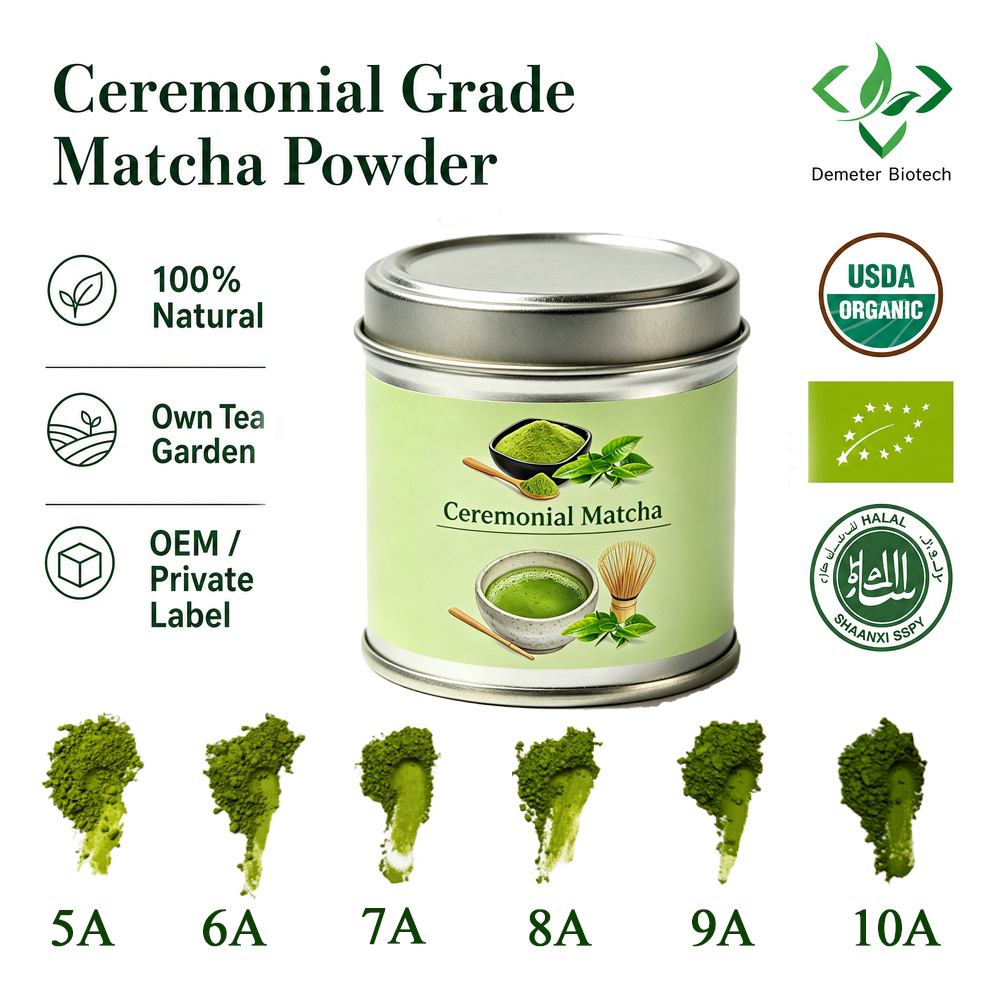
500–1500 Mesh Fine Matcha Powder — Bulk Supply
The bulk format for formulation work: a defined fineness band in a one-kilogram foil bag, with the process fields written on measurable terms rather than on a shared name.
9. What this note does not claim
It does not rank the two countries, and it does not say which branch produces the better powder. It makes no statement about what the material does in a finished formulation. It does not settle the disputed point about Nanpu Shomyo’s cargo, and it does not offer a legal reading of either the ISO classification or the Japanese labelling framework. The 1986 and 2001 dates come from a single industry report and are reported as that source gives them. The compositional studies were run on experimental sets under their own conditions, not on commercial lots from either country.
The earlier notes in this series took apart the national figures and then the Chinese factory map. This one argues that the shared ancestor belongs in the background, not in the specification. If you take one thing from it, take the inversion in section six: the lineage explains why two names are the same, while the fields in section eight are what tell you whether two lots are.
References
- Ku KM, Choi JN, Kim J, Kim JK, Yoo LG, Lee SJ, Hong YS, Lee CH. Metabolomics analysis reveals the compositional differences of shade grown tea (Camellia sinensis L.). Journal of Agricultural and Food Chemistry. 2010;58(1):418-426. doi:10.1021/jf902929h
- Wang JQ, Fu YQ, Chen JX, Wang F, Feng ZH, Yin JF, Zeng L, Xu YQ. Effects of baking treatment on the sensory quality and physicochemical properties of green tea with different processing methods. Food Chemistry. 2022;380:132217. doi:10.1016/j.foodchem.2022.132217
- Han ZX, Rana MM, Liu GF, Gao MJ, Li DX, Wu FG, Li XB, Wan XC, Wei S. Green tea flavour determinants and their changes over manufacturing processes. Food Chemistry. 2016;212:739-748. doi:10.1016/j.foodchem.2016.06.049
- International Organization for Standardization. ISO 20715:2023 Tea — Classification of tea types. Geneva: ISO; 2023.
Historical and industry sources cited in the timeline: Xinhua, account of the development of tea culture in Japan; Guangming Daily, account of the Jingshan tea gathering and the transmissions to Japan; Zhejiang Gongshang University, 2018 international symposium record on the Jingshan tea banquet, including the note that the Nanpu Shomyo account is disputed; China Tea Marketing Association, industry report on Chinese steam-fixed tea and tencha lines. These are historical accounts and trade sources, not refereed research, and are identified as such where they are used. The text of the Japanese green tea labelling standard and of ISO 20715:2023 was not consulted directly; the comparison in section five follows published summaries and is offered as a question to ask, not a legal conclusion.
This article reports published compositional research and published historical and industry accounts. It reports no measurement on any commercial lot, makes no grade equivalence between origins and makes no statement about the use of the material. The metabolite and flavour differences quoted from the three studies were obtained under the experimental conditions described in those papers and are not specifications for any shipment. The timeline reports the accounts as published, including the recorded disagreement over one transmission. Every process field and lot claim has to be established for the material under discussion.
Post time: Nov-26-2026


