



Private Label Matcha: What Each Pack Format Actually Commits You To
A 2 g cap, a 30 g tin, a 500 g pouch and a 1 kg bulk bag hold the same powder, and they are not four sizes of one product. They differ in who seals the pack, who measures the serving, who carries the mandatory information on the outside, and which stretch of the shelf life anyone can be held to. Choose the format before you choose the artwork, because the format decides what the artwork has to say.
Most private label conversations start with a pouch and a logo, and then run into a question nobody planned for: who is responsible for the powder after the customer opens it. That question has a different answer for every format we pack. At Demeter Biotech we mill shaded tencha and pack it four ways — a 2 g serving sealed into a cap, tins at 30, 50 and 100 g, pouches from 30 to 500 g, and 1 kg foil bags for bulk. This article walks through what each one commits you to, in the order the decisions actually have to be made.
1. Four formats, one barrier — and the reason that barrier is aluminium
Before the formats diverge, they agree on something, and it is worth naming it because it explains why the choice between them is not a choice about protection. All four use an aluminium-bearing structure: the pouch film, the bag film, the liner inside the tin, and the foil seal over the powder held in the cap. That is not a premium option added for ceremonial grades. It is the minimum condition for shipping milled tea at all, and the evidence for that is old, published in a national research journal, and still the clearest experiment of its kind.
In 1978 the Japan Agricultural Research Quarterly published a comparison of packaging films for green tea. Bags with 45 cm² of surface were made from nine different film constructions, 45 g of tea was sealed into each, the headspace was replaced with nitrogen, and the bags were held for three months at 25 °C and 80% relative humidity. Moisture in the tea and oxygen in the headspace were then measured at intervals. The tea started at 3.00% moisture. What happened to that number over ninety days is the whole argument for foil.
Moisture in green tea after 90 days at 25 °C and 80% RH, sealed under nitrogen from a starting value of 3.00%
| Aluminium 9 µm laminate |
|
|||
| Aluminium 12 µm laminate |
|
|||
| Aluminium 15 µm laminate |
|
|||
| OPP with PVDC coating |
|
|||
| Nylon / PE |
|
|||
| PET / PE |
|
Bar length is proportional to moisture content on a 0–6% scale; the values are 3.0, 3.1, 3.1, 4.7, 5.1 and 5.2% in the order shown. Green marks the aluminium laminates, amber the structures without foil. Redrawn from the table of measured values in Fukatsu (1978); this is a rendering of published results, not a test on our powder.
The oxygen figures run the same way. In the three aluminium laminates, headspace oxygen fell to 0.2% or below and stayed there for ninety days. In the foil-free structures it climbed steadily, reaching 13.1% in the PET / PE bags and 13.6% in the nylon / PE bags by day ninety — from a starting point of essentially zero, since the bags had just been flushed. The powder in those bags was not merely getting damp; it was sitting in air again.
Two further details in that paper are easy to miss and both matter after the design meeting. The first is the author’s design rule: select a film that keeps the moisture content of the tea below 5.5% for the intended storage period. Read that against the chart above and the arithmetic is uncomfortable — the PET / PE bag finished at 5.2% after only three months, inside the threshold but with almost nothing left in reserve. The second is that the aluminium laminate is not indestructible. The paper records that a simply structured foil laminate still carries a risk of pinholes, that a 7 µm foil layer was found sufficient when properly laminated, and that the transport bags made from the two best structures went through drop tests and a 400 km truck run without trouble. A pinhole is a barrier failure you cannot see, which is why the integrity of the seal and the film, and not the thickness printed on the specification, is what the format is really buying.
Two honest limits on that evidence. It was published in 1978, on Japanese loose-leaf green tea, not on stone-milled matcha. A milled powder has far more surface per gram and a soluble fraction that a leaf does not expose, so the direction of the finding transfers and the magnitudes do not. What transfers intact is the ordering: an aluminium-bearing structure keeps the powder where it started and everything else does not. Which is why the four formats we pack all share that layer, and why the choice between them is not about protection at all.
2. Net weight spans five hundred times, and that is the real decision
The smallest unit we pack is 2 g. The largest is 1 kg. Between those two numbers sits a factor of five hundred, and almost every practical difference between the formats follows from it: how often the material meets air, who measures a serving, what the outside of the pack can legally say, and which party is holding the risk when the seal is broken.
| Format | Net content | Quoted in | Who seals it | How often it meets air | Who measures a serving |
|---|---|---|---|---|---|
| Cap, powder sealed in the lid | 2 g per cap | Pieces | We seal the powder chamber; you seal the bottle on your filling line | Once, at the moment the cap is twisted | Nobody — the chamber is the measure |
| Tin | 30, 50 or 100 g | Pieces, with net content stated | We close and, where printed, we decorate | Once per tin, then every time it is reopened before it is empty | The consumer |
| Pouch | 30, 50, 100, 250 or 500 g | Pieces, with net content stated | We fill, gas-flush and seal | Once per pouch, then on each reopening | The consumer |
| Bulk foil bag | 1 kg | Kilograms | We fill and seal | On every draw, for the whole bag | Whoever formulates with it |
Read the last two columns together and the formats sort themselves. The 2 g cap is the only one where a serving is a physical fact. The tins and pouches sell a net content and leave the serving to a scoop. The bulk bag sells a mass and leaves the drawing of it to a production room, which is the correct answer for a customer who is going to weigh the material into a blend anyway, and the wrong one for a customer who is going to sell it on a shelf.
3. Three units that do not convert, and the comparison they break
This is the part of private label quoting that produces the most avoidable arguments. A cap is priced per piece, a tin and a pouch are priced per piece with a net content attached, and a bulk bag is priced per kilogram. Those are three different denominators, and turning any of them into “cost per kilogram” in order to compare them requires three facts that no quotation contains: the cost of the container and its decoration, the labour of filling and sealing one unit, and the scrap and rework rate at that unit size.
The arithmetic underneath is worth doing once, because it explains why the smallest format can look absurd on a per-kilogram basis without being either a mistake or a markup. Suppose a programme needs one million servings of 2 g. That is two tonnes of powder, and it is one million caps, each with its own chamber, foil seal and lid. The same two tonnes packed as 500 g pouches is four thousand pouches. The powder is identical in both cases; the number of containers differs by a factor of two hundred and fifty, and with it the number of filling operations, seals, labels and inspections. That is arithmetic, not a price list — I am not quoting you a container cost — but it is why the honest way to compare formats is cost per thousand servings or cost per unit delivered, and never cost per kilogram of powder alone.
4. Printing or a label: the two doors into private label
Both the tin and the pouch offer the same fork, and it is the most consequential commercial choice in this whole article. You can have the container printed directly, or you can take a blank container and apply a printed label to it. They are usually presented as an aesthetic choice. They are not.
| Question | Direct print on the container | Blank container plus label |
|---|---|---|
| What has to be made before the first unit | A print run of the container, with plates or cylinders specific to that artwork | Nothing beyond the label stock and the artwork file |
| How small a first order can be | Set by the container print run, which is the binding constraint rather than the powder | Set by the label run, which is the cheapest thing in the project |
| What a change costs | A new print run — the old containers are already printed | A new label; the containers carry over |
| What carries the mandatory information | The container surface itself | The label, and only the label |
| Where the risk concentrates | Error is locked in at the print stage, before any product exists | Error is possible at every application, including the last box packed |
| What it suits | A design and a market you have already validated | A first market, a test SKU, several languages, several designs from one container order |
The third and fourth rows are where most of the real money and most of the real exposure sit. Direct printing puts the entire mandatory panel — the ingredient list, the net content, the lot code, the date marking, the storage instruction, the country of origin, the name and address of the party responsible — onto the container itself, which means a mistake is discovered after a print run rather than after a box. A blank container with a label moves all of that onto a sticker, which is cheaper to reprint and far easier to get wrong at the point of application, because the sticker is the last thing applied and often the least supervised. Neither route is better. They put the failure in different places, and the right choice depends on whether your next twelve months are a test or a rollout.
One consequence deserves to be written into the purchase order rather than remembered. The exact wording of every mandatory field, and the exact list of fields required in your destination market, belong to you as the party putting the product on the shelf. What we can give you is the technical content those fields are built from: the ingredient name, the net content, the lot and production date, the storage condition the material was packed for, the certification numbers where a claim of organic or halal rests on them, and the analytical results behind any compositional statement. We cannot confirm the wording of your label, because it depends on the rules of the market you are selling into, and that determination is not ours to make.
5. Only one format locks the serving, and it is the 2 g cap
A brand that prints “one serving” on a pouch has made a statement about a scoop, not about the pack. A brand that prints it on a cap has made a statement about a chamber. The difference is not semantic. In the cap, the powder sits in a fixed volume inside the lid, sealed under foil, and drops into the bottle when the cap is twisted. The quantity delivered is a property of the tooling. In a pouch, the quantity delivered is a property of whatever the customer uses to get the powder out, and two customers with two spoons will deliver two different amounts from the same pack.
The arithmetic that turns a percentage of a blend into milligrams per serving belongs to the capsule article, and I will not repeat it here. The point in this article is different and purely commercial: whichever arithmetic you use, the format decides whether the number you print can be executed by the person holding the pack. Caps and pouches sell a net content; only the cap converts the serving into hardware.
There is a second property of the 2 g cap worth naming, because it changes what has to be tested. Because the powder meets the water in the bottle rather than in a cup, dispersion has to work without stirring — the powder falls through the liquid and what happens over the next minute decides whether the drink looks right. That behaviour belongs to the beverage article rather than to this one; for a private label brief the relevant point is that a cap is a co-engineered component, and the fit between the cap, the bottle neck and the powder has to be established on your line, not assumed from a drawing.
6. What happens after the pack is opened, and why the format sizes that risk
Everything up to this point concerns the pack while it is closed. The evidence on the closed pack is reassuring: an aluminium structure holds moisture and oxygen where they started, and a batch certificate plus a film specification can support a shelf life claim on that basis. The opened pack is a different object, and there is useful published work on it that is routinely misread in both directions.
A study of chlorophyll as an indicator of green tea quality measured teas from a range of growing regions, with starting chlorophyll between 1.12 and 1.89 mg per gram, and followed them through storage in different containers and under different light conditions. Chlorophyll declined in every sample. From the sixth month onwards the decline was significant (P < 0.05) in all of them, irrespective of the storage conditions; original packaging and metal containers came out best, and glass or paper packs held in direct daylight did the most damage. The authors drew a blunt conclusion from their own data, that the shelf life of tea should be shorter than the twelve months most producers claim (Ošťádalová and colleagues, 2014) — and that sentence has been quoted at me more than once by a customer who thought it applied to a sealed, gas-flushed pouch.
It does not, and the reason is in the method. The samples in that study came from opened retail packs and were held in lidded containers — not sealed, not flushed, not an aluminium laminate. What it measures is what happens to tea in the ordinary conditions of a kitchen or a warehouse shelf after the pack has been opened. That is exactly the stretch of life that no format can protect for you, and exactly the stretch that the format can make longer or shorter by deciding how much material each opening exposes to air.
Put plainly: the format you choose sets how many times air gets in after the sale, and that number is not in anyone’s certificate. If your product will be consumed over months, the smaller unit is doing real work. If it goes into a production process within weeks, the bulk bag is the correct engineering choice and the instruction above is the whole of the mitigation.
7. Private label, OEM and white label: three different allocations of duty
The three words are used interchangeably in enquiries and they describe three different arrangements. The distinction is not price. It is which party holds the recipe, the design and the mandatory panel, and therefore which party has to answer for each of them.
| Arrangement | Whose specification | Whose design and panel | What we additionally carry | What it is for |
|---|---|---|---|---|
| White label | Ours, as listed | Yours, applied to our existing pack | Repeatability of the grade and the pack we already run | The shortest path to a product on a shelf with your name on it |
| Private label | Ours, selected to your brief | Yours, on your container or label | Lot consistency within the grade, technical content for the panel, certifications where they apply | A brand built on a grade that already has a specification behind it |
| OEM with your blend | Yours | Yours | Blending homogeneity, fill accuracy, and a documented packing record | A finished powder of your own formulation, packed in your format |
The third row carries an obligation that is easy to overlook when the enquiry is only about price. Once your formulation is in the bag rather than ours, the properties of the blend stop being properties of a matcha specification. A blend of matcha with sugar, with a protein, with a fibre or with another powder has its own particle distribution, its own tendency to separate in transit, its own water activity, and its own behaviour when the pouch is opened. We can control homogeneity and fill accuracy because those are process variables. We cannot transfer a shelf life from a single-ingredient specification to a blend, because the water activity and the matrix are different objects. So an OEM brief that needs a stated shelf life needs a stability check on the blend itself, and the honest answer at the quotation stage is to say so rather than to carry a number across.
8. Three questions that decide the format
Strip away the artwork and the enquiry usually resolves into three questions. Their answers point at one format each, and it is faster to answer them than to compare quotations.
| Question | If the answer is yes | If the answer is no |
|---|---|---|
| Does the person who uses it need the serving to be fixed for them? | The 2 g cap, because the chamber is the measure and no scoop is involved. | A tin or a pouch, where net content is the promise and the serving is the customer’s business. |
| Will the pack be opened many times before it is finished? | Choose the smallest unit that still makes commercial sense; exposure per opening is what shortens the usable life. | A larger unit is efficient, and a 1 kg bag is the right answer if the material goes into a process. |
| Are you still testing the market? | Blank container plus label: change the design without changing the container order. | Direct print on the container, once the design and the market have been validated. |
A fourth question sits behind all three and is usually the one that decides the project: what does the panel on the outside have to say, and in how many languages. A format that cannot hold the required text legibly is not a format, however good the powder inside it is. Which is why the useful brief names the market before it names the colour.
9. How Demeter supplies matcha for private label and OEM
We pack four ways: a 2 g serving sealed into a cap, tins at 30, 50 and 100 g, pouches at 30, 50, 100, 250 and 500 g, and 1 kg aluminium foil bags for bulk. Tins and pouches can be printed directly, or supplied blank for your own label. The powder behind all four is the same shaded tencha from our own gardens, de-stemmed, de-veined and stone-milled, in the grade you select — and every lot carries particle size, colour on a standardised dispersion, moisture with the measurement point named, the catechin profile and a residue screen written to the market you are selling into.
Tell us the format, the net content, whether the container is printed or labelled, the market and its language requirement, and whether you are packing our grade or your own blend. We will tell you what the format can and cannot commit to, where the panel has to be settled before the print run, and which certification you need attached to the lot rather than to the brochure.
USDA & EU Organic Certified Ceremonial Matcha — A-10A
Shaded first-flush tencha from our own gardens, de-stemmed and de-veined, stone-milled below 40 °C, dual-certified USDA and EU Organic. Batch COA covers colour on a standardised dispersion, particle size, moisture, the catechin profile and the residue screen. Halal available; OEM and private label supported in tins, pouches and bulk.
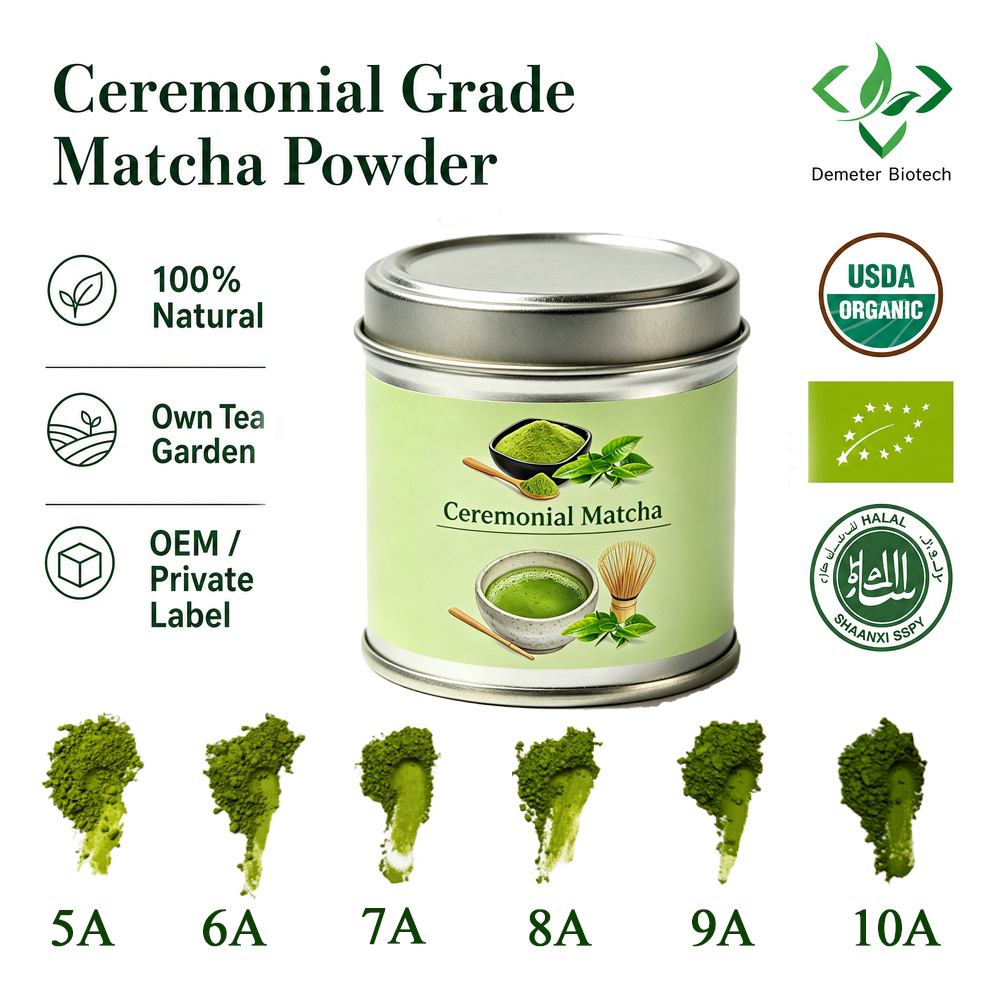
500–1500 Mesh Fine Ceremonial Matcha — Bulk Supply
The fine, free-flowing cut for programmes where the powder has to fill a small chamber or wet out cleanly: 500–1500 mesh in the same organic specification, milled from de-stemmed tencha, with particle size, colour and moisture reported on every lot so a fill weight or a dispersion can be designed rather than corrected afterwards.
References
- Fukatsu S. Storage of green tea by the use of various packaging. Japan Agricultural Research Quarterly. 1978;12(1):33-38. Full text available from the JIRCAS archive: https://www.jircas.go.jp/en/publication/jarq/12/1/33
- Ošťádalová M, Tremlová B, Pokorná J, Král M. Chlorophyll as an indicator of green tea quality. Acta Veterinaria Brno. 2014;83(10):S103-S109. doi:10.2754/avb201483s10s103
This article describes pack formats, the paperwork each format requires, and the published behaviour of milled tea in storage. It is not a statement of efficacy and it is not advice on use. The storage results quoted were obtained on Japanese loose-leaf green tea in defined film structures and on commercial green tea samples held in lidded containers; they are reported as the findings of those studies and not as values for any lot, blend or pack, and a milled powder has a different surface-to-mass ratio from a leaf. Statements about the information required on a label are general and are not a legal opinion on any market; the party placing the product on the market is responsible for the wording, the language and the completeness of every mandatory field. The only figures that bind a lot are those on its batch certificate of analysis.
Post time: Nov-18-2026


