


Matcha vs Regular Green Tea: Whole-Leaf Nutrition
Not variety, not grade — the real divide is how the leaf reaches the cup. Matcha is the whole leaf, stone-milled and whisked in; regular green tea is an infusion you steep and throw away. That single fact decides how much of the leaf’s composition actually lands in the serving.
Two products come from the same plant, Camellia sinensis, and often from the same leaf chemistry. What separates them on a specification sheet is not the cultivar — it is the format. A bowl of matcha is 1–2 g of leaf powder you consume entirely. A cup of green tea is a 235 mL infusion of 2–3 g of leaf, most of which you discard. So “matcha has more of compound X than green tea” is true mainly because matcha delivers the whole leaf and brewed tea delivers only the water-soluble fraction. For a B2B purchaser the useful question is which numbers survive the trip from leaf to finished product, and how to write that into a comparable specification. At Demeter Biotech we mill whole-leaf matcha from our own China gardens and report the full composition on every batch COA. Below is the mechanism, the per-serving gap, and how to turn it into a buying spec.
1. The one difference that matters: whole leaf vs infusion
The chemistry of the two drinks overlaps almost completely — same catechins, same L-theanine, same caffeine, same chlorophyll. The difference is mechanical. Steeping extracts the water-soluble part of the leaf into the liquid and leaves the solid matrix behind. Stone-grinding and whisking put the entire matrix into the cup. A 2026 review comparing the two formats notes that because matcha is consumed as a suspension of the whole ground leaf, the eater ingests the complete leaf matrix, whereas a traditional sencha infusion delivers only what water pulled out (Sławińska & Raczkowska, 2026). The earliest quantitative work on this made the same point with catechins: measuring matcha against a brewed green tea showed the whole-leaf form carries far more of the leaf’s catechin pool per serving, because none of it is left in a discarded leaf (Weiss & Anderton, 2003, Journal of Chromatography A). In short, the grade question and the format question are separate; this article is about format.
2. What actually reaches the cup
The table below uses planning figures drawn from the 2026 review, scaled to a 2 g matcha serving against a 235 mL brewed sencha cup. They are ranges, not guarantees — grade, origin and brewing all move them — but the direction is the robust part.
| Compound | Matcha (2 g, whisked) | Brewed sencha (235 mL) | What it means for your spec |
|---|---|---|---|
| Total catechins | ~170 mg | 51–160 mg | Matcha’s range sits at or above the brewed ceiling |
| EGCG (headline catechin) | ~110 mg | 10–80 mg | Whole-leaf delivery drives the gap per serving |
| L-theanine | ~50 mg | Lower — most stays in the leaf | Amino acid only fully delivered by whole leaf |
| Dietary fibre | From the whole leaf matrix | ~0 (discarded with leaf) | Fibre is a whole-leaf marker, not an infusion marker |
| Chlorophyll | Abundant (shade-grown) | Small (fat-soluble left in leaf) | Colour marker travels with the leaf |
| Leaf consumed? | Yes — the whole leaf | No — leaves discarded | The structural reason the gap exists |
The standouts are fibre and chlorophyll: both live in the leaf tissue, so an infusion leaves most of them in the spent leaf while matcha delivers them with the powder. Catechins and L-theanine, too, are present in the whole leaf at concentrations a brewed cup only partially transfers. We cover EGCG and the catechin family as a compound topic in a separate article; here the point is delivery, not potency.
3. The gap is real, but it is a range — not a slogan
Because the comparison tea and the brewing method vary so widely, any single multiplier is misleading. Published serving figures place a 2 g matcha at roughly 1.5–11× the EGCG of a typical brewed sencha (Sławińska & Raczkowska, 2026). The honest statement is therefore a range, and the useful habit is to state the denominator every time: compare leaf to leaf, or serving to serving. A gram of matcha and a gram of brewed-leaf solids are the same leaf; a bowl of matcha and a cup of brewed tea are not the same measurement base. Quote the serving, not the slogan.
4. Writing whole-leaf delivery into a specification
Three lines capture it on a purchase order:
| Parameter | What to write | Why |
|---|---|---|
| Composition, per gram | Request the full panel (EGCG, EGC, total catechins, L-theanine) and the method | Same leaf, so numbers are directly comparable across lots |
| Composition, per serving | Define your serving (g of powder) and the resulting mg | The number your label and your customer’s label must show |
| Leaf ingested | Confirm “whole-leaf powder” on the spec | Unlike brewed tea, matcha’s per-gram COA figures translate fully into the finished product |
If your product is built on a “whole-leaf” or “eat the leaf” positioning, matcha is the ingredient that actually delivers it; brewed green tea cannot make that claim. Ask for moisture, ash and particle size on the same COA, and you can model your finished-product composition before you order rather than after.
One note on our own labels: Demeter’s RM / EM / OM tiers are our internal classification of how a given lot was shaded, milled and certified — they are not an industry-standard grade. We map them to your application and certify the lot against your specification on request, rather than asking you to read our internal shorthand.
5. How Demeter supplies whole-leaf matcha you can verify
At Demeter Biotech we mill whole-leaf matcha from our own tea gardens in China and pack in light-shielded barrier bags to hold the green. Tell us your serving definition, your composition target and your certification needs — USDA Organic, EU Organic or Halal — and we will confirm the batch figures on the COA before the container leaves.
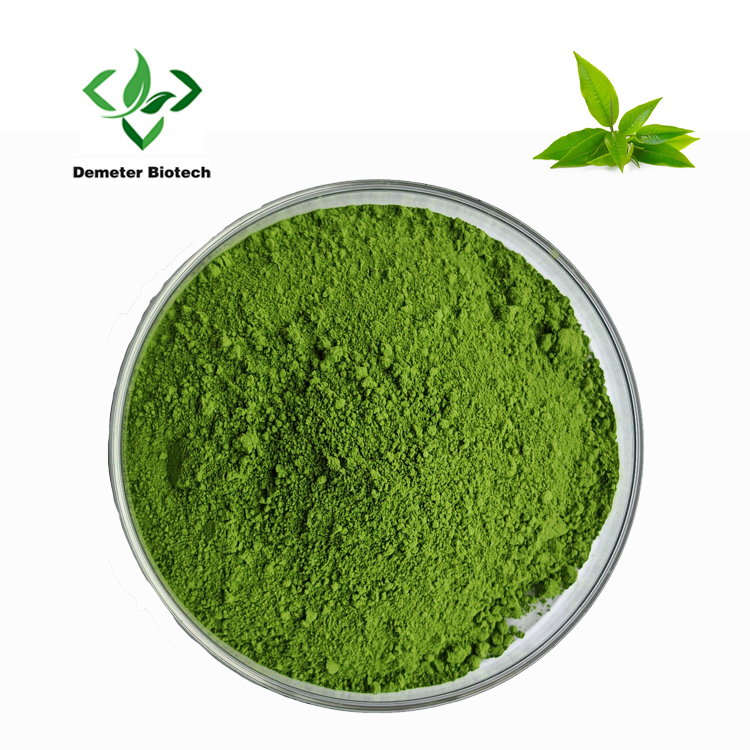
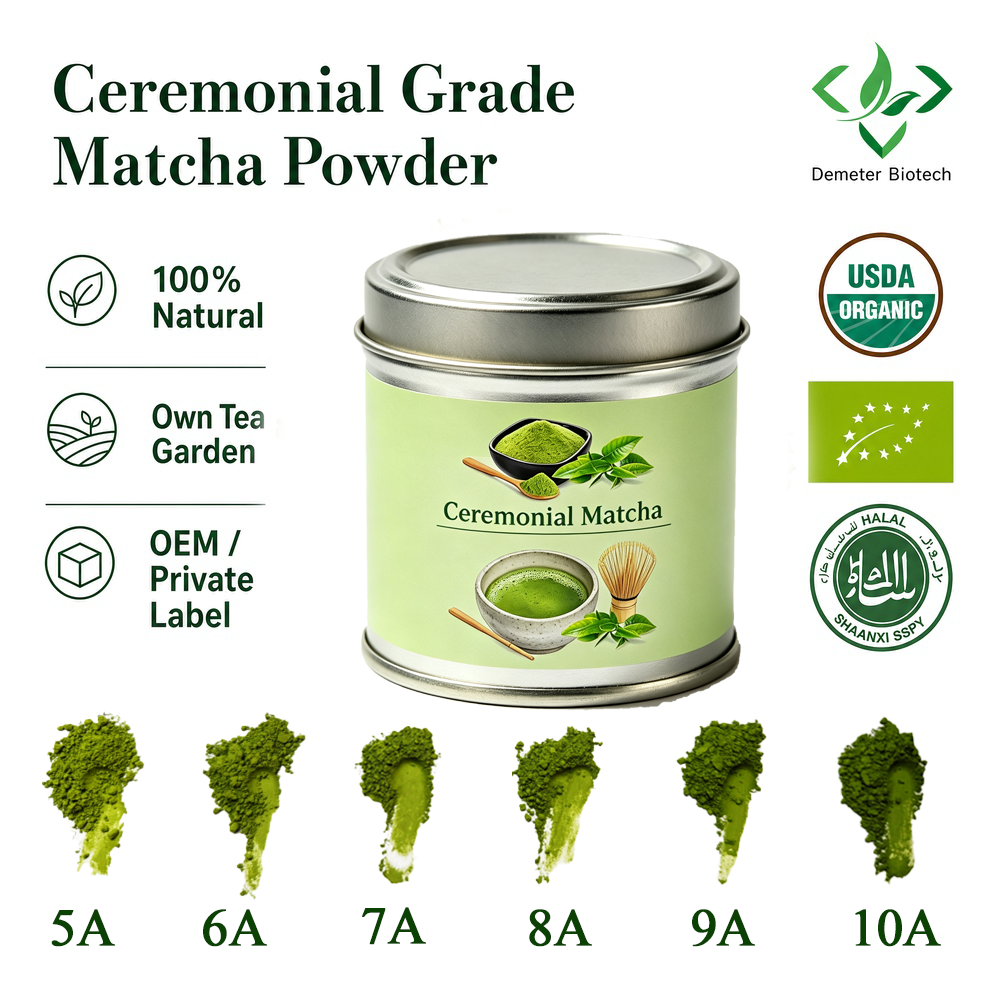
USDA & EU Organic Certified Ceremonial Matcha — A-10A
Shaded first-flush tencha from our own gardens, stone-milled below 40 °C, dual-certified USDA and EU Organic. Batch COA covers EGCG, the catechin profile, L-theanine, colour, residue screen and particle size. Halal available; OEM and private label supported.
500–1500 Mesh Fine Ceremonial Matcha — Bulk Supply
The fine, free-flowing cut for RTD lines, blending and large-format repacking: 500–1500 mesh (roughly 10–25 µm) in the same organic specification, with the catechin profile and L-theanine reported on every lot for your composition work.
Send us your target composition, your serving definition and your certification list, and we will map the right lot and confirm the numbers on the COA before you commit — so the leaf you specify is the leaf you receive.
References
- Weiss D, Anderton C. Determination of catechins in matcha green tea by micellar electrokinetic chromatography. Journal of Chromatography A. 2003;1011(1-2):173-180. doi:10.1016/S0021-9673(03)01133-6
- Sławińska P, Raczkowska E. Matcha as a Source of Bioactive Compounds: A Review of Health-Promoting Properties and Potential Applications. Nutrients. 2026;18(10):1613. doi:10.3390/nu18101613
This article describes ingredient composition and specification only. It is not a statement of efficacy or medical advice. “Antioxidant” is used to mean a measured in-vitro chemical property, not any effect on the human body. Catechin, L-theanine and fibre values cited come from the published work referenced above and from common B2B specifications; they vary with cultivar, origin, grade and brewing, and the only figures that bind a lot are those on its batch COA.
Post time: Oct-16-2026


