


Matcha in Capsules and Functional Blends: Fill Weight, Dilution and Identity
A capsule brief says 300 mg of matcha. Whether that number survives contact with the filling line depends on three things that are almost never written down: the tapped density of the lot, the share of matcha inside the blend, and the water activity the finished unit lives at. Here is how each one sets a hard limit, and what to put in the specification so the label stays true.
Supplement briefs are written in the grammar of extracts. You name a marker, you fix a percentage, you state milligrams per unit, and the vendor standardises to it. That grammar works because an extract is a purified fraction whose concentration can be adjusted upward by processing. A matcha powder for capsules is the opposite kind of material: it is the whole leaf, milled, and nothing has been concentrated or removed. Once you accept that, three consequences follow that decide the entire product design — fill weight becomes a volume question rather than a weight question, a percentage in a blend stops predicting a milligram dose, and a specification built around one marker figure starts selecting the wrong material. At Demeter Biotech we stone-mill our own shaded tencha and ship it into capsule and blend programmes, and these three points are what we settle with a customer before the first trial batch rather than after the first label review.
1. Fill weight is a volume problem wearing a weight label
A capsule shell has a fixed internal volume. What goes into it is therefore not a mass you choose but a mass that results from the volume and from how densely the powder packs into it. The working relationship is simple enough to write on one line: fill weight equals shell volume, multiplied by tapped density, multiplied by however efficiently the filling machine reaches that density.
Two of those three terms are properties of your powder, and they are not constant between lots. In a comparison of matcha powders of different geographical origins, the sorption behaviour, the glass transition temperature, the colour parameters and the physical properties all depended on which sample was measured; the sample with the highest water solubility index above 80 °C was also the one with the lowest bulk density (Stépień et al., 2025). Read that as a warning about labels rather than about origins. Two lots that are both honestly described as shaded, de-stemmed, stone-milled matcha can differ in bulk density, and if you fill them by volume into the same shell, one lot delivers your stated milligram dose and the other does not. The label did not change. The dose did.
This is why a phrase like “300 mg per capsule” is not a specification on its own; it is the output of a calculation whose inputs you have not been given. There are two honest ways to make it repeatable. The first is to buy on a stated tapped density with a tolerance, and to accept that the shell size may have to be chosen per lot. The second, which is what most solid-dose plants actually do, is to fill gravimetrically: weigh each fill rather than meter a volume. That removes the density dependence from the dose entirely, at the cost of throughput, and it is worth asking which principle your filler uses before you argue about milligram claims with anyone.
There is a second-order effect worth knowing. A powder with a low bulk density carries more air per gram, and the air it carries is oxygen sitting in intimate contact with the powder inside a sealed shell. Air also makes a powder more compressible, which shows up later as capping and weight variation if the same material is ever run on a tabletting press. Neither of those is a reason to reject a lighter powder; both are reasons to state the density so that the filling and tabletting steps are designed around the material you actually have.
2. A percentage in a blend is not a milligram in a serving
The second constraint arrives the moment matcha stops being the product and becomes an ingredient. In a multi-ingredient powder — protein, dietary fibre, prebiotic, vitamin premix — matcha is bulky and relatively light, so it competes for volume with ingredients that carry far more mass per scoop. In practice it ends up at a few percent of the formula, and a few percent of a 10 g serving is a very different number from what most people picture when a pack says “with matcha”.
Three things follow, and all three belong in the specification. First, lock the milligram of matcha per serving and the serving size together, because a scoop change silently rewrites the dose even when the formula percentage is untouched. Second, read stick packs and sachets as the tightest version of the problem: the fill volume is small, so the same formula percentage delivers less absolute matcha than a jar of powder does, and a “matcha” claim carried over from the jar version will not hold. Third, decide whether matcha is present as a character ingredient or a nominal one, and write the number that matches the decision — a blend at 3% is a legitimate product, but it is a product whose matcha is a colour and a note rather than a dose.
The formulator’s counterpart to this is a volume budget. If a serving is fixed, something has to give, and matcha’s low density means it gives first: to hold a gram of matcha in a 10 g serving you need ten percent of the formula’s mass and considerably more than ten percent of its volume. That is a design decision about the product, not a purchasing decision about the powder, and it is far cheaper to make it on paper than in a sensory panel.
3. It is a powder, not an extract — and the specification should say so
The third constraint is the one that causes the most disagreement, because it is about identity rather than arithmetic. In an extract, a marker percentage is a process target: concentration is adjustable, so a higher figure is bought by purifying harder. In a whole-leaf powder there is no purification step to turn. The catechin figure is a property of the leaf that was harvested, its age, and how long it was shaded, and it moves with the season rather than with the order. A specification that names a single percentage and reads it as a standardisation guarantee is therefore asking for something the material cannot promise, and a vendor who appears to promise it has usually either blended to hit the number or is quietly describing a different material.
That has a practical edge for capsules. A shell you can swallow holds a fraction of a gram, and matcha is not dense. If a brief requires a defined catechin figure in a single small unit, the arithmetic rarely closes with leaf powder at all; at that point the honest options are to accept fewer milligrams, to spread the dose over more units, or to move to an extract and stop describing the product as matcha. Choosing the third while keeping the matcha story is where most of the incoherent labels in this category come from, and it is not a sourcing problem that a better lot will fix.
What a whole-leaf powder can be specified on is physical and measurable, and it is a longer list than the one marker figure it replaces:
| Dimension | Why it binds the product |
|---|---|
| Particle size distribution | Sets how the powder behaves in the blender, whether it dusts, and whether a stick pack shows speckling. A fine cut disperses; a coarse one separates from denser ingredients in a blend. |
| Colour on a standardised dispersion | The only colour figure two laboratories can compare. Measured on the dry powder it is a different quantity and cannot be set against another vendor’s reading. |
| Water activity | The switch on both caking and degradation, covered in the next section. It is not the same measurement as moisture content and cannot be inferred from it. |
| Tapped and bulk density | Turns the milligram claim into a fill the machine can reproduce. |
| Microbiological count and residue screens | A solid dosage form gets no kill step after blending. Pesticide residue and heavy metals belong in the same line, because a capsule concentrates whatever the leaf carried. |
| Caffeine | Present in the leaf, not removed. It is a label arithmetic item when several caffeine-bearing ingredients share a serving. |
4. Water activity is the shelf-life switch in a solid dosage form
In a beverage, water is the medium. In a capsule or a stick pack, water is a contaminant that arrives slowly through the packaging, and its effect is set by water activity rather than by moisture percentage. Two recent measurements make the case concretely.
Matcha powders stored across a wide water activity range from 0.11 to 0.93, either light-shielded or under continuous laboratory lighting at roughly 450–500 lx, behaved the way a hygroscopic powder is expected to behave and then went further. Higher water activity raised the water solubility index and lowered the water absorption index, which the authors read as structural loosening of the powder. Total polyphenol and flavonoid contents fell progressively, most sharply at high water activity and under light. The kinetic analysis is the commercially useful part: the gallated catechins, EGCG and ECG, showed short half-lives of approximately 30–40 days under light exposure, while gallic acid stayed comparatively stable — and storage at water activity at or below 0.53 together with light shielding gave markedly better retention of the compounds measured (Kim et al., 2026).
Three readings of that, each of which changes a document rather than a formula. The first is that the half-life figure is conditional. Thirty to forty days is what the trial measured under light, so the light barrier is a packaging specification, not a warehouse preference, and an opaque or metallised pack is doing measurable work. The second is that the two levers are separable. Water activity and light act through different routes, so improving one does not compensate for the other; a foil pack in a humid room is still a humid product. The third is the mechanistic hint in the last pair of observations: gallated catechins falling while gallic acid holds is consistent with loss of the gallate group by hydrolysis, which is a water-driven path. If that reading is right, water activity is not merely correlated with the loss — it is part of the route, which makes it something you can control at the plant rather than something you can only observe afterwards.
The sorption work adds the other half of the picture. Across the matcha powders measured, all showed sigmoidal water adsorption isotherms at 25 °C, and the monolayer moisture content corresponding to the point of maximum stability fell in a narrow band of 0.045 to 0.053 g water per g of sample, while the glass transition temperature of the anhydrous powders ranged from 106.3 to 139.0 °C (Stépień et al., 2025). Two notes keep those figures from being misused. The monolayer figure is a target for storage, and it is narrow because the sorption behaviour was similar across samples even though other properties were not. The glass transition figure is measured on anhydrous powder, and water is a plasticiser, so the transition that matters at ambient humidity sits far below the anhydrous value; 106–139 °C is a material characterisation number, not a storage temperature, and a powder held above its humidity-plasticised transition will cake and lose structure long before any of those figures is reached.
5. Three dosage forms, three different bottlenecks
Once fill weight, dilution and water activity are on the table, the choice of dosage form stops being a marketing question. Each format pushes hardest on a different one of the three.
| Format | Where the limit comes from | Exposure during life | What the specification must carry |
|---|---|---|---|
| Two-piece capsule | Fixed shell volume multiplied by tapped density. The milligram ceiling is physical, and a low-density lot lowers it further. | Sealed against water ingress by the shell and the blister, but not against the oxygen already inside; no light protection from a clear shell | Tapped density with tolerance, fill principle (volumetric or gravimetric), water activity, shell colour or opaque packaging, microbiological count |
| Stick pack, sachet, single-serve | Small fill volume, so the formula percentage delivers the least absolute matcha of any format | The largest surface-to-mass ratio of the three, and the format most often packed in a clear film | Water activity, film water-vapour transmission, light barrier, milligram of matcha per pack stated separately from the percentage, particle size for dispersion in the pack |
| Compressed tablet | Die volume and compression behaviour; a light, air-rich powder compresses unevenly | Low porosity once compressed, which helps against water and hurts nothing except disintegration | Density and compressibility data, particle size, lubricant and disintegrant compatibility, water activity, hardness and disintegration time |
The stick pack is the format that most often fails quietly, because it combines the smallest dose with the largest exposed surface and the most transparent packaging. If a programme is moving from a jar to a stick, the matcha content per serving should be recalculated rather than carried across, and the film specification should be revisited at the same time.
6. Six lines that make a matcha specification honest
None of these is exotic; each one closes a gap where a label can drift away from the product. Together they let a customer check a lot without visiting the plant, and they let a vendor describe what it actually controls.
| Line | What to record | The failure it closes |
|---|---|---|
| Density and fill principle | Tapped density with a tolerance, and whether fills are volumetric or gravimetric | A milligram claim that changes when the lot changes |
| Matcha per unit and per serving | Milligrams of matcha, the serving size, and the formula percentage stated as a separate figure | A percentage being read as a dose, and a scoop change going unnoticed |
| Particle size distribution | Distribution rather than a single mesh figure | Segregation in a blend and speckling in a stick pack, reported later as a quality complaint |
| Water activity | Value, method and the pack it was measured in | Caking and a shortened shelf life that moisture content did not predict |
| Light barrier and film transmission | Pack construction and the water-vapour transmission figure | Degradation during storage that the powder passed for at dispatch |
| Marker figure as a lot-typical band | A catechin figure expressed as a range typical of the leaf and season, with the method named | A standardisation promise a whole-leaf powder cannot keep, and the substitution that pretending otherwise invites |
The last line is the one that separates a vendor of leaf from a vendor of extract, and it is worth saying plainly in a specification because it stops a later misunderstanding. A band with a named method is a truthful description of an agricultural material. A fixed percentage presented as guaranteed is a claim about a purification step that did not happen.
7. How Demeter supplies matcha for capsules and blends
At Demeter Biotech we shade our own tencha before harvest, steam it, dry it flat without rolling, de-stem and de-vein it, and stone-mill it below 40 °C. For capsule and blend programmes we report tapped and bulk density, particle size distribution, colour on a standardised aqueous dispersion, water activity and microbiological counts on a batch basis, and we state the catechin figures as a lot-typical band with the analytical method named — because we sell milled leaf, not a standardised extract, and a specification should describe the material that is in the drum.
Tell us the shell size or pack format, whether your filler is volumetric or gravimetric, the milligram of matcha you want per unit, and the pack construction you intend to use. We will tell you which cut fits, where the water activity needs to sit, and where the dose is likely to run out of volume before it runs out of formula.
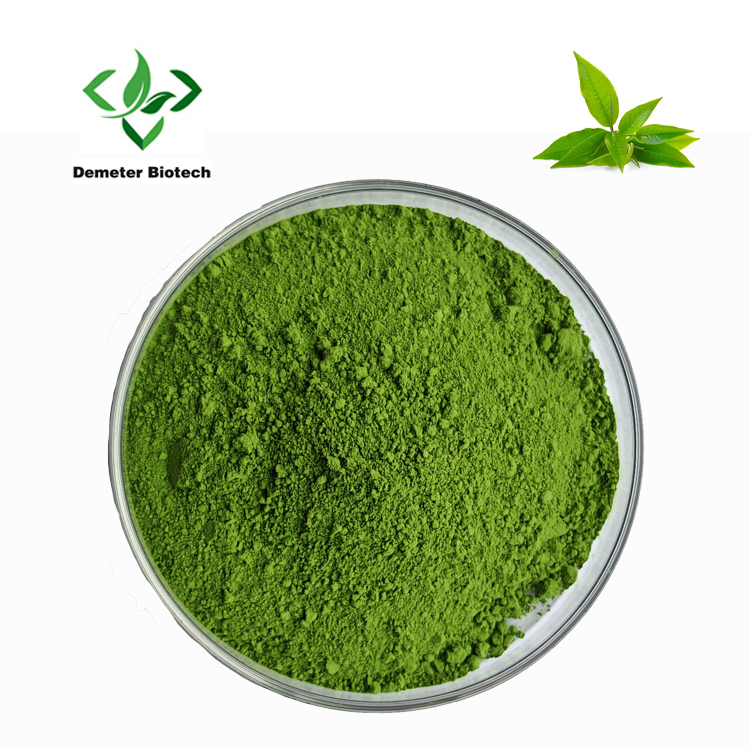
USDA & EU Organic Certified Ceremonial Matcha — A-10A
Shaded first-flush tencha from our own gardens, de-stemmed and de-veined, stone-milled below 40 °C, dual-certified USDA and EU Organic. Batch COA covers colour on a standardised dispersion, particle size, water activity, L-theanine, the catechin profile and the residue screen. Halal available; OEM and private label supported.
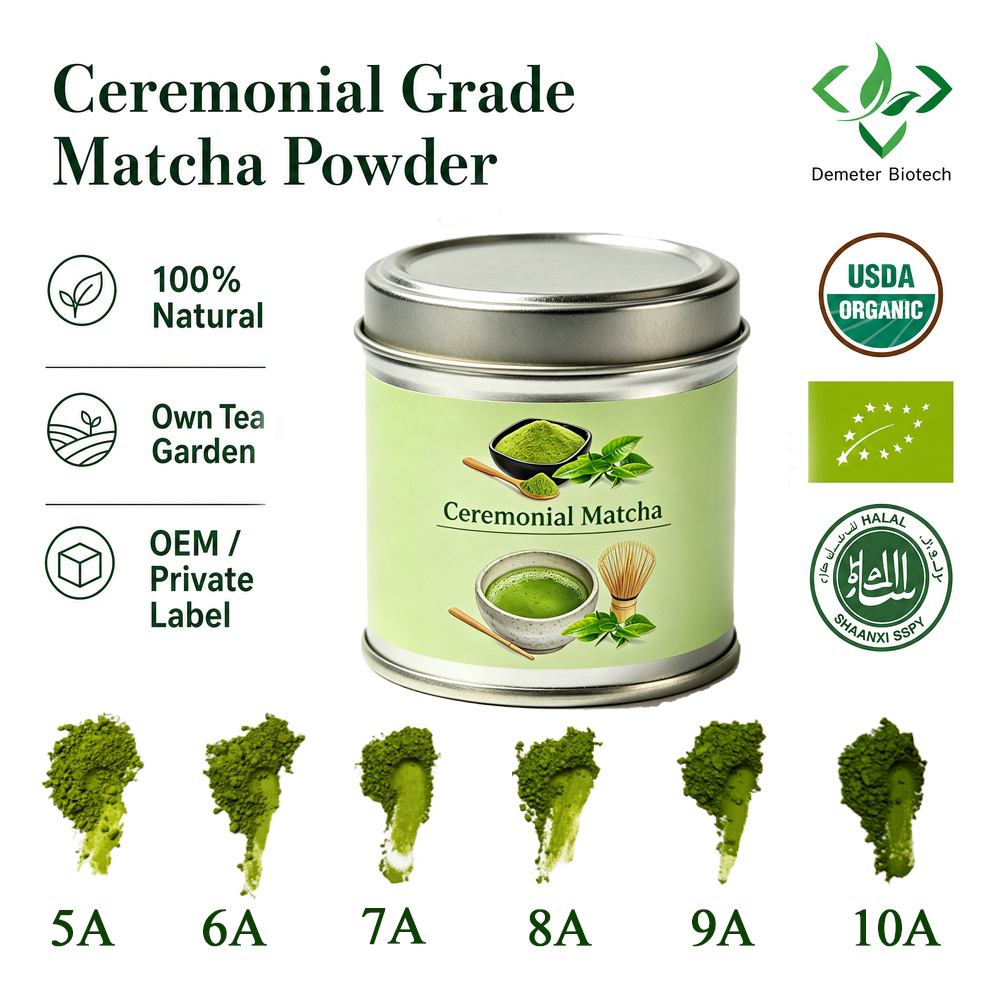
500–1500 Mesh Fine Ceremonial Matcha — Bulk Supply
The fine, free-flowing cut for capsule filling, stick packs and blend manufacture: 500–1500 mesh in the same organic specification, milled from de-stemmed tencha, with tapped density, particle size, water activity and colour reported on every lot so a fill weight can be calculated rather than assumed.
References
- Stépień A, Liszka-Skoczylas M, Gwóźdź G. Comparison of technological and physical properties of matcha powders of different geographical origins. Journal of the Science of Food and Agriculture. 2025;105(4):2569-2577. doi:10.1002/jsfa.14030
- Kim JM, Lee K-Y, Choi S-G, Heo HJ. Effect of water activity and light exposure on the stability of bioactive compounds in matcha (Camellia sinensis) powder during storage periods. Food Chemistry. 2026;510:148655. doi:10.1016/j.foodchem.2026.148655
This article describes the physical behaviour of matcha powder in capsule, tablet and blend manufacture, its composition and its sourcing documentation only. It is not a statement of efficacy or medical advice. The findings cited above are reported as the results obtained on the systems those studies examined — matcha powders of several origins measured for sorption, glass transition and colour, and matcha powder stored under controlled water activity and lighting — and are given as directions of change rather than as values for a specific lot, formula or pack. Milligram examples are arithmetic illustrations and not a specification; shell size, tapped density, fill principle, serving size, water activity and pack construction all shift the outcome. The only figures that bind a lot are those on its batch certificate of analysis.
Post time: Nov-09-2026


