


Matcha in Beverages: Lattes, RTD, Smoothies & Bubble Tea
Every beverage brief in this category starts with the same wrong word: soluble. Matcha does not dissolve. It suspends, and once you accept that, the four things that decide whether your drink looks and tastes the same in week twelve as it did on day one become visible.
Ask ten formulators what they need from a matcha powder and nine will say “good solubility”. It is the wrong test, and the word hides a real problem. Matcha is a whole-leaf powder: the leaf is steamed, dried, de-stemmed and ground, so what you put in the tank is not an extract but a suspension of leaf particles in water. Some of the mass dissolves — sugars, amino acids, caffeine, organic acids, part of the polyphenol fraction. A large part does not: cell-wall fibre, chloroplast-bound pigment, protein, and the cuticle fragments that survive milling. That split is what makes matcha beverage applications a dispersion problem rather than a dissolution problem, and it is why a powder that disperses beautifully in one format can fail in another without anything being wrong with the powder. At Demeter Biotech we stone-mill our own tencha and ship it into beverage programmes, so the failures below are ones we see in real trials rather than in theory.
1. It suspends, it does not dissolve
Two consequences follow from the paragraph above, and both change how a brief should be written. First, what you are formulating is a particle system, so the controlling variables are wetting, particle size and viscosity — the same three that govern any suspension, and not the ones that govern a solution. Second, the standard “solubility” line on a specification sheet measures the behaviour of the soluble fraction, which is the easy half. A powder can score well on that test and still form lumps with dry cores in your tank.
Wetting is where most beverage trials actually fail, and the reason is a surface property rather than a milling defect. In a study that used matcha powder as a model plant particulate, matcha particles dispersed in acidic aqueous media showed only weak aggregation, which the authors read as evidence of a relatively hydrophobic particle surface (Schröder et al., 2021). Hydrophobic powder plus water gives you exactly what you would expect: clumps that wet on the outside, stay dry on the inside, and take far longer to break than the mixer cycle allows. The fixes are physical, not chemical — dry-blend the powder with sugar or another carrier before it meets water, wet it with a little glycerin or alcohol first, or use a high-shear head with the powder added below the surface rather than on top of it. Raising the water temperature wets faster and costs you colour, which is the subject of section 3.
One number worth holding in mind: stone-milled matcha typically sits in the low tens of micrometres on a D50 basis, and the fines that give the powder its body are also the fraction that scatters light most strongly. The same particles that make the drink opaque are the ones that settle. There is no grade of matcha where that trade-off disappears; there is only a viscosity and a particle-size distribution where it can be managed.
2. Four formats, four different stresses
The reason one powder passes a latte trial and fails a bottled RTD trial is that the four common formats do not subject the suspension to the same conditions. They differ in heat load, pH, protein, hold time and the amount of mechanical agitation the drink gets after filling — and those five variables, not the grade, decide what the consumer sees at the end of the shelf life.
| Format | What dominates the stress | What you will notice first | What to design around |
|---|---|---|---|
| Hot latte | 65–80 °C plus dairy protein, consumed within minutes | A duller, slightly olive green as the cup cools; a soft sediment if it stands | Heat load is short, so colour survives; the protein is doing the mouthfeel work for you |
| Bottled RTD | A heat step, an acidic pH, weeks to months of storage, and light through the bottle | Hue drift toward brown, a settled layer, and a thinner body over time | The longest list of simultaneous stresses; plan colour and sediment as separate projects |
| Smoothie / frozen | Fruit acids, plant or dairy protein, fibre, and a freeze–thaw cycle | Colour shift in acid systems; separation on thaw | pH is the main lever; a finer, better-wetted powder helps because nothing re-disperses it after thawing |
| Bubble tea | Sugar syrup, a starch gel, fat or creamer, and a long ambient hold in the shop | Colour dilution, starch haze, and a settling layer in the holding urn | Viscosity works for you here; the hold time is the spec that matters |
Reading the table across, the pattern is that colour and suspension have different enemies. Colour is damaged by heat, acid, light and time. Suspension is damaged by low viscosity, large particles, temperature cycling and standing still. A format can be kind to one and hostile to the other — the bubble tea base, for instance, suspends almost effortlessly and still loses its green to a long warm hold.
3. Colour is a pigment problem, not a grade problem
The green in matcha is chlorophyll a and chlorophyll b, each a porphyrin ring holding a magnesium ion at its centre. Lose the magnesium and you get pheophytin, which reads olive-brown; lose the phytol chain as well and you get pyropheophytin. The conversion is not gradual cosmetic fading, it is a specific chemical step with a specific set of drivers — and a 2024 study on multiple tea cultivars ranked them by importance.
For the rate at which each chlorophyll converts to pheophytin in steamed shoots, the ranking was steaming duration first, chlorophyll content of the fresh shoots second, and pH third. For the hue angle of the same material it was steaming duration, then total chlorophyll, then pH, then the chlorophyll a to b ratio (Hirono et al., 2024). That ranking carries two very different messages for a beverage programme.
The first message is that most of your colour was decided before the powder existed. Steaming duration is a factory decision — the process side of it sits in our separate note on the tencha-to-matcha chain, and no downstream ingredient will put back a hue that the steam step already took away. The second message is more useful: at the drink end, pH is the only one of those three factors you can still turn. Acidic systems push the conversion forward, which is why a fruit-based RTD with citric acid goes olive while the same powder in a neutral dairy base stays bright. If your beverage is acidified, colour is a race you are running against your own formulation, and the honest options are to raise the pH, to dose higher and accept a darker shade, or to accept the shift and design the product’s appearance around it.
Light belongs in the same conversation. Chlorophyll is photo-labile, so a clear bottle on a lit shelf is a slow version of the same loss. An opaque or amber pack and a nitrogen flush are cheaper than any reformulation.
4. Protein, polyphenol, and the mouthfeel bill
Dairy is the reason the latte works, and the chemistry behind that is measurable. In a study of tea polyphenols binding milk proteins, EGCG bound β-casein with an association constant of about 1.59 × 10⁴ M−1, roughly twice the value obtained for α-casein at 7.4 × 10³ M−1, and the binding was accompanied by unfolding of the protein’s secondary structure (Hasni et al., 2011).
Two practical readings. The binding takes the sharpest edge off the astringency, which is why a milk base makes a strong matcha drinkable and why the same dose in water tastes thin and bitter by comparison. Less conveniently, the polyphenol is now attached to protein rather than floating free, so the drink’s composition is not simply the sum of its ingredients. And the physical consequence is the one that ends up in a complaint: heat, protein, polyphenol and time together give you sediment and a paler layer at the bottom of the bottle. That is a formulation event, not a defective lot.
Plant proteins do not behave like casein here. Pea and oat proteins are more heat-sensitive, can gel on a hot fill, and flocculate most strongly near their isoelectric point — so an acidified oat latte is the hardest of the protein systems to hold together, and the one where a finer, better-wetted powder buys you the most.
5. Why it settles, and the only three levers you have
Settling is governed by the density difference between particle and liquid, the square of the particle diameter, and the viscosity of the continuous phase. The density of plant solids and the density of water are not variables you control, so the levers reduce to two: make the particles smaller, or make the liquid thicker. Everything else in the list below is a way of doing one of those two things, or of hiding the fact that you did neither.
| Lever | What it does | What it costs |
|---|---|---|
| Finer particle size | Slows settling and improves opacity and mouthfeel | More surface area, so faster colour and flavour loss; more dust and more wetting trouble |
| Hydrocolloid viscosity | Holds particles up; xanthan, gellan, CMC and pectin all work | Body changes the flavour release; too much reads as slimy, and some gums haze the green |
| Shear and homogenisation | Breaks agglomerates down to primary particles and wets the dry cores | Capital cost, plus heat input if the head is aggressive |
| Pack format and instruction | Shake-before-use, opaque bottle, nitrogen flush | Nothing but honesty; a settle spec line protects both sides when the layer is normal |
Which is why the most useful line you can agree with anyone on this subject is a sediment line: how much settled layer is acceptable after a stated time at a stated temperature, read by a stated method. Without it, a normal suspension behaves exactly as physics says it will and is still recorded as a fault.
6. Dose: a starting point, not a standard
Dose is where a beverage brief is most often copied from a competitor’s menu rather than calculated. The arithmetic worth doing is converting grams per serve into per cent by weight of the finished drink, because that is the number your costing model and your sensory panel both operate on.
| Powder per serve | Serve volume | % w/w of finished drink | What that level is usually for |
|---|---|---|---|
| 1 g | 250 ml | ≈ 0.4% | A light tea-forward drink; colour reads pale and the astringency is gentle |
| 2 g | 300 ml | ≈ 0.67% | The common middle ground for a bottled or canned product |
| 3 g | 250 ml | ≈ 1.2% | A latte or a thick smoothie where the powder is a headline ingredient |
| 3 g | 350 ml | ≈ 0.86% | The same dose spread thinner — colour falls faster than flavour does |
These are starting points for a trial, not a specification, and they are deliberately given as a band rather than a figure. Two things move the number. First, protein: a dairy base mutes astringency, so it will carry a higher dose than water at the same perceived strength. Second, cost: at around 1% by weight the powder is one of the largest single cost lines in the formula, which is why the choice of grade is a cost decision before it is a flavour decision. That choice is set out in a separate note in this series; what matters here is that a cheaper grade used at a higher dose to reach the same colour usually costs more, not less, once the sediment and colour-drift consequences are priced in.
7. The bubble tea case, and why fat changes the picture
Bubble tea is worth its own paragraph because it is the format where the same hydrophobic surface that makes wetting difficult becomes an asset. In a creamy or fatty base, plant particles can sit at the oil–water interface and act as stabilisers in their own right; in the study cited earlier, matcha-particle-stabilised oil-in-water emulsions were physically stable, which the authors attributed to the particles’ intermediate hydrophobicity (Schröder et al., 2021). A matcha drink with cream or a non-dairy creamer is therefore not simply a suspension — the powder is partly doing emulsion work.
Three practical consequences follow. Add the powder to the aqueous phase where you can, so it wets before it meets fat; expect a creamier texture than the same dose in water, which lets you cut the dose; and watch the sugar. A high-sugar syrup raises viscosity, which helps suspension, but it also dilutes the colour per unit volume once the starch gel and the toppings are in the cup. In a shop the binding constraint is not shelf life but hold time: a few hours in a warm urn is enough for both hue drift and a settled layer, so the urn’s turnover rate is a real part of the specification.
8. Five fields to write into a beverage specification
A matcha specification written for a beverage programme needs five lines that a general-purpose food powder specification usually leaves out. All five are measurable, and all five let you compare two lots on the terms your process actually runs on.
| Field | What to record | What it protects you from |
|---|---|---|
| Dispersion behaviour | Method and result for a standardised dispersion — how the powder wets, and the residue on a stated sieve or the particle size distribution of the wet dispersion | Buying a lot that meets a dry-powder sieve spec and still forms lumps in your mixer |
| Colour baseline | L*, a*, b* read on a standardised dispersion at a stated concentration, not on the dry powder | Comparing a colour figure taken by two different methods as though it were one quantity |
| pH window tested | The pH range the colour and dispersion figures were measured in | Discovering the acid problem after the RTD has been filled |
| Sediment over time | Settled layer as a percentage of volume, after a stated hold at a stated temperature | Reading normal physics as a defective batch, and having no line to hold a lot to |
| Sensory reference | Dose, liquid and temperature of the standard preparation used for tasting, with the astringency and umami reference points | Two teams tasting two different drinks and arguing about the powder |
9. How Demeter supplies matcha for beverages
At Demeter Biotech we grow our own tencha in China, shade it before harvest, steam it, dry it flat without rolling, de-stem and de-vein it, and stone-mill it below 40 °C. For beverage work the two things you will care about most are the milling cut and the documentation, because those are the two you cannot fix downstream. We quote the fine cut for RTD and blending programmes, and we report dispersion, colour, particle size and the composition panel on a batch basis rather than as a single typical value. Every lot carries a certificate of analysis with the figures a beverage trial needs, and is available under USDA Organic, EU Organic and Halal certification with OEM and private label supported.
Tell us the format, the pH, the protein system and the dose band you are working in, and we will tell you which lot and which cut fits it — and where the trial is likely to fail before you spend a week in the pilot plant.
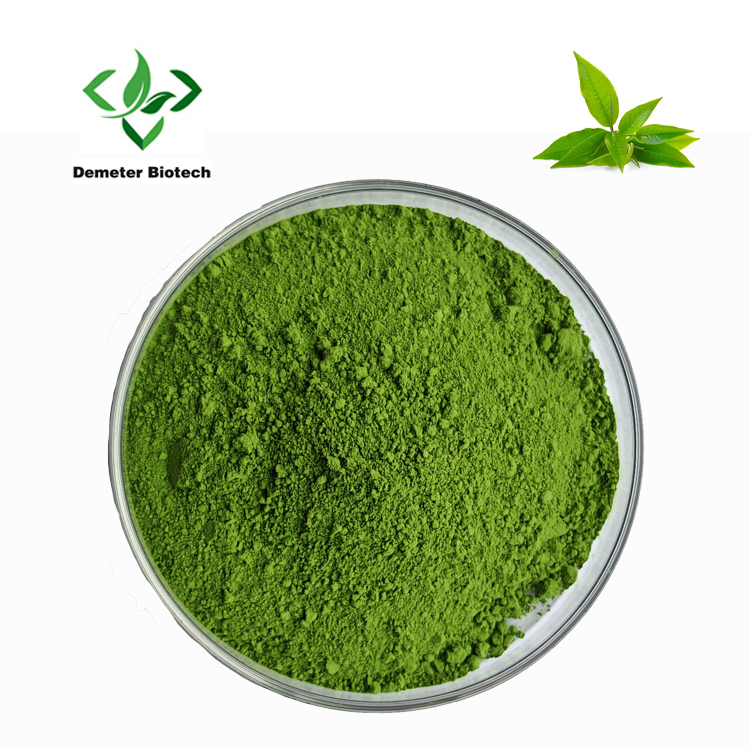
USDA & EU Organic Certified Ceremonial Matcha — A-10A
Shaded first-flush tencha from our own gardens, de-stemmed and de-veined, stone-milled below 40 °C, dual-certified USDA and EU Organic. Batch COA covers colour, particle size, L-theanine, the catechin profile, crude fibre and residue screen. Halal available; OEM and private label supported.
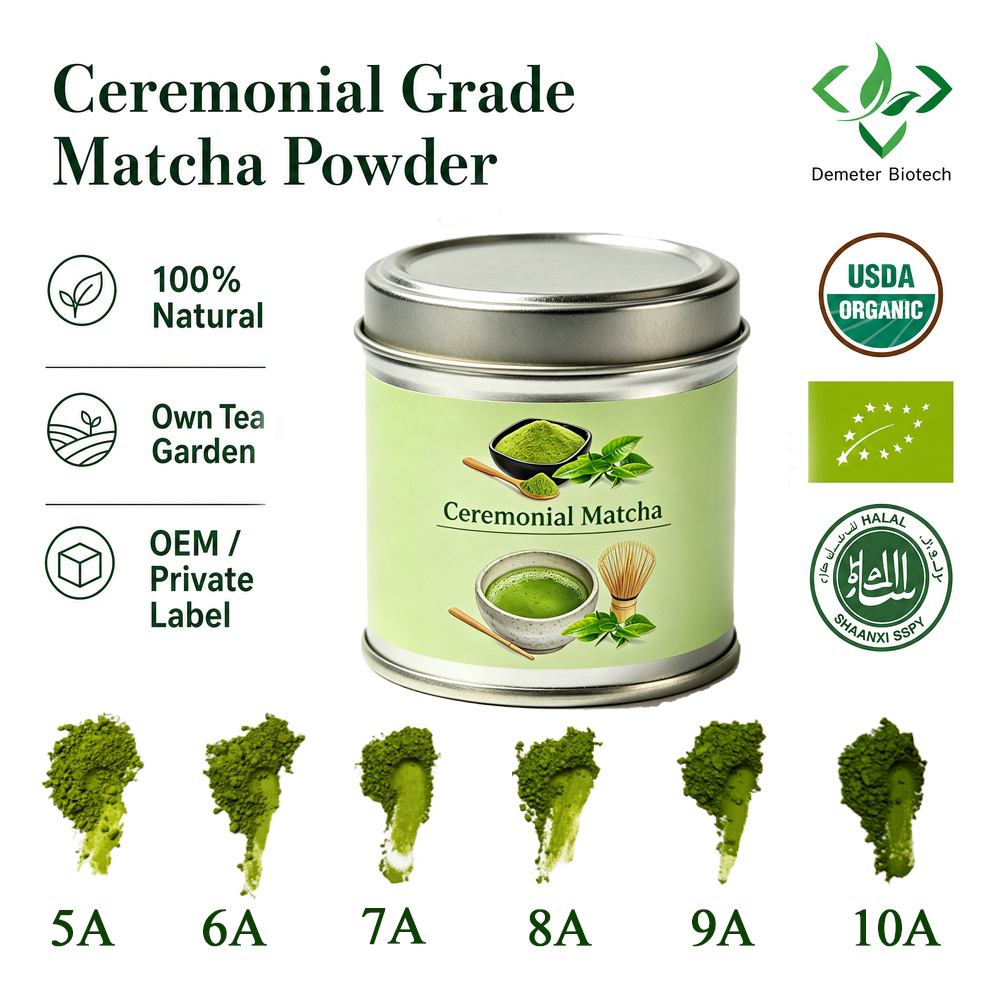
500–1500 Mesh Fine Ceremonial Matcha — Bulk Supply
The fine, free-flowing cut for RTD lines, blending and large-format repacking: 500–1500 mesh in the same organic specification, milled from de-stemmed tencha, with particle size and colour reported on every lot so your dispersion and hue targets can be checked against the actual batch.
References
- Schröder A, Laguerre M, Tenon M, Schroën K, Berton-Carabin CC. Natural particles can armor emulsions against lipid oxidation and coalescence. Food Chemistry. 2021;347:129003. doi:10.1016/j.foodchem.2021.129003
- Hasni I, Bourassa P, Hamdani S, Samson G, Carpentier R, Tajmir-Riahi HA. Interaction of milk α- and β-caseins with tea polyphenols. Food Chemistry. 2011;126(2):630-639. doi:10.1016/j.foodchem.2010.11.087
- Hirono H, Yamashita S, Hirono Y. Influence of steaming duration, chlorophyll-a and -b content and ratio, and pH on the color of green tea processed from multiple tea (Camellia sinensis L.) cultivars. Journal of the Science of Food and Agriculture. 2024;104(15):9410-9422. doi:10.1002/jsfa.13763
This article describes the physical and chemical behaviour of matcha powder in beverage systems, its composition and its sourcing documentation only. It is not a statement of efficacy or medical advice. Findings cited above are reported as the results obtained on the samples and systems those studies examined, including model dispersions and emulsions that differ from any commercial beverage, and are given as directions of change rather than as values for a specific lot. Dose bands are illustrative starting points for trial work and not a specification; processing, pH, protein system, thermal load and storage conditions all shift the outcome. The only figures that bind a lot are those on its batch certificate of analysis.
Post time: Nov-03-2026


