


Matcha in Baking & Confectionery: Dosing and Colour Stability
In a baked good, matcha is a pigment before it is a flavour. Change that one ordering and three otherwise puzzling facts line up: why the dose is set by colour rather than by taste, why the colour fails in ways no grade can rescue, and why the most reliable fix is not an ingredient at all.
Most baking briefs describe matcha as a flavour ingredient that happens to be green. In the oven the reverse is closer to the truth. Aromatics are volatile and are largely gone after a bake at 170–200 °C; the pigment is a solid that stays in the crumb, and keeps changing while it is there. What a customer judges first is therefore the colour, and colour is the one sensory attribute in a baked product that a formulator can design on paper. That is why culinary grade matcha dosing in bakery work is almost always set by target shade rather than by target strength — and why the colour failures in this category are structural rather than a matter of buying a better lot. At Demeter Biotech we stone-mill our own tencha and supply it into bakery and confectionery programmes, so the sequence below is the one we walk through with customers before a trial rather than after a complaint.
1. The dose is set by colour, and colour is a subtraction problem
Two things follow from reading matcha as a pigment first. The first is that the useful question is not “how much flavour do I want” but “how dark may this product become”. The second is that adding more powder does not move colour in the direction most people expect.
A cookie trial makes the point cleanly. When green tea powder was folded into wheat flour at 1, 2 and 4% of flour weight and baked into cookies, the lightness of the finished cookie fell from 53.63 in the control to 33.23 at 4%, the yellow-blue value b* fell from 29.02 to 24.39, and the red-green value a* rose from 3.61 to 5.23, in proportion to the amount added (Ahmad et al., 2015). Read that last figure twice. A higher dose of a green powder made the cookie more red, not more green.
The explanation is not mysterious once the two colour sources are separated. A baked crumb is already moving toward red and yellow through non-enzymatic browning and caramelisation, and the polyphenols in the powder are themselves oxidising to brown products. The chlorophyll green is being diluted by the added mass at the same time as it degrades, so it never accumulates the way the dose rises. What increases reliably is darkness.
That reframes the whole exercise. You are not buying green; you are buying the smallest loss of green that your process will allow, and then working out how far the resulting shade can be carried by the surrounding colour. A bakery brief that says “make it green” and a bakery brief that says “keep the shade inside a stated window after a stated bake” will select different powders and will have different arguments with their customer.
One more result from the same trial is worth carrying, because it rules out a tempting shortcut. Thermal analysis of the flour–tea blends showed no significant change in the onset temperature, end temperature or enthalpy of the flour when the powder was added. The tea is not changing the way the dough behaves thermally. Everything you see happening to the colour is chemistry inside the matrix, plus simple optical dilution — which means no adjustment to bake profile can be expected to rescue it, and no story about the powder “holding colour because of how it bakes” is grounded in anything.
2. Chlorophyll has two doors to pass through, and a bake opens both
The green in matcha is chlorophyll a and chlorophyll b: a porphyrin ring with a magnesium ion held at its centre. Replace the magnesium with two protons and you have pheophytin, which reads olive-brown. This is a specific chemical step, not gradual cosmetic fading, and the food-science literature has pinned down what controls its rate. Two findings matter most to a bakery, because they explain why the same powder behaves so differently in a cookie and in a sponge.
The first door is temperature, and it does not open at all below a threshold. In a kinetic study of green leaves heated in buffered systems, the conversion of chlorophyll to pheophytin only began above a threshold of 50–60 °C, behaved as a pseudo-first-order reaction, and — the part that matters commercially — ran at a rate proportional to the square root of the hydrogen-ion concentration (Haisman and Clarke, 1975). The authors explained the dependence through what heat does to the chloroplast itself: it collapses into a smectic mesophase that occludes the pigment, so the rate ends up being governed by how quickly hydronium ions can cross that interface, which in turn can be altered substantially by changing the interfacial potential.
That mechanism is worth more than the number, because it says the physical state of the material around the pigment is a control variable, not just the pH of the mix. Any process step that changes how accessible the pigment is — how finely it is dispersed, how much of it is embedded in a fat or a sugar glass rather than in free water — changes the rate. It also explains why a temperature threshold exists at all: below it, the chloroplast structure has not collapsed, so the proton has limited access.
The second door is water, and it opens earlier than most bakeries assume. In a study of chlorophyll degradation in a low- and intermediate-moisture spinach system, the authors reported that above a water activity of 0.32 the dominant mechanism of loss was conversion to pheophytin; the reaction showed first-order dependence on pH, on water activity and on pigment concentration; and adding glycerol, a water-binding agent, increased the rate of degradation (Lajolo and Lanfer Marquez, 1982). Two further observations in that paper are unusually relevant to confectionery. Above about 57 °C at low water activity the activation energy changed, indicating a different mechanism took over; and below 38 °C the rate tended to increase as temperature fell, because the sorption isotherm shifted and the sample took up more water at the lower temperature.
Read those together and the practical map becomes clear. Water activity is not a minor line in a specification for a matcha-bearing product; in a solid matrix it is one of the two variables that decide how fast the green goes. And “store it cold” is not automatically the safe answer, because in a humid environment a colder sample can hold more water and degrade faster. The colour your powder had when it left the factory is a separate subject, covered in our note on the tencha-to-matcha chain; from here on, the question is only what happens after it enters a dough or a batter.
3. Four matrices, two variables
Because the two doors are heat and water, the useful way to group bakery products is by how hard the process pushes on each, not by product category. Four groupings cover most of the work.
| Matrix | Heat load | Water activity | Where the colour is actually lost | What you can still do |
|---|---|---|---|---|
| Cookie, shortbread, wafer, biscuit | High surface temperature, short time; the centre rarely approaches oven temperature | Low, and falls further during the bake | In the thin surface layer, which browns first and most; the interior keeps more of its shade | The most forgiving matrix of the four — dose for the shade you want and accept a darker rim |
| Sponge, chiffon, muffin | Moderate oven temperature, longer time; the centre stays well below it | High, and drops slowly because the structure holds water | Throughout the crumb, because high water activity keeps the second door open for the whole bake and after it | Reduce water activity where the recipe allows, and count post-bake storage as part of the colour spec |
| Bread and laminated doughs | Long bake at high oven temperature | High, and the dough has already spent hours wet and mildly acidic before the oven | Partly before baking: a fermenting dough satisfies the water condition well ahead of the heat | Add the powder late in mixing, shorten the exposure, and do not expect a bright crumb |
| Coating, filling, drizzle, dusting | None to low — fat melting and setting, or no heat at all | Low at the start, rising as the product equilibrates with its surroundings | Slowly, and mostly through moisture migration from the crumb into the coating over shelf life | The only position in a bakery product that sits below the temperature threshold; the barrier between phases is the design problem |
The last row is the one worth arguing for in a product meeting. A compound coating, a ganache, a cream filling, a dusting applied after cooling — all of these keep the powder below 50–60 °C, which is the one condition under which the conversion has been shown not to start. Moving the matcha from the crumb into the coating is a bigger colour decision than changing grade or dose, and it costs no ingredient at all. What it does cost is a moisture-barrier problem: a water-rich crumb will hand water to a hydrophilic coating over weeks, and once the coating’s water activity rises past the point where the second door opens, the shade starts to go anyway. That is a packaging and shelf-life question, and it belongs in the trial plan from the start.
4. Both pH directions lead to brown
pH is the variable formulators reach for first, and in this system it is a trap, because the two colour-bearing fractions in matcha respond to it in opposite directions. This is the least intuitive part of the subject and the part most often got wrong in bakery notes circulating online.
Lowering the pH accelerates the loss of green directly. With the rate proportional to the square root of hydrogen-ion concentration, a fall of one pH unit makes the conversion roughly 3.16 times faster; two units, about ten times. That is arithmetic, not an estimate: the square root of ten is 3.16. Any acidic component — fruit acid, yoghurt powder, an acidic leavening system, an extended ferment — is therefore a direct multiplier on colour loss, before any consideration of the second fraction.
Raising the pH holds the green but browns the polyphenols. Alkalising agents, sodium bicarbonate among them, are a long-standing way to keep chlorophyll in processed green vegetables, and the reason is exactly the square-root dependence above. The problem is what the same pH does to the catechins. In pH-controlled model systems, the auto-oxidative browning of the four main tea flavan-3-ols in the pH range typical of tea preparations ran in the order EC > ECg > EGCg > EGC, and holding browning back in real tea required keeping the pH below about 4 (Tan et al., 2025). A further kinetic study of EGCG across pH 2.2–8.0 and 25–165 °C found stability falling with both rising pH and rising temperature, with rate constants spanning from 1.06 × 10⁻⁷ s−1 at the mildest condition tested to 8.83 × 10⁻² s−1 at the most severe, together with epimerisation to GCG that also accelerated with both variables (Xu et al., 2019). Those two endpoints move pH and temperature together, so the ratio between them is not a pH effect alone — but the direction is unambiguous, and it is the opposite of what chlorophyll wants.
There is one more consequence that is easy to miss. Because a* rose rather than fell as the dose went up in the cookie trial described in section 1, part of what looks like “less green” at higher doses may be brown products accumulating faster than green is being added. That is a reason to test a dose ladder on finished-product colour rather than on batter colour, and to measure the crumb as well as the surface.
5. Pairing: the chemistry behind the combinations that work
Pairing notes in this category tend to be written as taste folklore. Most of the reliable combinations have a chemical reason, and knowing the reason is what lets you extend the list to your own product instead of copying someone else’s menu.
| Partner | Why it works, chemically | Risk it carries |
|---|---|---|
| Butter, cream, white chocolate, milk powder | Fat and dairy protein associate with the polyphenols, which lowers perceived astringency; the light background also gives the green something to contrast against | Protein–polyphenol complexes contribute to staling and to a duller surface colour over shelf life |
| Red bean, chestnut, sesame, almond | Low-acid, low-water partners that add sweetness and a colour contrast without touching the matrix pH | Little; watch total water activity in pastes |
| Citrus, berry, yoghurt, cultured dairy | Bright acidity lifts a flavour that can otherwise read flat | The acid is a direct multiplier on chlorophyll loss — the flavour works and the colour pays for it |
| Cocoa, coffee, dark chocolate | Roast notes stand up to a strong green dose | Weak visual contrast, plus the astringency of both fractions adding rather than balancing; alkalised cocoa also raises matrix pH |
The practical rule is to decide, for each product, whether the acid is in the same phase as the powder. An acid cream layered against a matcha sponge keeps most of the two apart; an acidified matcha batter puts them in contact for the whole bake. Both are legitimate products; only one of them will still be recognisably green in month three. These are formulation and sensory observations about how the ingredients behave together, and nothing more.
6. Dose, and the three ceilings on it
Published bakery work on green tea powder generally sits in the 1–4% of flour weight range, which is the band used in the cookie trial cited above. Take that as a starting point for a trial, not a specification, and then find your own ceiling — because in this category the ceiling is set by three separate constraints, and whichever arrives first decides the dose.
The colour ceiling comes first in most products. At the top of the tested range, L* had fallen to the low thirties, which is a deep olive-grey rather than a green. Past that point more powder buys darkness, not more colour, and the product starts to look dusty.
The structure ceiling is the one bakeries discover late. In the same trial the powder significantly reduced the water absorption capacity of the flour and lowered the fracture force of the cookies, while retarding retrogradation of the gelatinised starch gel. In practice that means a dough that needs its water adjusted upward as the dose rises, a crumb that becomes more tender and more fragile, and a product whose staling behaviour has changed — three formulation consequences that arrive with the colour.
The taste ceiling is the familiar one: astringency accumulates faster than aroma does, so a dose chosen for maximum colour is usually past the point where the flavour is pleasant. This is where the partner table above earns its place, since a fat and protein background raises the amount of powder a product can carry before it reads harsh.
7. Six fields for a baking specification
A specification written for a bakery programme needs to describe two things that general food-powder specifications leave out: the colour of the powder measured in a way that is comparable, and the colour of the finished product under a stated bake. The first three fields belong to the powder; the last three belong to your process and are what turn a powder figure into an agreement.
| Field | What to record | What it protects you from |
|---|---|---|
| Colour baseline | L*, a*, b* read on a standardised aqueous dispersion at a stated concentration, not on the dry powder | Comparing two figures taken by two methods as though they were one quantity |
| Particle size and dispersion | Distribution and the wetting behaviour in a stated medium | Streaking and speckling in a low-water dough, which reads as a colour defect and is really a mixing one |
| Crude fibre or de-stemming statement | The figure, or an explicit statement that the tencha was de-stemmed and de-veined | Grit and dark specks in a fine crumb; the fibre figure is the proxy you can check without visiting the plant |
| Bake model | Oven temperature, time, tin or sheet, piece weight and target L* for the reference product | Two teams baking two different things and arguing about the powder |
| Colour after bake | ΔE and the retained a* between the unbaked mix and the baked product under the model above | Discovering the loss after a production run instead of in a 24-cookie trial |
| Colour after storage | The same readings after a stated time, temperature and light exposure, in the stated pack | A product that passes at the oven door and fails on the shelf |
The fifth and sixth fields are the ones that change behaviour, because they move the conversation from “what colour is your powder” to “what colour does my product end up”. A powder with a strong baseline figure and a poor retention figure is a worse buy than a slightly duller powder that holds what it has, and only a paired measurement shows which is which.
8. How Demeter supplies matcha for baking and confectionery
At Demeter Biotech we grow our own tencha in China, shade it before harvest, steam it, dry it flat without rolling, de-stem and de-vein it, and stone-mill it below 40 °C. For bakery work the two lines that matter most are the de-stemming and the milling cut, because both show up as visible defects in a fine crumb and neither can be fixed downstream. We report colour on a standardised dispersion, the particle size distribution and the crude fibre figure on a batch basis rather than as a single typical value, and we will run the bake model with you so that the ΔE line in the specification refers to a real process rather than a nominal one.
Tell us the matrix, the oven profile, the pH of the system and the shade you are targeting, and we will tell you which cut and which grade fits — and where the colour is likely to go before you commit to a production run.
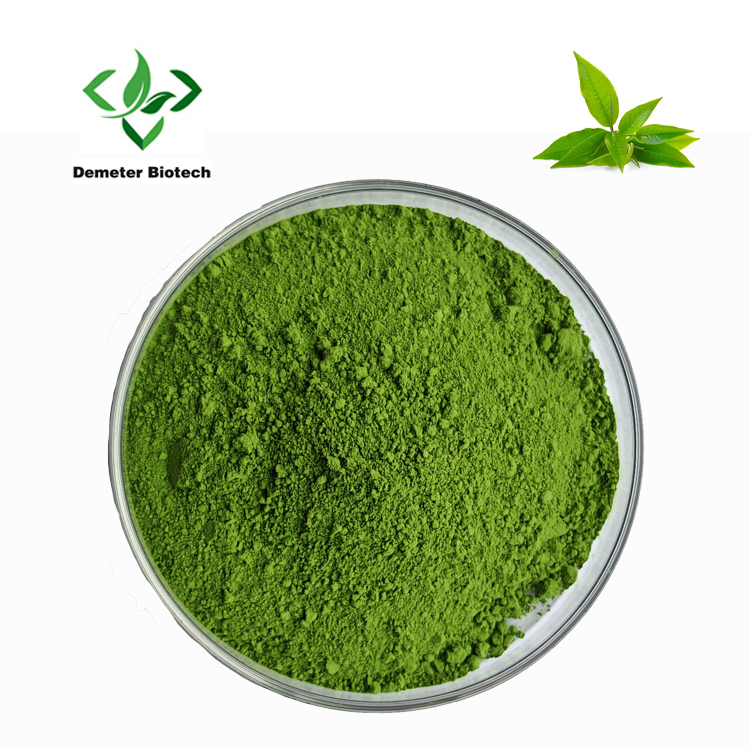
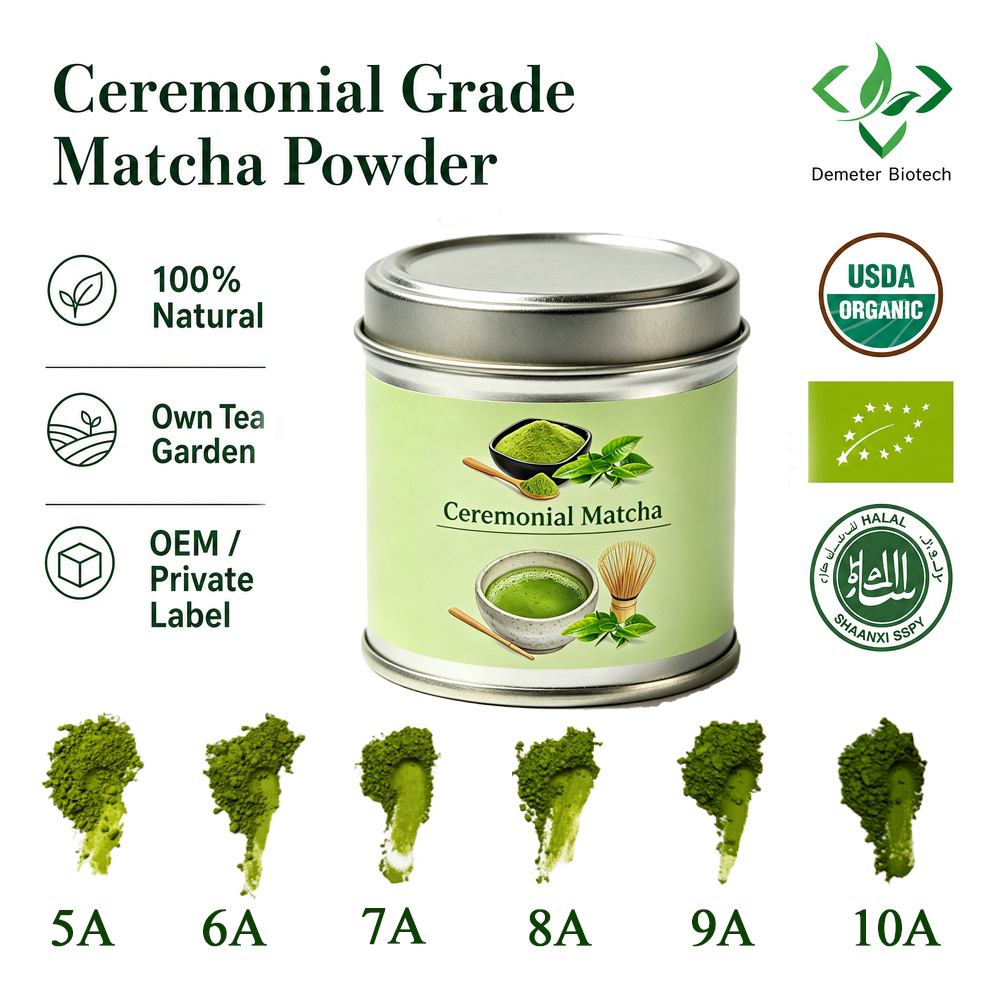
USDA & EU Organic Certified Ceremonial Matcha — A-10A
Shaded first-flush tencha from our own gardens, de-stemmed and de-veined, stone-milled below 40 °C, dual-certified USDA and EU Organic. Batch COA covers colour, particle size, L-theanine, the catechin profile, crude fibre and residue screen. Halal available; OEM and private label supported.
500–1500 Mesh Fine Ceremonial Matcha — Bulk Supply
The fine, free-flowing cut for bakery blending, dough incorporation and large-format repacking: 500–1500 mesh in the same organic specification, milled from de-stemmed tencha, with particle size, colour and crude fibre reported on every lot so your shade window can be checked against the actual batch.
References
- Haisman DR, Clarke MW. The interfacial factor in the heat-induced conversion of chlorophyll to pheophytin in green leaves. Journal of the Science of Food and Agriculture. 1975;26(8):1111-1126. doi:10.1002/jsfa.2740260809
- Lajolo FM, Lanfer Marquez UM. Chlorophyll degradation in a spinach system at low and intermediate water activities. Journal of Food Science. 1982;47(6):1995-1998. doi:10.1111/j.1365-2621.1982.tb12929.x
- Ahmad M, Baba WN, Wani TA, Gani A, Gani A, Shah U, Wani SM, Masoodi FA. Effect of green tea powder on thermal, rheological & functional properties of wheat flour and physical, nutraceutical & sensory analysis of cookies. Journal of Food Science and Technology. 2015;52(9):5799-5807. doi:10.1007/s13197-014-1701-3
- Xu YQ, Yu P, Zhou W. Combined effect of pH and temperature on the stability and antioxidant capacity of epigallocatechin gallate (EGCG) in aqueous system. Journal of Food Engineering. 2019;250:46-54. doi:10.1016/j.jfoodeng.2019.01.016
- Tan J, Vincken JP, Sanders MG, Lin Z, de Bruijn WJC. The influence of pH on auto-oxidative browning of flavan-3-ols and gallic acid as a promising browning inhibitor. Food Chemistry. 2025;473:143066. doi:10.1016/j.foodchem.2025.143066
This article describes the chemical and physical behaviour of matcha powder in baked and confectionery matrices, its composition and its sourcing documentation only. It is not a statement of efficacy or medical advice. The findings cited above are reported as the results obtained on the systems those studies examined — green leaves in buffered media, a spinach model system, cookies and aqueous catechin solutions — and are given as directions of change rather than as values for a specific lot or recipe. Dose bands are illustrative starting points for trial work and not a specification; water activity, pH, oven profile, piece size and storage conditions all shift the outcome. The only figures that bind a lot are those on its batch certificate of analysis.
Post time: Nov-05-2026


