



Matcha Buying Guide
Matcha Grades, Explained: Ceremonial, Culinary, Latte — and How B2B Buyers Actually Specify Them
When a buyer asks for “ceremonial grade” or “baking grade” matcha, they are using the language the market really speaks. These labels are useful shorthand — but they are not a legal standard. Here is what each one signals, the measurable specs that actually separate them, and how Demeter maps its own range so a label becomes a spec sheet.
Most inbound matcha inquiries do not open with “D50″ or “first flush.” They open with a word: ceremonial, culinary, or latte (sometimes called barista or café grade). That vocabulary is real, and it is how buyers, formulators, and procurement teams communicate intent. The catch is that none of these three terms is governed by a single legal definition. Japan’s JAS and international norms define what matcha is as a product — shade-grown tencha, steamed, dried without rolling, then milled — but they do not establish a ceremonial or culinary tier. So the practical question for a buyer is never “is this label real,” but “what does this supplier mean by it, and what numbers sit behind the name.”
1. What the three labels usually mean in procurement
Ceremonial / 仪式级. The label applied to powder intended to be whisked with water and drunk straight — usucha or koicha. Buyers specify it for premium drinking formats, gift sets, and brands that lead with “drink it pure.” Expect vivid green, a silky texture, and a mild umami character.
Latte / café / barista grade. A mid-tier powder chosen to stay recognizable through milk, sugar, and heat. Buyers use it for lattes, smoothies, and ready-to-drink products where dairy and sweetness mask delicate top notes. This is fitness-for-purpose, not inferiority.
Culinary / baking grade (烘焙级). A more robust, economical powder for baking, confectionery, ice cream, and savory recipes where matcha is one ingredient among many. Its color and strength must survive fat, sugar, and oven heat.
2. The properties that actually separate them
Because the labels are loose, the spec sheet — not the name — should drive the decision. Four measurable proxies matter:
- 1Particle size (D50). Stone-milled ceremonial-grade powder typically measures D50 ≈ 5–10 µm; latte grade ≈ 10–15 µm; culinary ≈ 15–30 µm. Finer powder disperses more smoothly in water and feels less sandy. (For reference, an 800-mesh commercial powder is ≈ 18 µm.)
- 2Harvest timing. First flush (一番茶, ichibancha), picked in spring after winter dormancy, carries the highest amino-acid load and the brightest color — the leaf most often sold as ceremonial. Later flushes trend toward latte and culinary use.
- 3Shade duration. Covering the bushes 20–30 days before harvest raises chlorophyll and amino acids while lowering bitter catechins. The biochemistry is documented: shade treatment increases theanine and caffeine accumulation and reduces catechin (polyphenol) content in the leaf (Chen et al., 2022; Lee et al., 2013).
- 4Color and umami as outcomes. More shade → higher L-theanine (the amino acid behind umami/savory character) and higher chlorophyll (vivid green). Less shade or later harvest → more catechins (astringency) and a duller color.
| Trade label | Typical D50 (µm) | Typical harvest | What buyers use it for | Color / texture expectation |
|---|---|---|---|---|
| Ceremonial / 仪式级 | ~5–10 | First flush, shaded 20–30 d | Whisked straight (usucha / koicha), premium drinking, gift | Vivid green, silky, mild umami |
| Latte / café / barista | ~10–15 | First or early flush | Lattes, smoothies, RTD through milk / sugar | Green holds through dairy, balanced |
| Culinary / baking (烘焙级) | ~15–30 | Later flush acceptable | Baking, confectionery, ice cream, savory | Robust, color survives heat / fat |
3. How Demeter organizes its own matcha range (internal classification)
RM (Regular / Manufacturing). Bulk raw-material matcha for food factories and blenders. Supplied by kg with a flexible specification, suited to formulations where matcha is one of several inputs.
EM (Europe-Standard). Matcha built for the EU market — broad pesticide-residue screening (600+ parameters), third-party COA from Eurofins / SGS, and the documentation buyers need to clear EU entry.
OM (Organic). USDA + EU organic certified matcha from our own tea gardens, with Halal available — for brands that lead with certified-organic positioning.
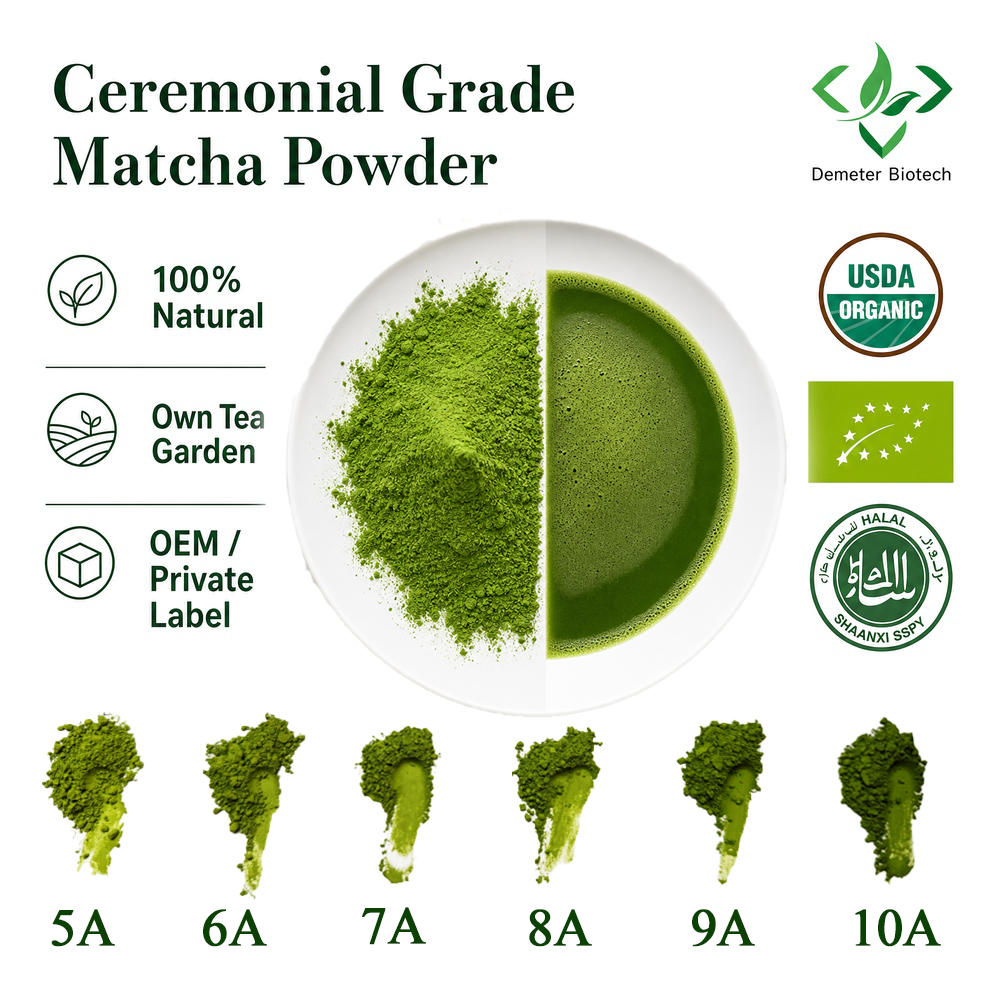
The takeaway for buyers: tell us the application (whisked drink, latte, or baked good), the certification (organic / Halal / EU residue screen), the particle-size target, and the color expectation — and we map you to the right RM / EM / OM supply.
4. A practical buying checklist
- 1State intended use first. Let the grade follow the function, not the other way around.
- 2Ask for the numbers. Request D50, harvest (first flush?), shade days, and a COA — not just a label.
- 3Match certification to market. USDA + EU organic for organic brands, EU residue screen for Europe, Halal for the Middle East.
- 4Validate in your recipe. Request a working sample and evaluate color, dispersion, and taste in the actual product (latte, batter, cube), not in water alone.
Grades are a starting vocabulary, not a finish line. The buyers who get consistent matcha are the ones who translate a trade label into a spec sheet — and who choose a supplier that can show the numbers behind the name. Explore Demeter’s matcha range →
References
- Chen X, Ye K, Xu Y, Zhao Y, Zhao D. Effect of Shading on the Morphological, Physiological, and Biochemical Characteristics as Well as the Transcriptome of Matcha Green Tea. International Journal of Molecular Sciences. 2022;23(22):14169. doi:10.3390/ijms232214169.
- Lee LS, Choi JH, Son N, Kim SH, Park JD, Jang DJ, Jeong Y, Kim HJ. Metabolomic analysis of the effect of shade treatment on the nutritional and sensory qualities of green tea. Journal of Agricultural and Food Chemistry. 2013;61(2):381–388. doi:10.1021/jf304161y.
This article describes agronomic and compositional properties of matcha as an ingredient. It is written for B2B buyers and formulators and does not make claims about effects on the human body. Internal tier names (RM / EM / OM) refer to Demeter’s own product organization and are not industry-standard grade definitions.
Post time: Sep-22-2026


