


Matcha for Cosmetics: What an Antioxidant Claim Actually Requires
Moving matcha from a food specification to a cosmetic one is not a matter of adding a line for appearance. The audit order inverts: microbiology comes first, the INCI name decides what the powder is allowed to be called, and the same polyphenols that make an antioxidant story possible are also the part of the formula most likely to turn brown in the jar. Here is what each of those conditions asks of the raw material, and what a claim needs underneath it before it is safe to print.
Cosmetic briefs arrive in a different grammar from food briefs. Nobody asks for a catechin percentage first. They ask for an INCI name, a microbiological specification, a colour reading on a standardised dispersion, and a particle size that will not feel gritty on skin. Those four questions tell you what kind of material this is: a whole leaf powder that will sit in a formula as particles plus a soluble fraction, whose colour and chemistry both move after it is in the jar. At Demeter Biotech we mill shaded tencha and ship it into food and cosmetic programmes from the same gardens, and the conversation changes completely once a customer crosses that line. This article sets out what changes, in the order the problems actually arrive.
1. The first audit is microbial, and the limit is an order of magnitude tighter than food
A leaf powder carries the microbiology of a leaf. Milling multiplies the surface area and adds the handling steps, so a matcha that is entirely acceptable as a food ingredient can be a failed cosmetic raw material without anything about the leaf having changed. Cosmetics are not required to be sterile, but they are held to a numeric limit, and that limit is set at a level most food specifications never have to reach.
The relevant reference is ISO 17516:2014, Cosmetics — Microbiology — Microbiological limits. It divides products into two categories and sets a total aerobic mesophilic count for each, then requires the absence of four named organisms.
| Organism or count | Eye area, mucous membranes, children under three | All other products |
|---|---|---|
| Total aerobic mesophilic microorganisms (bacteria plus yeast and mould) | ≤ 1 × 10² CFU per g or ml | ≤ 1 × 10³ CFU per g or ml |
| Escherichia coli | Absence in 1 g or 1 ml | Absence in 1 g or 1 ml |
| Pseudomonas aeruginosa | Absence in 1 g or 1 ml | Absence in 1 g or 1 ml |
| Staphylococcus aureus | Absence in 1 g or 1 ml | Absence in 1 g or 1 ml |
| Candida albicans | Absence in 1 g or 1 ml | Absence in 1 g or 1 ml |
Two footnotes in that standard matter more than they look. The first is that the plate count method has inherent variability, so a result is read as out of limit only above 2 × 10² CFU per g or ml for the stricter category and above 2 × 10³ for the other, following the interpretation rules given in the official compendial methods. The second is that the standard does not demand an absence of all microorganisms; what it demands is that unspecified organisms are not able to grow in the finished product, which is established either through a preservation efficacy study or by showing the product cannot support growth. That distinction is where a raw material and a formula have to be designed together, because a botanical powder enters the jar carrying a load, and whether that load can proliferate depends on the water in the formula rather than on the powder alone.
The practical consequence for buying is blunt. A certificate written to a food specification commonly reports a total plate count against a limit several orders of magnitude looser, and it does not report the four named organisms at all, because food specifications are not organised around them. Printing that certificate into a cosmetic technical file does not make the material compliant with anything; it just moves the gap downstream to a stability or safety assessment, where it is far more expensive to close. If a cosmetic programme is planned, ask for a microbiological panel written to the cosmetic limits, on the lot, with the method named — and be aware that the count is a property of the lot and the season, so a single historical result does not carry forward automatically.
What can be done about a high count is a separate conversation with trade-offs rather than a switch. Anything that reduces microbial load by heating will also cost colour, because the green of a matcha is a pigment system with its own temperature tolerance. Irradiation and comparable processes carry their own regulatory position in the destination market and their own labelling consequences, which have to be checked per market rather than assumed. Process hygiene, controlled atmosphere and packaging are the levers that do not touch the product, and they are the reason a milled leaf intended for cosmetics is normally produced and packed on a line dedicated to that purpose rather than swept up from a food run.
2. The INCI name is a leaf powder, not an extract — and the database files it as an exfoliant
The second condition is naming, and it is more consequential than it sounds, because in cosmetics the name on the ingredient list is a regulatory identity rather than a description. Three different materials can all be honestly derived from the same plant, and they appear on a label as three different entries.
| INCI entry | What it physically is | What it implies on a label |
|---|---|---|
| Camellia Sinensis Leaf Powder | The dried leaf, ground. Nothing removed, nothing concentrated. | Insoluble particles in the formula, plus whatever dissolves out of them. This is what a matcha is. |
| Camellia Sinensis Leaf Extract | A liquid or powder obtained by extracting the leaf with a solvent. | A soluble fraction. It can be standardised and it can be clear in a formula. |
| Camellia Sinensis Leaf Water | The aqueous phase of a distillation or infusion. | A water-soluble fraction with essentially no particles. |
Matcha belongs in the first row and only the first row. It is the whole leaf, milled, with the veins and stems taken out and nothing extracted. Writing it as an extract on a label is not a shorthand for the same thing; it names a material that was processed differently and that a formulator would dose differently, because an extract dissolves and a powder does not.
There is a further detail that surprises formulators who look it up. In the European Commission’s CosIng inventory, the official entry for Camellia Sinensis Leaf Powder carries exfoliating as its registered function. That is not a judgement on the powder and it is not a downgrade; it is a description of the mechanical role a milled leaf plays when it is rubbed on skin, and it is the role the database has assigned to the name. What it does mean is that the entry will not do any work for you. An INCI name establishes identity, not a claim. Nothing in the inventory entry supports an antioxidant statement, and a marketing submission that cites the ingredient listing as its evidence has cited the wrong document.
So the naming question has a clean answer and an uncomfortable one. Clean: buy the powder as a powder, list it as a powder, and do not let a trading name drift into extract language on the artwork. Uncomfortable: if a formula needs a transparent serum with no sediment and a defined marker content, a milled leaf will not deliver it, and no amount of specification writing will change that. The material that does deliver it is an extract, which is a different purchase and a different claim file.
3. In an emulsion, matcha is both an antioxidant and a substrate for oxidation
Here is the part of the cosmetic conversation that gets skipped most often. Catechins are reducing agents. That is the property the antioxidant story is built on, and it is also the reason a formula containing them can discolour. A reducing agent reacts with oxygen, and if it is the most available reducing agent in the jar, it will be consumed protecting everything else — including the water, the emulsifier and the other actives. The chemistry does not distinguish between an oxidation you wanted stopped and the polyphenol itself being oxidised into a coloured product.
The measured behaviour of one of those catechins gives the useful picture. In a citrate buffer system studied across pH 4 to 7 and dissolved oxygen from 0 to 7.59 mg/L, the degradation of epigallocatechin gallate followed pseudo-first-order kinetics, and the rate constant rose log-linearly with both pH and dissolved oxygen concentration. Temperature dependence was modelled by an Arrhenius relationship, with an average activation energy of 18.7 ± 1 kcal/mol, and the three variables were combined into a predictive model (Zimeri and Tong, 1999).
Read that as a statement about multipliers rather than about a shelf life. Three independent variables each push the same reaction, and none of them substitutes for another: lowering the temperature does not compensate for a high dissolved oxygen level, and degassing a batch does not compensate for a pH that sits in the wrong place. A formulator who controls one of the three has controlled a third of the problem.
| Variable | What the evidence shows | What a formula can actually do about it |
|---|---|---|
| Dissolved oxygen | Rate rises log-linearly with oxygen concentration across 0–7.59 mg/L in a buffered model system. | Reduce aeration at homogenisation, minimise headspace, consider inert gas on filling, and read an airless pack as a reduction in exposure rather than as an absence of oxygen. |
| pH | Same log-linear rise across pH 4 to 7 in the same system. | Choose the finished-formula pH against measured retention in that formula, not against a number copied from another product. Measure pH after everything is in, and track it in storage rather than at day zero. |
| Temperature | Arrhenius behaviour, average activation energy 18.7 ± 1 kcal/mol. | Add the powder during cool-down rather than into the hot water phase, and count any hold at elevated temperature as a loss with a calculable size. |
There is a fourth factor that is not in that model and that matters in real formulas: transition metals. Polyphenols form coloured complexes with iron and copper, which is why a trace-metal contribution from water, from a pigment, or from a steel contact surface can darken a batch that was otherwise well controlled. Chelation is the standard countermeasure, but the chelator has to be tested in the actual formula against a matched control, because a chelator changes pH, changes preservation and sometimes changes viscosity, and one instability solved by creating another is not progress.
The conclusion is uncomfortable for a marketing team and useful for a formulator. Adding matcha does not make a formula more oxidation-resistant in any general sense. It adds a reactive solid phase that will consume oxygen, and it adds particles with a large surface area and a water-soluble fraction that can migrate into the continuous phase. Whether the net effect is protective, neutral or damaging depends on dose, on the oxygen budget, on pH and on what else is competing for the same oxygen. A well-designed formula protects the matcha; it is not the matcha that protects the formula.
4. Heat does not only remove catechins, it converts them
The second piece of chemistry is about what the word “loss” means. In the same aqueous system studied from 25 °C to 165 °C and modelled in two ranges, epigallocatechin gallate did not simply disappear as it degraded. It epimerised, converting to its stereoisomer gallocatechin gallate, so the two compounds interconverted and the reaction kinetics of degradation and epimerisation were established together rather than separately. At the higher temperatures in that range, the converted form became the more abundant of the two catechins (Wang, Zhou and Jiang, 2008).
For a specification this changes what you are buying when you buy a retention figure. If an assay reports that a percentage of the starting epigallocatechin gallate remains, an unknown part of the rest may be sitting in the jar as a different catechin rather than having left the product. That is not a reason to distrust the assay; it is a reason to ask what the assay was asked to measure — a single compound, a sum of catechins, or the total polyphenol figure — because the three can move in different directions. A formula that looks like it lost a third of its target compound may have lost much less of its total catechin content, and the colour may have shifted anyway, since the coloured products of these reactions are not the same molecules as the ones the assay was counting.
That has a process consequence that is easy to write into a batch record. The point at which the powder is charged decides how much of the two temperature ranges the material ever sees. Charged into a hot water phase, it passes through the high range and the kinetics of that range apply, including the conversion. Charged during cool-down into a pre-dispersed slurry, it sees the lower range only. Neither option is free: a cool-down addition risks uneven dispersion and particulates if the powder is not wetted properly first, which is why the usual practice is to pre-disperse in a portion of the water or a glycol and add that slurry rather than the dry powder. What should not happen is a batch record that specifies a temperature without specifying the stage, because the same number can describe two very different exposures.
The boundary with the baking article is worth marking, because both are about heat and colour and they are not the same problem. There, the material was a minor component inside a solid matrix, and the pigment was being asked to survive a bake and a water activity it could not avoid. Here, the material is a particulate phase in a liquid, and what is at stake is the chemistry of the polyphenols in the continuous phase over a shelf life. Different variables, different levers, and a specification that mixes the two will ask for the wrong tests.
5. What an antioxidant or anti-inflammatory claim has to stand on
Both terms are usable. Both are also load-bearing, which means both have to rest on something specific, and the first thing to establish is that the something is a measurement rather than a category.
The antioxidant capacity of a botanical is not one number. Methods fall into families that work by different chemistry — some measure the transfer of an electron to a radical, others measure the transfer of a hydrogen atom — and the reaction kinetics differ between them. A review of the standardised methods in this field sets out that comparison directly, and its practical message is that results from different assays are not interchangeable and cannot be converted into one another; even the total phenolic figure obtained with the Folin–Ciocalteu reagent measures the reducing capacity of the sample against a gallic acid calibration, which is not the same quantity as a radical-scavenging result (Prior and Schaich, 2005).
So a claim built on “high antioxidant activity” without a method name is not a weak claim; it is an unverifiable one. What makes it verifiable is a small, boring package: the assay named, the sample preparation described, the calibration standard stated, the result with its units, and the lot it applies to. That package can be produced for a powder, and it will be different for the same powder measured by a different method — which is why the method name belongs on the same line as the number rather than in a footnote.
The anti-inflammatory term needs one more layer of honesty, and it is not a chemical one. What the literature records for catechins in this respect comes from laboratory and animal work on defined systems. That is where the evidence sits, and it should be described that way, without being carried across into a statement about what happens on a person. A cosmetic claim in the European Union is governed by common criteria requiring that it be supported by adequate and verifiable evidence, be truthful and not misleading; those criteria bind the party making the claim, which is the brand that puts it on the pack, not the party that supplied a drum of powder. A raw material certificate is evidence of composition. It is not a substantiation dossier for a label statement about skin.
There is also a formulation point that is easy to get backwards. A gentler product is not produced by adding an ingredient whose extracts have been studied for anti-inflammatory properties. Irritation in a cosmetic usually comes from the surfactant system, the preservative, the fragrance or the pH, and a botanical powder does not offset any of those; it adds a particulate phase, a colour and a microbiological load that the preservative system now has to carry. If the aim is a formula that behaves gently, the work is in the base. The matcha then sits on top of that decision rather than substituting for it.
6. Six fields that belong in a cosmetic-grade specification
Assembling the previous four sections gives a purchasing specification that looks quite unlike the food version of the same document. Six fields carry most of the weight.
| Field | Why it binds the product | What to write |
|---|---|---|
| INCI identity | The label entry is a regulatory identity, and the wrong entry names a different material. | Camellia Sinensis Leaf Powder, with the botanical part and the preparation consistent with that name. |
| Microbiological panel | The cosmetic limit is numeric and much tighter than the food limit, and it is lot-specific. | Total aerobic mesophilic count against the applicable category of ISO 17516, with absence of the four named organisms in 1 g, and the test methods named. |
| Particle size and dispersion | Determines whether the powder reads as smooth or gritty, how fast it wets out, and how evenly colour develops. | A distribution with a method (mesh or laser diffraction, stated), and how the powder behaves when dispersed in the intended phase. |
| Colour on a standardised dispersion | Colour is the first thing a consumer judges and the first thing storage changes. | L*a*b* readings on a defined dispersion at a defined concentration, not a photograph and not an adjective. |
| Moisture or water activity | Water drives both microbial proliferation and the chemical routes above, and it moves after milling. | A value with the method named and the point in the process where it was measured. |
| Polyphenol and catechin data | This is the raw material for any claim, and its value depends entirely on the method. | Total polyphenols with the calibration standard, the catechin profile by HPLC, and any antioxidant result with its assay named. |
Two fields that food specifications expect are worth a comment. A catechin percentage written as a guaranteed minimum is the least reliable line in a cosmetic specification for the same reason it is unreliable anywhere: it invites a material to be selected for a number rather than for what it is. And a specification that stops at appearance has stopped one field too early, because a powder can look right and still carry a load the preservative system was never designed for.
7. How Demeter supplies matcha for cosmetic programmes
At Demeter Biotech we shade our own tencha before harvest, steam it, dry it flat without rolling, de-stem and de-vein it, and stone-mill it below 40 °C. For cosmetic programmes we supply the milled leaf as Camellia Sinensis Leaf Powder, and we report on a lot basis what a formulator needs to design around: particle size distribution with the method stated, colour on a standardised aqueous dispersion, moisture or water activity with the measurement point named, and a microbiological panel written to the cosmetic limits rather than to a food limit. Where a claim is planned, we supply the analytical package behind it and name the methods, so the numbers can be defended rather than repeated.
Tell us the format you are making — a wash-off mask, an anhydrous powder, an emulsion, a scrub — the phase you intend to charge the powder into, the pH you expect at the end, and whether the product will be preserved. We will tell you which cut wets out cleanly in your phase, where the microbiological specification has to sit for your category, and where the colour is likely to move first.
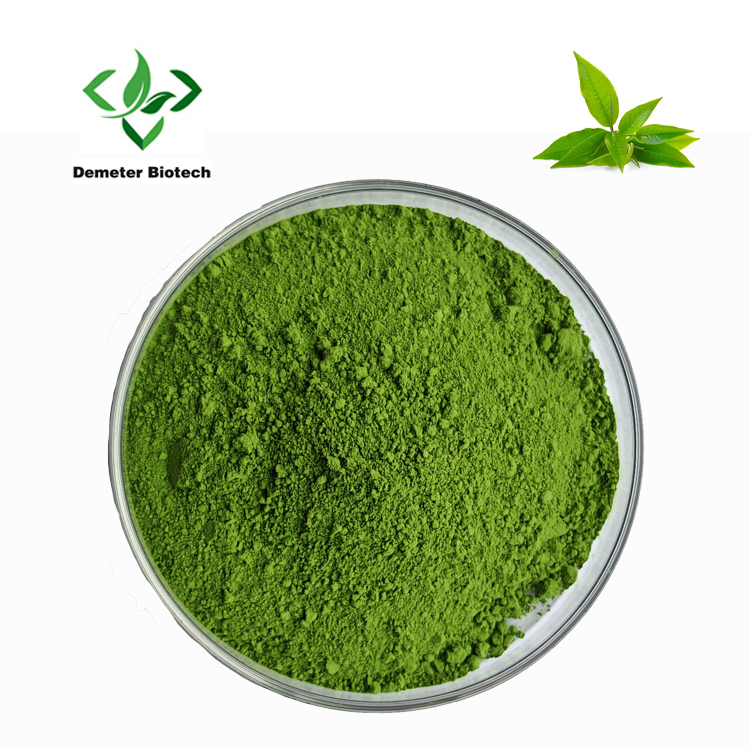
USDA & EU Organic Certified Ceremonial Matcha — A-10A
Shaded first-flush tencha from our own gardens, de-stemmed and de-veined, stone-milled below 40 °C, dual-certified USDA and EU Organic. Batch COA covers colour on a standardised dispersion, particle size, moisture, the catechin profile and the residue screen. Halal available; OEM and private label supported.
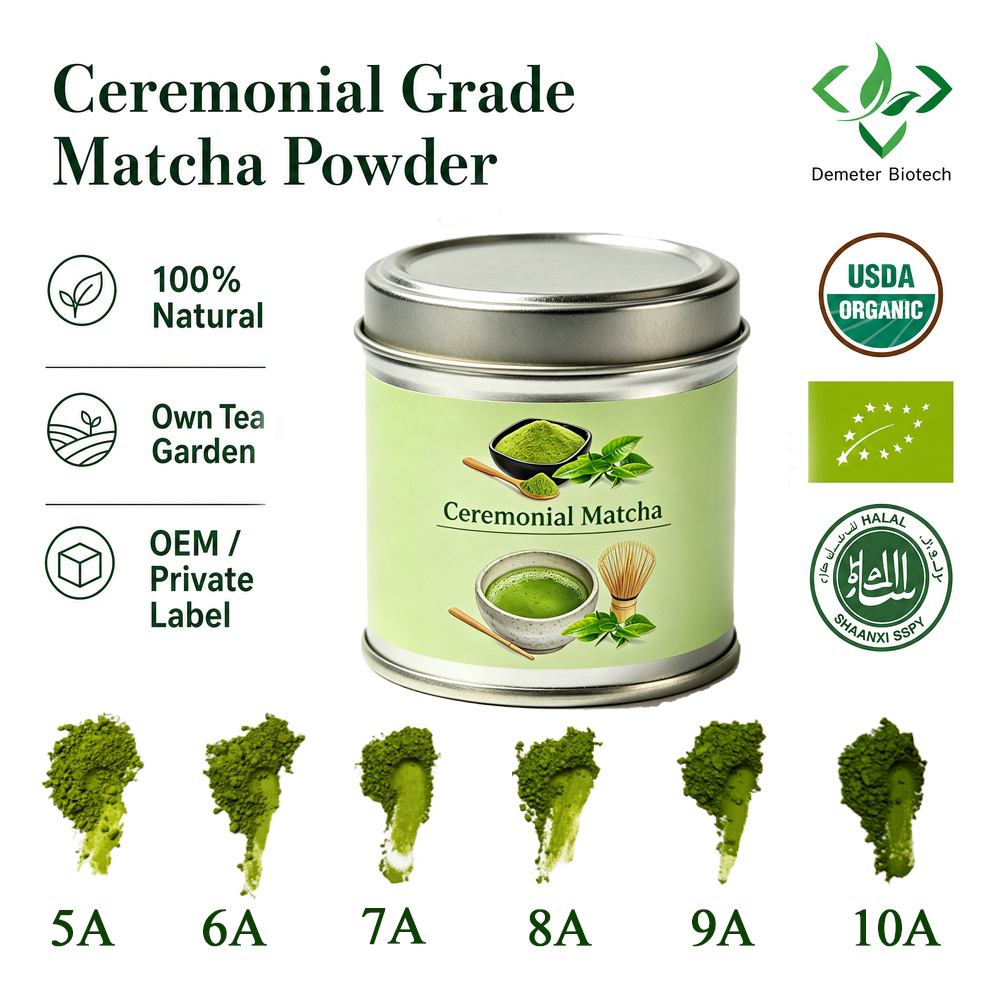
500–1500 Mesh Fine Ceremonial Matcha — Bulk Supply
The fine, free-flowing cut for cosmetic and food programmes: 500–1500 mesh in the same organic specification, milled from de-stemmed tencha, with particle size, colour and moisture reported on every lot so a dispersion can be designed rather than corrected after the first batch.
References
- Zimeri J, Tong CH. Degradation kinetics of (−)-epigallocatechin gallate as a function of pH and dissolved oxygen in a liquid model system. Journal of Food Science. 1999;64(5):753-758. doi:10.1111/j.1365-2621.1999.tb15905.x
- Wang R, Zhou W, Jiang X. Reaction kinetics of degradation and epimerization of epigallocatechin gallate (EGCG) in aqueous system over a wide temperature range. Journal of Agricultural and Food Chemistry. 2008;56(8):2694-2701. doi:10.1021/jf0730338
- Prior RL, Schaich K. Standardized methods for the determination of antioxidant capacity and phenolics in foods and dietary supplements. Journal of Agricultural and Food Chemistry. 2005;53(10):4290-4302. doi:10.1021/jf0502698
- ISO 17516:2014. Cosmetics — Microbiology — Microbiological limits. International Organization for Standardization, Geneva.
This article describes the composition of matcha powder, its behaviour in cosmetic formulation, and the documentation a lot can carry. It is not a statement of efficacy and it is not advice on use. The studies cited are reported as the results obtained on the systems they examined — a buffered model system at defined pH and dissolved oxygen, a dilute aqueous system across a temperature range, and a comparison of analytical methods — and are given as directions of change rather than as values for a specific lot, formula or pack. Microbiological limits quoted are those of the standard named and are not a substitute for testing the material and the finished product in the market where they will be sold. The only figures that bind a lot are those on its batch certificate of analysis.
Post time: Nov-12-2026


