


Matcha Cultivars Compared: Yabukita, Samidori, Asahi, Gokou and Beyond
A cultivar is the genetic identity of the tea plant — the starting point for every flavour and composition number on your specification. Here is how the names you hear in quotes actually map to what you buy.
When a tea garden lists a cultivar name on a quote, it is naming the clone of Camellia sinensis that grew the leaf. Cultivars are propagated by cutting rather than seed, so every plant of a given cultivar carries the same genetics and therefore the same baseline chemistry. That genetic ceiling sets how much L-theanine, how many catechins and how much chlorophyll the leaf can hold before shading, milling or grading ever enter the picture. For a B2B team building a formulation or a private-label line, the useful question is not “which cultivar is best” — it is “which cultivar profile does my specification need, and can I verify it on the COA regardless of the name?” At Demeter Biotech we mill matcha from our own China gardens and report the full composition on every batch, so the cultivar mix never becomes a black box. Below is the cultivar map, the chemistry that makes names meaningful, and how to write cultivar intent into a buying spec.
1. What a cultivar is — and what it is not
A cultivar (short for “cultivated variety”) is a tea plant selected and bred for specific traits, then cloned by cutting so the trait stays stable across generations. All the famous Japanese matcha names — Yabukita, Samidori, Asahi, Gokou, Okumidori, Saemidori — are cultivars developed within Camellia sinensis var. sinensis. Two points matter for a specification:
Cultivar is the genetic floor, not the finished product. Genetics decide the leaf’s potential amino-acid and catechin balance; shading, harvest timing, steaming and milling then move the actual numbers. We cover shading as a separate lever in another article — the point here is that two leaves of different cultivars, shaded identically, will still finish with different chemistry because their starting genetics differ.
Cultivar is not a grade. “Samidori” tells you the plant’s family, not whether the powder is ceremonial or culinary. Grade is set by measured specification — particle size, colour and amino-acid content — which any cultivar can reach or miss depending on how it was farmed and processed.
2. The six cultivars you will hear named
The descriptions below are the common trade character attributed to each cultivar in Japanese tencha literature — they are general industry descriptions of flavour and typical role, not measured laboratory values. The only numbers that bind a lot are those on its batch COA.
| Cultivar | Home region | Trade character (flavour & chemistry) | Typical role in matcha |
|---|---|---|---|
| Yabukita | Japan (Shizuoka-led); dominant | Hardy, high-yielding, balanced with moderate astringency; the workhorse plant | Backbone of many blends; rarely a single-name ceremonial leaf |
| Samidori | Uji (Kyoto) | Vivid green, naturally sweet, low astringency, amino-acid-leaning | Prized for premium matcha and gyokuro |
| Asahi | Uji (Kyoto) | Very high umami and sweetness, low astringency, bright green | Competition-grade; low yield, demanding to grow |
| Gokou | Uji (Kyoto) | Deep umami, rich colour, distinctive covered aroma; premium | Traditional gyokuro / matcha cultivar; rare, high value |
| Okumidori | Japan (multiple regions) | Vibrant colour, delicate sweetness, minimal astringency; strong shading response | Widely used for high-grade matcha |
| Saemidori | Japan (Kagoshima-led) | Bright, approachable, high amino acids; lighter yellow-green hue, not dark | Increasingly sold as single-cultivar matcha |
3. Why the names matter: cultivars carry different chemistry
Cultivar names are not marketing decoration — they correspond to measurable chemical differences. A 2022 study comparing two green-tea cultivars by NMR found that ‘Yabukita’ carried higher epicatechin, while ‘Yutakamidori’ carried higher theanine and caffeine, confirming that genetics alone shifts the amino-acid-to-catechin balance of the leaf (Santos et al., 2022, Food Chemistry). A 2017 survey went further: across 21 cultivars of Camellia sinensis, each showed a distinct catechin-derivative pattern, and a chemometric model could tell all 21 apart from their chemistry alone (Fang et al., 2017, Food Chemistry).
The practical takeaway for your specification: if you need a leaf that leans amino-acid-rich (sweeter, lower astringency) you are implicitly asking for a high-theanine cultivar profile; if you need a more astringent, catechin-forward leaf, the genetics point the other way. Shading then amplifies or trims whichever direction the cultivar already leans — which is exactly why the shading story and the cultivar story are two separate dials on the same leaf.
| Measured finding | What the study showed | What it means for your spec |
|---|---|---|
| Cultivar shifts the amino-acid / catechin balance | Yabukita higher in epicatechin; Yutakamidori higher in theanine and caffeine (Santos et al., 2022) | Name the chemistry you need, then confirm it on the COA |
| Cultivars are chemically distinguishable | 21 cultivars each showed a unique catechin-derivative pattern; a model separated all 21 (Fang et al., 2017) | Cultivar declaration is a verifiable, not a decorative, claim |
| Harvest season also moves the numbers | Fang et al. (2017) found harvest time changed EGC, theanine and afzelechin gallate abundance | Cultivar plus picking time together set the lot — both belong on the spec |
4. Single-cultivar vs blend: the B2B reality
Most commercial matcha on the market is a blend. A mill will often build the base from a high-yield, hardy cultivar such as Yabukita and layer in a smaller proportion of a character cultivar — Samidori, Gokou or similar — to set the colour and sweetness. This is normal and not a quality problem; it is how consistent volume and a stable profile are achieved at scale. A single-cultivar matcha is the premium, traceable exception: one named clone, one predictable profile, and a higher price that reflects lower yield and tighter farm control.
The choice is therefore a specification decision, not a status decision. If your product needs a specific, repeatable amino-acid-to-catechin balance and you want to name the source plant, single-cultivar with a COA is the right call. If your product needs consistent, certifiable numbers at volume, a well-controlled blend specified by chemistry is the more reliable path — and the cultivar mix stops mattering the moment every lot is certified against the same numbers.
5. Writing cultivar intent into a purchase order
Three lines capture cultivar intent on a specification:
| Parameter | What to write | Why |
|---|---|---|
| Chemistry target | Specify the amino-acid / catechin balance and the method | This is the part genetics and shading actually deliver; verify it per lot |
| Cultivar declaration | Require a named cultivar only if traceability is the point | A declared cultivar is verifiable; an undeclared blend is fine if the COA carries the numbers |
| Lot verification | Request the full panel — EGCG, EGC, total catechins, L-theanine, colour, residues — on every lot | The only figures that bind a lot are those on its COA, whatever the plant’s name |
If cultivar traceability is part of your brand story, say so in the order and we will declare it and certify the lot against your chemistry target. If it is not, we will hold the same numbers on a controlled blend and save you the single-cultivar premium.
6. How Demeter supplies matcha you can verify
At Demeter Biotech we grow and mill matcha from our own gardens in China and pack in light-shielded barrier bags to hold the green. Tell us the chemistry target, the certification you need — USDA Organic, EU Organic or Halal — and whether cultivar traceability matters, and we will confirm the batch figures on the COA before the container leaves.
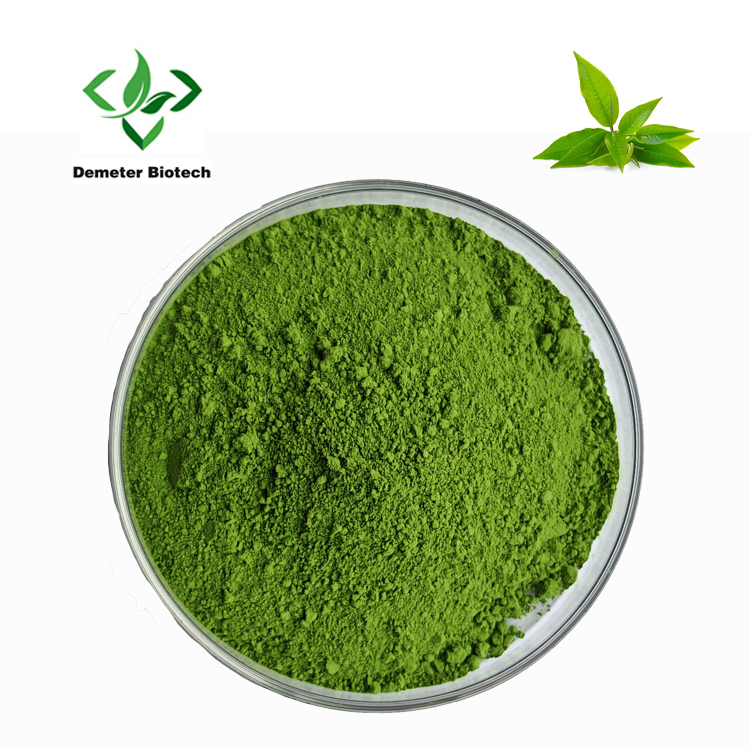
USDA & EU Organic Certified Ceremonial Matcha — A-10A
Shaded first-flush tencha from our own gardens, stone-milled below 40 °C, dual-certified USDA and EU Organic. Batch COA covers EGCG, the catechin profile, L-theanine, colour, residue screen and particle size. Halal available; OEM and private label supported.
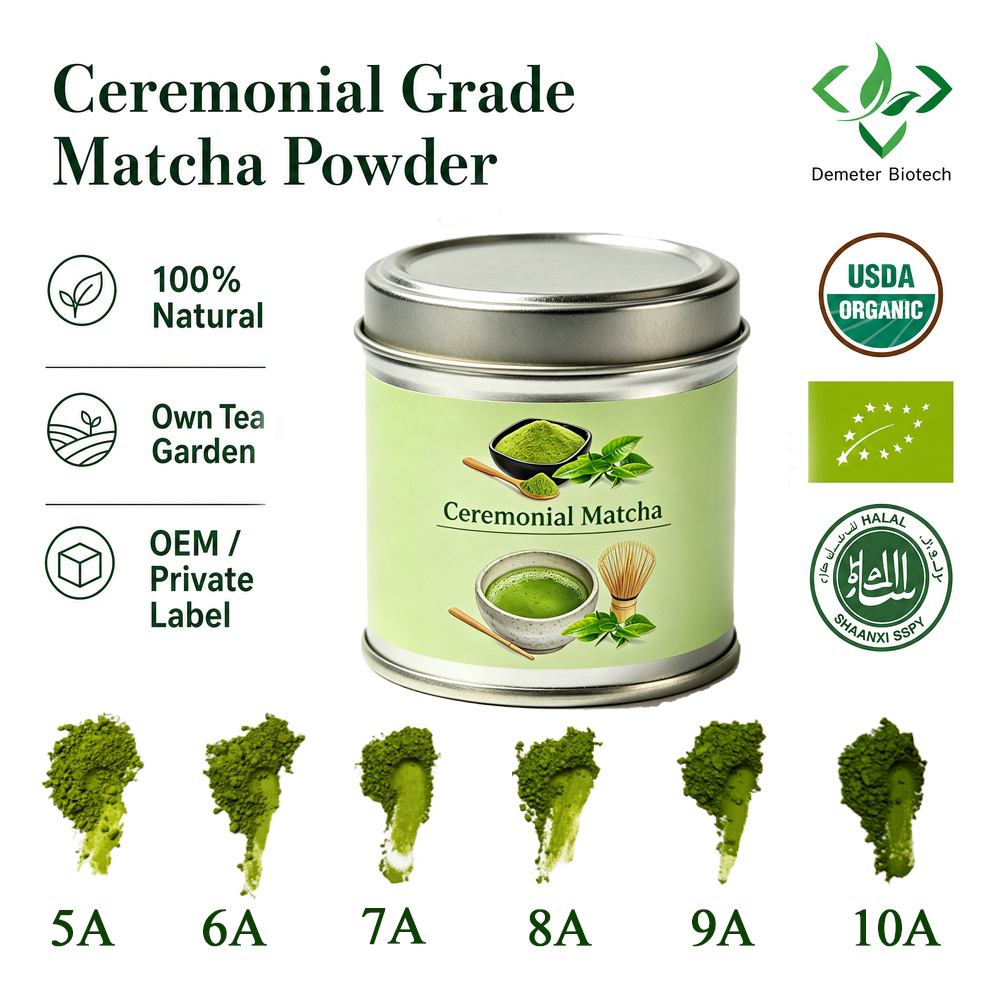
500–1500 Mesh Fine Ceremonial Matcha — Bulk Supply
The fine, free-flowing cut for RTD lines, blending and large-format repacking: 500–1500 mesh (roughly 10–25 µm) in the same organic specification, with the catechin profile and L-theanine reported on every lot for your composition work.
Send us your chemistry target, your certification list and your cultivar question, and we will map the right lot and confirm the numbers on the COA before you commit — so the leaf you specify is the leaf you receive.
References
- Santos MdFC, Rech KS, Dutra LM, Menezes LRdA, Barison A. 1H HR-MAS NMR chemical profile and chemometric analysis as a tool for quality control of different cultivars of green tea (Camellia sinensis). Food Chemistry. 2022;385:135016. doi:10.1016/j.foodchem.2022.135016
- Fang R, Redfern SP, Kirkup D, Porter EA, Kite GC, Terry LA, Berry MJ, Simmonds MSJ. Variation of theanine, phenolic, and methylxanthine compounds in 21 cultivars of Camellia sinensis harvested in different seasons. Food Chemistry. 2017;220:517-526. doi:10.1016/j.foodchem.2016.09.047
This article describes plant genetics, ingredient composition and specification only. It is not a statement of efficacy or medical advice. Cultivar trade descriptions summarise common Japanese tencha industry usage and are not measured values; the only figures that bind a lot are those on its batch COA. Composition varies with cultivar, origin, shading, harvest timing, grade and processing.
Post time: Oct-19-2026


