


L-Theanine in Matcha: The Amino Acid Built by Shading
A B2B ingredient note on what L-theanine is, why shade-grown tencha carries more of it, the typical numbers by grade, and how to put it into a purchase specification.
L-theanine is the free amino acid that gives shaded matcha its rounded, savory character. It is not a flavor additive — it is a compound the tea plant builds on its own, and the level in the powder tracks directly with how the leaf was grown. For a B2B purchaser, that makes it one of the few quality markers you can both request in writing and confirm on a certificate of analysis. This article explains what L-theanine is, why shading raises it, what the typical numbers look like by grade, and how to write it into a specification that we can actually meet.
1. What L-theanine actually is
L-theanine (γ-glutamylethylamide) is a non-protein amino acid found almost exclusively in Camellia sinensis. In most plants the precursor glutamic acid is common, but ethylamine — the second building block — accumulates specifically in Camellia species and most strongly in tea (Cheng et al., 2017). The plant assembles L-theanine from those two pieces in its roots, then moves it up into the young leaves where you finally taste it. That route is why L-theanine is concentrated in the tender first leaves and why it shows up as the dominant free amino acid in a properly shaded matcha. It is also why the same word — theanine — appears on both a flavor description and a lab report: it is the same molecule, reported two different ways.
2. How the plant builds it
Two enzymes do the work. Theanine synthase couples glutamic acid with ethylamine to form L-theanine, and that reaction runs mainly in the roots before the compound is transported to the shoots (Cheng et al., 2017). Light and temperature then decide what happens next: in full sun the leaf actively breaks L-theanine back down into glutamic acid and ethylamine, and the ethylamine carbon is routed into catechins — the astringent, bitter-tasting compounds. So the same leaf can end up amino-rich or catechin-rich depending almost entirely on how much light it saw. This is a metabolic switch, not a variety quirk, and it is the reason shading — not the harvest date alone — is what protects the number through to the mill.
3. Why shading makes the number climb
Shading flips that switch. With 85–95% of light blocked for 20–30 days before harvest, the leaf cannot run the sun-driven catechin pathway at full speed, so nitrogen that would have become polyphenols is retained as free amino acids instead. A matcha-specific shading study recorded higher free-amino-acid and theanine content and lower catechin content under 85% and 95% shade versus an open-air control (Chen et al., 2022). The practical read is simple: longer, heavier shading before harvest is the single biggest lever on the L-theanine number. First-flush leaf begins with a winter accumulation of amino acids, but it is the shade cover that keeps them from being converted away before the leaf is picked and stone-milled.
4. What the number means for your specification
Three points matter when you turn this into a purchase order:
- L-theanine is a measurable input, not a vague “quality” word. You can write a floor — for example, ≥ 15 mg/g for a ceremonial-grade spec — and check it on the COA.
- It is reported two ways. A certificate may show total free amino acids (often as a % of dry weight) and L-theanine specifically (mg/g). They are not the same line — ask for the L-theanine line if you want the real marker.
- A higher number is not automatically “better” for every use. A latte or a baked good may deliberately use a middle band where catechins carry more of the flavor; specify high L-theanine only when the application rewards a smooth, savory profile.
5. Reading it on a certificate of analysis
| Grade (common trade term) | Typical total free amino acids | Typical L-theanine |
|---|---|---|
| Ceremonial (shaded, first-flush) | about 2–3% of dry weight | 15–25 mg/g |
| Latte / standard | about 1–2% of dry weight | 10–15 mg/g |
| Culinary / food | about 0.5–1.5% of dry weight | 6–15 mg/g |
Trade terms (ceremonial / latte / culinary) are not legal grades; they are buying conventions. Use the L-theanine and amino-acid figures — not the word — to compare lots.
6. What Demeter supplies
At Demeter we grow shaded first-flush tencha for our A-10A ceremonial line and report amino-acid data on the lot COA, so the L-theanine level is something you can verify before ordering rather than trust. For blends and bulk formats we also supply a fine 500–1500 mesh ceremonial-grade powder in the same organic specification.
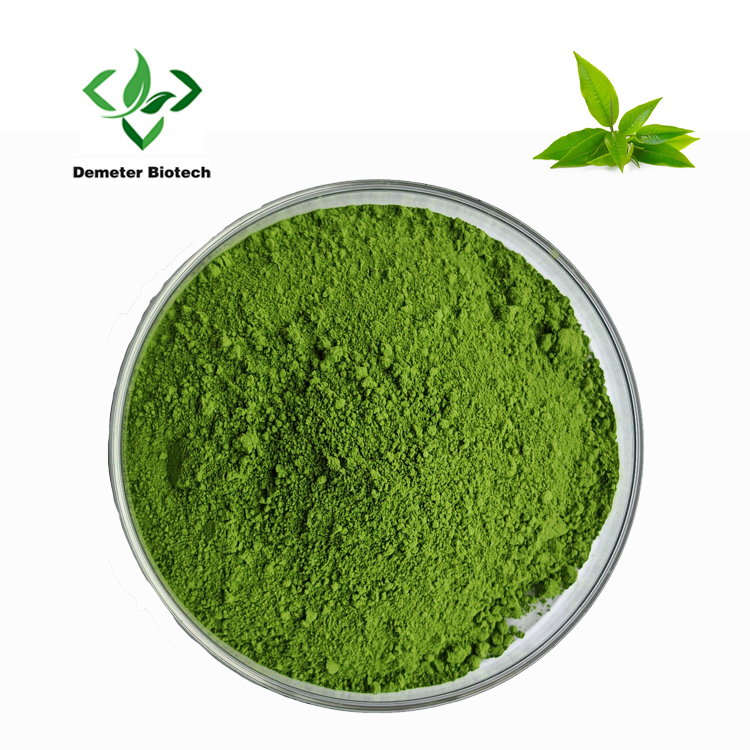
USDA & EU Organic Certified Matcha — Ceremonial Grade (A-10A)
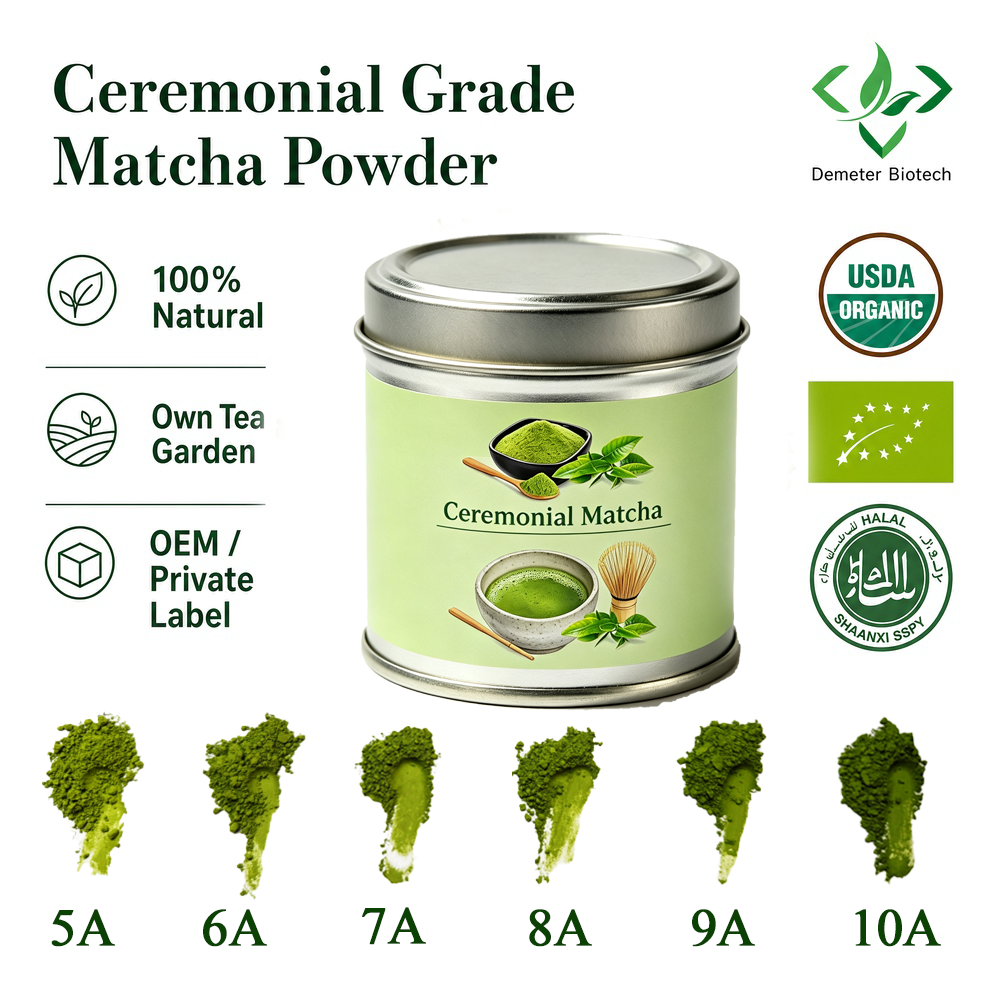
Shaded first-flush tencha from our own gardens, stone-milled below 40 °C, dual-certified USDA and EU Organic, with batch COA covering amino acids, moisture, ash, residue screen and particle size. Halal available; OEM and private label supported.
500–1500 Mesh Fine Ceremonial Matcha — Bulk Supply
The fine, free-flowing cut for RTD lines, blending and large-format repacking: 500–1500 mesh (roughly 10–25 µm) in the same organic specification, packed in light-shielded barrier bags for long routes, with D50/D90 and the amino-acid numbers on every lot.
7. Your L-theanine specification, in one line
State the grade band you need, the L-theanine floor (mg/g) or total free-amino-acid floor (%), the shading or flush expectation, and ask for both lines on the COA. Send us your target band and we will map it to the right lot and return a COA that shows the number — not just the word. Explore Demeter’s A-10A shaded ceremonial matcha →
References
Chen X, Ye K, Xu Y, Zhao Y, Zhao D. Effect of Shading on the Morphological, Physiological, and Biochemical Characteristics as Well as the Transcriptome of Matcha Green Tea. International Journal of Molecular Sciences. 2022;23(22):14169. doi:10.3390/ijms232214169
Cheng S, Fu X, Wang X, Liao Y, Zeng L, Dong F, Yang Z. Studies on the Biochemical Formation Pathway of the Amino Acid L-Theanine in Tea (Camellia sinensis) and Other Plants. Journal of Agricultural and Food Chemistry. 2017;65(33):7210–7216. doi:10.1021/acs.jafc.7b02437
This article describes the composition and biosynthesis of an ingredient. It does not describe effects on the human body. Reported values are from published literature and common B2B specifications and vary with cultivar, shading, flush and method; actual levels are confirmed only by the lot certificate of analysis.
Post time: Oct-12-2026


