


From Tencha to Matcha: Steaming, De-Stemming & Stone-Grinding
Shading decides what the leaf contains. Processing decides how much of it reaches the powder. Here is the factory half of the story — the seconds of steam, the step that is defined by not doing it, the machinery that removes stems and veins, and the slow grind that has to stay cold.
A shaded leaf is not matcha. Between the plucked shoot and the green powder there are four operations — steam fixation, flat drying with no rolling, de-stemming and de-veining, and low-temperature milling — and each one either protects the composition the grower worked three weeks to build, or quietly spends it. Most of the quality arguments in this category are argued at the farm. A meaningful share of the complaints that arrive at the lab are made in the factory, in the hours and seconds after the leaf comes in. This article walks the process chain in order, says which steps are checkable on a document, and where a lot can lose grade without anyone intending it. Shading itself, and the particle-size side of milling, are covered in separate notes in this series; here we stay on the sequence in between. At Demeter Biotech we steam, dry, de-stem and stone-mill tencha from our own gardens in China, so the process record for a lot is something we can confirm rather than describe.
1. Tencha is a process state, not a leaf variety
The vocabulary here causes more confusion on a purchase order than any other part of the category. Tencha is not a cultivar and not a grade. It is what the shaded leaf becomes after it has been steamed, dried flat without being rolled, and stripped of stems and veins. Matcha is that tencha, milled. Nothing else is added and nothing is removed at the mill, which means every property of the powder was set upstream — in the garden, in the steam, in the drier, and in the sorting line.
That sequence is why a factory that runs a good tencha line can produce matcha from a mediocre leaf but cannot produce a good powder from a badly fixed one. The two irreversible decisions are made in the first minutes: whether the enzymes were stopped in time, and whether the pigment survived the heat that stopped them.
2. Steam fixation: the only step that locks colour
Fresh tea leaf carries polyphenol oxidase, the copper-containing enzyme that browns a cut apple and reddens black tea. It sits in the tissue waiting for damaged cells and oxygen. If it is allowed to act, the catechins oxidise into brown polymer pigments and the lot is finished as a green product regardless of how well it was shaded. Steaming is the operation that denatures that enzyme, and because the enzyme is heat-labile, the reaction stops irreversibly once the tissue itself — not just the leaf surface — reaches the inactivation temperature.
The same heat that saves the colour can also spend it. Chlorophyll is a porphyrin ring chelated around a central magnesium ion, and that magnesium is what makes the molecule green. Under heat, and helped by the organic acids naturally present in leaf tissue, hydrogen ions displace the magnesium and the pigment converts to pheophytin — an olive-brown compound — and the reaction does not run backwards. In a 2025 characterisation of commercial matcha grades, pheophytin and pyropheophorbide signals were read as secondary products of chlorophyll breakdown consistent with the heat step applied to stop polyphenol oxidase (Toniolo et al., 2025). The colour of a lot is therefore not only a shading outcome; it is also a heat-history outcome.
This is why the steaming step is talked about in seconds. Commercial tencha is normally quoted in a window of roughly 15 to 30 seconds of steam at atmospheric pressure, with the shorter end used on thin first-flush leaf and the longer end on heavier leaf from later harvests or thicker cultivars. Under-steaming is the more dangerous error of the two: a few seconds short leaves active enzyme in the deepest tissue, the leaf still looks green at the steaming station, and the browning only appears hours later in the drier, when it cannot be corrected. Over-steaming fails differently — the colour shifts toward olive, the leaf softens, and the powder takes on a rounder but duller character.
3. No rolling — the step defined by doing nothing
Every other Japanese green tea is rolled. Sencha is kneaded and shaped into needles, a process that breaks cell walls, releases juice and concentrates flavour. Tencha deliberately skips it. After steaming, the leaf is cooled with forced air to carry the residual heat away, then dried flat in a multi-pass hot-air oven — industry builds use three stacked conveyor belts with inlet air above 150 °C and a total residence time in the region of 20 to 30 minutes — and comes out as a thin, fragile, unrolled flake.
Skipping the roll has three consequences that matter commercially. It keeps the cell structure intact, so the leaf mills cleanly instead of smearing. It keeps the flake thin and brittle, which is what makes the next step — separating leaf flesh from stem and vein — physically possible at all. And it removes the point where juice oxidises on a roller, which is one reason tencha holds its colour better than a rolled green tea of the same leaf age.
Drying is also where the pigment keeps drifting. Chlorophyll does not fall in a single moment of the process; it declines across the whole tencha sequence, and it can be followed stage by stage. A 2023 study monitored chlorophyll a, chlorophyll b and total chlorophyll through tencha processing using portable near-infrared spectroscopy, and the calibration models reached prediction correlations of 0.92 to 0.94 across the three fractions (Liu et al., 2023). The practical reading is not that a factory needs a spectrometer. It is that pigment is a process variable with a curve, not a property fixed once at harvest — and that the drying stage, which holds the leaf at temperature for minutes rather than seconds, is where that curve is spent.
4. De-stemming and de-veining: what separates matcha from green tea powder
This is the step that decides whether the material is matcha or merely powdered green tea, and it is the one most often skipped by producers selling on price. The dry flake leaving the oven still carries every stem and every vein. Those fractions are high in fibre, low in chlorophyll, and carry a harder, more astringent character of their own. Ground into the powder, they show up as three things you can see and taste: a duller, yellower colour, a gritty rather than silky mouthfeel, and a foam that collapses quickly instead of standing.
Removal is mechanical and unglamorous. Modern tencha lines use air separation, which exploits the different specific gravities of the light leaf flakes and the heavier stems and veins, followed by optical colour sorting to pull out yellowed flakes and foreign material. What comes out of that line is the pure leaf blade — and it is a smaller mass than what went in. The yield loss is real, it is not recoverable, and it belongs in the price of a proper lot.
For a purchasing team this converts into one of the most useful single figures on a specification: the fibre content. A powder that was genuinely de-stemmed carries the fibre level of leaf tissue; a powder that was milled whole carries the fibre of stem and vein as well. You do not need to visit the factory to ask the question. Ask for crude fibre on the certificate of analysis, ask what the de-stemming step actually was, and compare that number against the particle size and colour you were promised. A lot with a glossy colour claim and a high fibre figure is telling you two different stories.
5. Stone grinding: heat is the constraint, not fineness
Milling is the step the category talks about most and understands least. Granite stones grind slowly for one reason: friction. A mill that runs faster makes more powder per hour and more heat per minute, and heat is the one thing the powder cannot take. Volatile aroma compounds leave, and the pigment and the amino-acid profile that the whole upstream chain was built to protect start to move. The working target in stone milling is to keep the powder cool — commonly stated as staying below about 40 °C at the stone — rather than to reach a number on a particle-size report.
The throughput figure explains the price of the category better than any marketing claim. A granite mill turning at roughly 30 to 40 revolutions per minute yields powder in the tens of grams per hour — the commonly quoted band is 40 to 60 g/h — so one stone produces a few hundred grams across a full shift. Compare that with an impact or jet mill that moves kilograms per hour and you can see exactly what a stone-milled lot is paying for. A comparison of grinding routes on particle size and throughput is a separate topic in this series; the point here is that stone milling is not a fineness technology, it is a temperature technology.
The second consequence of grinding is surface area. Milling multiplies the contact area between the powder and the air by orders of magnitude, so oxidation that was slow in a flake becomes fast in a powder. This is why serious producers mill against a shipping schedule rather than into stock, store tencha cold and dark until the mill runs, and pack the powder into light-shielded barrier film immediately. If the interval between milling and dispatch on a lot is long, that is a freshness question worth asking about before it is a quality question.
6. Five process fields to write into a specification
“Stone-ground” and “first flush” are both true of a great many lots that behave nothing alike. These five fields describe a process rather than a reputation, and each one can be confirmed on a document or by analysis.
| Field | What to record | Why it matters to the powder |
|---|---|---|
| Steam depth | Seconds of steam, and whether the lot was run short, medium or long | Sets how much chlorophyll survives and how soft the leaf becomes |
| Drying route | Flat hot-air drying with no rolling, plus the final moisture of the flake | The longest heat exposure in the chain, and the stage where pigment drifts |
| De-stemming | Whether stems and veins were removed, by what method, and the crude fibre figure | Decides colour clarity, mouthfeel and foam; the fibre number is the proxy test |
| Milling temperature | Mill type, and the powder temperature the line is held below | Heat at the stone is the main way a good tencha becomes a dull powder |
| Milling-to-dispatch | The date the lot was milled against the date it shipped, and the packaging barrier | Fresh powder has enormous surface area; the gap is a freshness risk |
Add those five to the panel you already require — particle size, colour, L-theanine, catechins, moisture, residue screen — and the process conversation stops being a story about craft and becomes a set of lines you can hold a lot to.
7. How Demeter processes and ships matcha you can verify
At Demeter Biotech we run the full chain on tencha from our own gardens in China: steam fixation, flat drying without rolling, de-stemming and de-veining, then stone milling held below 40 °C, with the powder packed into light-shielded barrier bags to carry the green through shipping. Every lot is classified within our internal RM / EM / OM system and ships with a full composition panel — particle size, colour, L-theanine, the catechin profile, moisture, ash and a residue screen — plus the crude fibre figure that tells you whether the de-stemming step was real. If the process record on a specific batch matters to your specification, ask for it before you commit and we will confirm what was run on that batch rather than describing the category in general. Tell us the panel you need, the certification you require — USDA Organic, EU Organic or Halal — and the steaming and milling questions you care about, and we will match the lot to the numbers you approve.
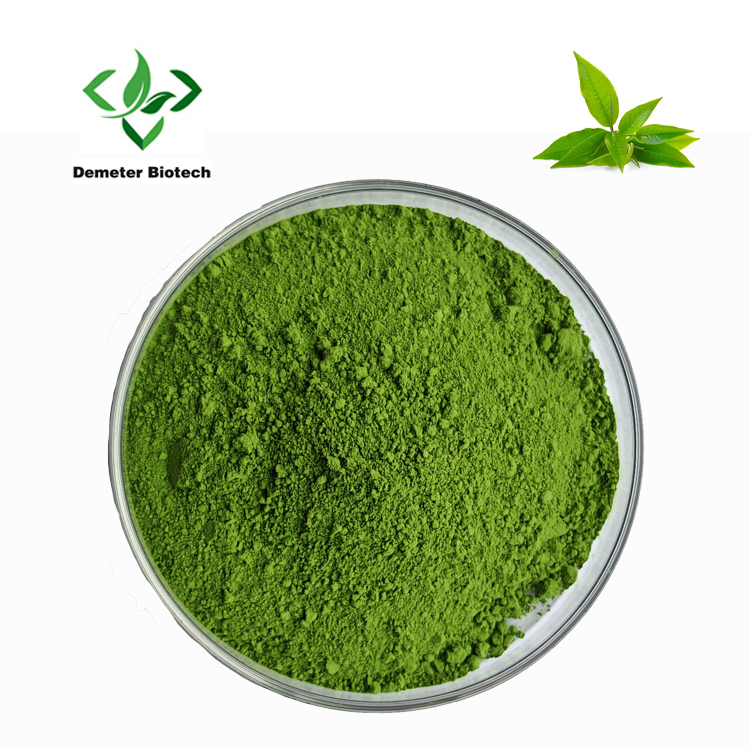
USDA & EU Organic Certified Ceremonial Matcha — A-10A
Shaded first-flush tencha from our own gardens, de-stemmed and de-veined, stone-milled below 40 °C, dual-certified USDA and EU Organic. Batch COA covers EGCG, the catechin profile, L-theanine, colour, crude fibre, residue screen and particle size. Halal available; OEM and private label supported.
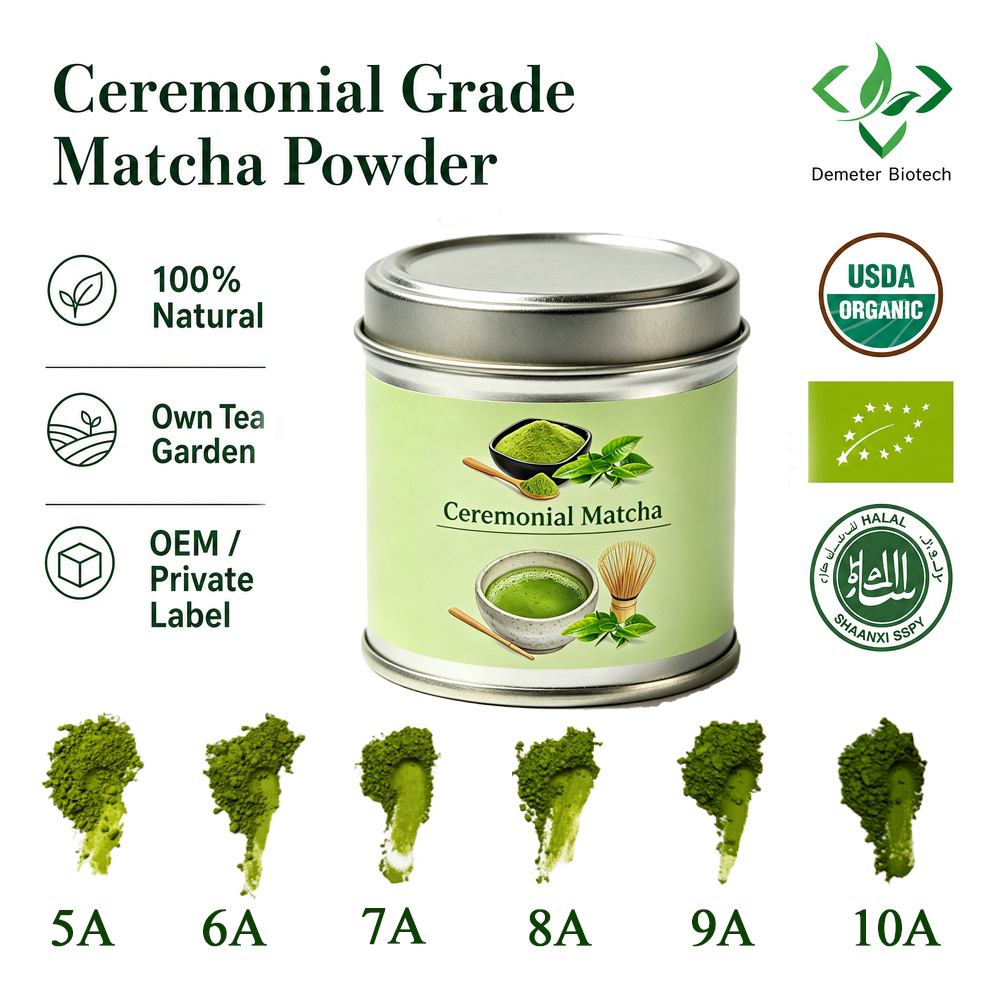
500–1500 Mesh Fine Ceremonial Matcha — Bulk Supply
The fine, free-flowing cut for RTD lines, blending and large-format repacking: 500–1500 mesh (roughly 10–25 µm) in the same organic specification, milled from de-stemmed tencha with the catechin profile and L-theanine reported on every lot for your composition work.
Send us the process questions you want answered — steam depth, drying route, de-stemming, milling temperature and the interval to dispatch — together with the composition panel your product needs, and we will confirm the lot figures on the certificate of analysis before the order is packed. A process you can read is worth more than a process you have to believe.
References
- Liu L, Zareef M, Wang Z, Li H, Chen Q, Ouyang Q. Monitoring chlorophyll changes during Tencha processing using portable near-infrared spectroscopy. Food Chemistry. 2023. doi:10.1016/j.foodchem.2023.135505
- Toniolo C, Patriarca A, De Vita D, Santi L, Sciubba F. A Comparative Multianalytical Approach to the Characterization of Different Grades of Matcha Tea (Camellia sinensis (L.) Kuntze). Plants. 2025;14(11):1631. doi:10.3390/plants14111631
This article describes processing operations, pigment chemistry and ingredient composition only. It is not a statement of efficacy or medical advice. Steaming windows, drier residence times, milling temperatures and throughput figures quoted for commercial practice are industry ranges, not measured values for any specific lot; the only figures that bind a lot are those on its batch certificate of analysis. Composition varies with cultivar, origin, shading, harvest timing, grade and processing.
Post time: Oct-27-2026


