


EGCG & Catechins in Matcha: Antioxidant Potency, Explained
What the polyphenol numbers on a matcha COA actually tell you — and why the culinary grade often carries more of them than the ceremonial.
Catechins are the largest family of phenolic compounds in matcha, and epigallocatechin gallate (EGCG) is their headline molecule. They are also the part of the profile most often misread: the grade with the best colour and the most L-theanine is not the grade with the most catechins. This article explains what catechins are, how matcha’s growing method moves them, what the numbers look like by grade, and how to read them on a certificate of analysis — so you can specify the powder your product actually needs instead of paying for a word.
1. What catechins are, and why EGCG is the one you hear about
Catechins are a class of flavonoids — specifically flavan-3-ols — that make up the bulk of the phenolic fraction in Camellia sinensis. Matcha carries six of them in meaningful amounts: EGCG, EGC (epigallocatechin), ECG, EC, GCG and GC. Of these, EGCG is consistently the single most abundant catechin in matcha; in a 2023 survey of commercially available green teas, EGCG was the highest-concentration catechin in every matcha sample measured (Meyer et al., 2023). EGC, the non-galloylated member of the pair, is the next large one. Together the gallated and non-galloylated forms account for most of the catechin mass on a COA.
In the leaf, these compounds are the plant’s own secondary metabolites, and in the cup they are what gives green tea its characteristic astringency and slight bitterness. That is a compositional fact, not a judgement — and it is the first thing to keep in mind when a matcha listing leads with “high EGCG” as a selling point.
2. The shading switch: the mirror image of the L-theanine story
In our companion piece on L-theanine we showed that shading before harvest builds free amino acids. The same genetic switch works in reverse on catechins. Shading down-regulates the flavonoid biosynthesis pathway (the phenylpropanoid enzymes that build catechins), so a heavily shaded, first-flush leaf — the leaf that becomes ceremonial grade — ends up with lower total catechins than a less-shaded, later-harvest leaf. One 2025 study noted directly that the earlier-harvested, strongly shaded leaves used for ceremonial matcha “may reduce flavonoid synthesis,” while culinary products carried more (White et al., 2025).
This is a compositional trade, not a quality verdict. More shade means more umami and a brighter green; less shade means more of the catechin pool. The two movements are the same agronomic dial turned in opposite directions, and a good specification names which side your product needs.
3. What the numbers show by grade
The honest picture is more nuanced than the marketing slogans, so here it is straight:
- EGCG specifically is grade-neutral. Reported EGCG ranges widely — roughly 20–60 mg/g — because the number shifts with the extraction method (aqueous versus aqueous-organic solvent). In one 2023 study ceremonial averaged slightly higher (56.6 vs 50.5 mg/g); in a 2025 study culinary averaged slightly higher (26.1 vs 21.8 mg/g). The takeaway: EGCG is a consistency and authenticity check, not a clean grade divider.
- EGC and the broader pool run higher in culinary. EGC was significantly higher in culinary matcha in the 2023 work (28.6 vs 22.5 mg/g), total phenolic content was higher in culinary products in the 2025 work, and the flavonoid share of that phenolic load was also larger (White et al., 2025).
- Measured in-vitro capacity follows the pool. The same 2025 study reported culinary matcha with a higher CUPRAC value — a laboratory reducing-power assay — averaging about 24% above ceremonial. More phenolics and flavonoids, more measured activity in the test tube.
Net: a culinary, less-shaded matcha typically carries a larger total catechin and flavonoid load and a higher in-vitro antioxidant reading; EGCG itself sits in a comparable band across grades. That is the most defensible statement the data supports.
4. “Antioxidant potency” — what that phrase means here
One clarification, because the word gets misused. In this article, “antioxidant” refers to a measured chemical property in vitro — the ability of the extract to scavenge free radicals or reduce metal ions, read in assays such as CUPRAC, ORAC or DPPH. It is a laboratory number that describes the composition of the powder. It is not a claim about any effect on the human body, and this article makes no such claim. Matcha’s catechins are simply among the most-studied phenolic compounds for that kind of in-vitro activity, which is why the word appears on so many labels.
In practice the point is straightforward: if your product is built around the powder’s polyphenol load — a functional beverage, a capsule or blend, a “high-polyphenol” positioning — a culinary, less-shaded grade can deliver more total catechins per gram at a lower cost than a ceremonial grade, while still being real, shade-grown matcha.
5. How to write catechins into a specification
Copy the structure below into your purchase spec, and you have turned a vague “high EGCG” line into something verifiable:
| What to ask for | Why | Method note |
|---|---|---|
| EGCG and EGC, mg/g | EGCG confirms authenticity (it must be the dominant catechin); EGC tracks the grade’s polyphenol load | HPLC; always state the extraction/assay method — numbers shift with it |
| Total catechins or total polyphenols | A single EGCG line hides the pool; the pool is what the in-vitro reading tracks | Folin–Ciocalteu for total polyphenols; HPLC sum for total catechins |
| Grade expectation by application | Polyphenol-led product → culinary/less-shaded; colour- and umami-led product → ceremonial | Name the use, not just the word “premium” |
| Authenticity flag | A matcha where a catechin other than EGCG dominates is worth questioning | Compare the EGCG share against the HPLC profile |
6. How Demeter supplies catechins you can verify
At Demeter Biotech we report EGCG, the catechin profile and total polyphenols on the batch COA for both our A-10A ceremonial line and our 500–1500 mesh bulk fine powder. Because we control the gardens and the harvest, we can also tune shading and picking for a higher-catechin culinary cut when your product is built around the polyphenol load rather than the brightest green. Tell us the application and the target profile, and we will map the lot and confirm the catechin numbers before the container leaves.
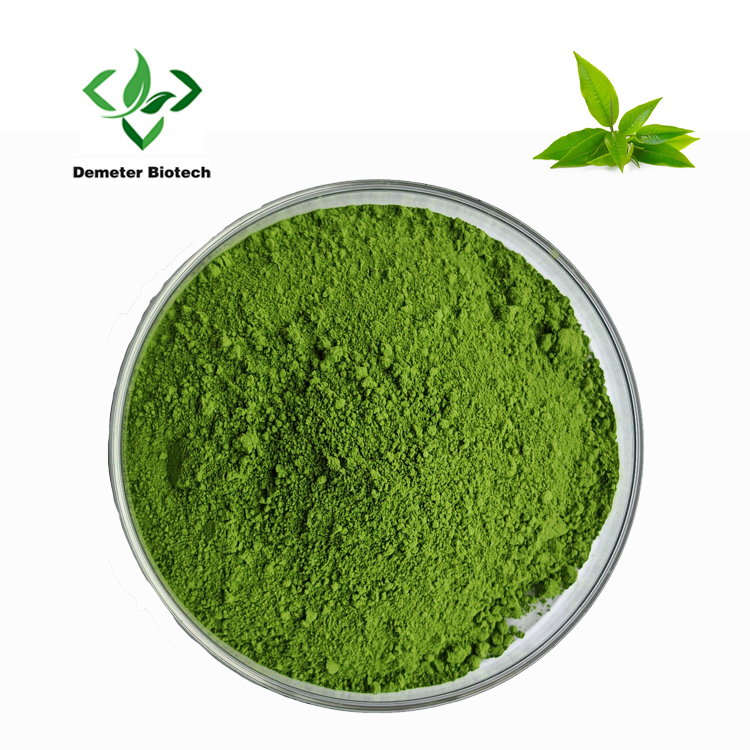
USDA & EU Organic Certified Ceremonial Matcha — A-10A
Shaded first-flush tencha from our own gardens, stone-milled below 40 °C, dual-certified USDA and EU Organic. Batch COA covers EGCG, the catechin profile, L-theanine, colour, residue screen and particle size. Halal available; OEM and private label supported.
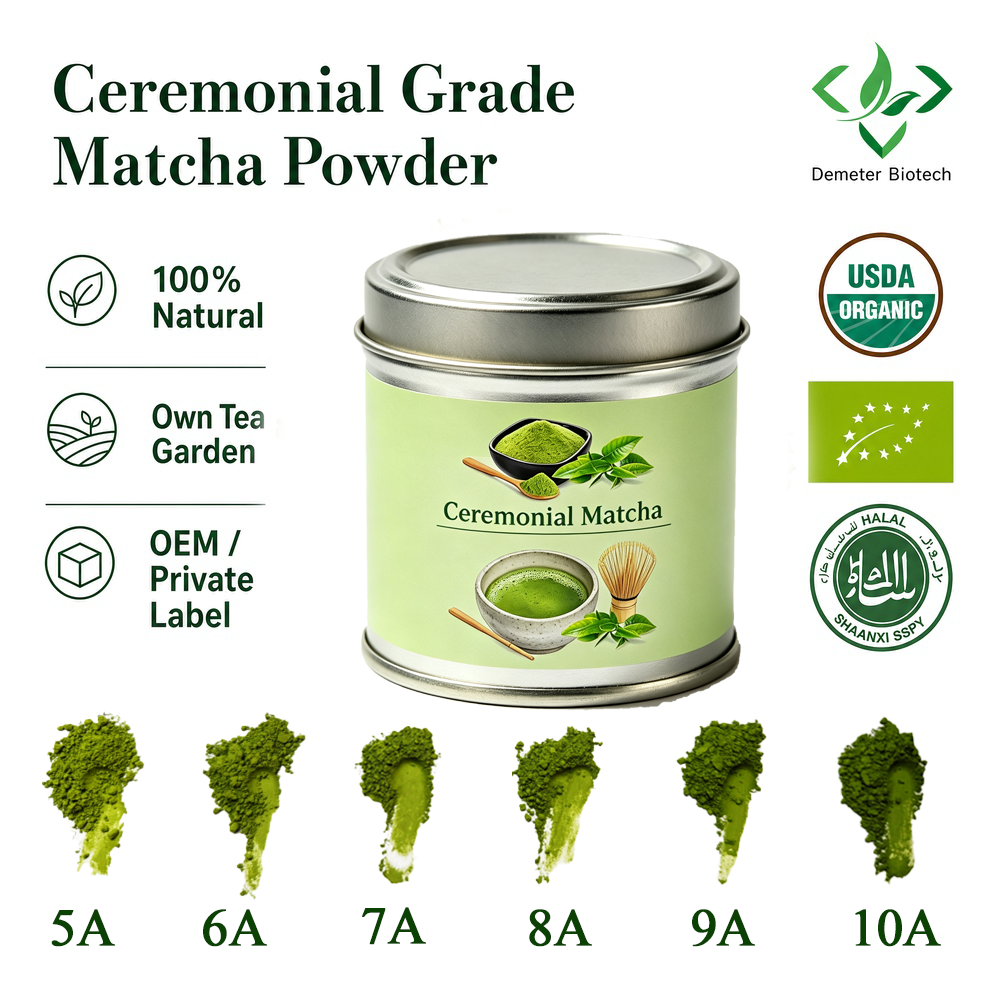
500–1500 Mesh Fine Ceremonial Matcha — Bulk Supply
The fine, free-flowing cut for RTD lines, blending and large-format repacking: 500–1500 mesh (roughly 10–25 µm) in the same organic specification, with the catechin profile and D50/D90 on every lot — the right base when your product leans on the polyphenol load.
Send us your target catechin profile, your application and your pack format, and we will match the lot to it and confirm the numbers on the COA before the container leaves — so what you approve is what arrives.
References
- White HM, Meyer BR, McCormack JD, Lawson HP, Niemeyer ED. Comparison of culinary and ceremonial matcha green teas: relationship between phytochemical composition and antioxidant properties. Journal of Food Measurement and Characterization. 2025;19:03448. doi:10.1007/s11694-025-03448-7
- Meyer BM, White HM, McCormack JD, Niemeyer ED. Catechin composition, phenolic content, and antioxidant properties of commercially-available bagged, gunpowder, and matcha green teas. Plant Foods for Human Nutrition. 2023;78:662–669. doi:10.1007/s11130-023-01121-2
This article describes the chemical composition of matcha as an ingredient and how to specify it. It is not a statement of efficacy, a health claim, or medical advice. “Antioxidant” is used throughout to mean a measured in-vitro chemical property (CUPRAC, ORAC, DPPH), not any effect on the human body. Catechin values cited come from the published laboratory work referenced above and vary with cultivar, origin, shading, extraction method and milling; the only figures that bind a lot are those on its batch COA.
Post time: Oct-13-2026


