


Chinese Matcha vs Japanese Matcha: Origin, Price & Capacity in 2026
Two figures circulate in every conversation about this comparison: about 12,000 tonnes from China and about 6,000 tonnes from Japan. They are not the same measurement. One counts finished powder and the other counts the dried leaf that powder is milled from, so the gap between the two origins is wider than the headline numbers suggest — and the price gap between them is a statement about grade mix, not a discount on identical material.
At Demeter Biotech we mill shaded tencha in China and ship it in bulk, in pouches, in tins and in cap format, and we quote into programmes that also buy Japanese leaf. That position makes one question unavoidable at every quotation stage: are we comparing the same thing? Usually not. This article sets the two origins side by side on a single basis, shows where the price difference actually sits, and ends with the fields we would put into a specification before either origin is chosen. Production geography and flavour have been covered elsewhere; this piece stays on tonnage, price, grade vocabulary and the shape of the contract.
1. Two headline numbers that do not measure the same thing
The Chinese figure comes from the China Tea Marketing Association, which released its national matcha industry report at the Tongren matcha conference in May 2026. It puts Chinese matcha output for 2025 at above 12,000 tonnes, roughly 60–70% of world output depending on which version of the report is cited, against 3,916 tonnes in 2020 — a compound annual growth rate of about 28.7%. The same report records that in 2025 China’s matcha export volume passed Japan’s for the first time.
The Japanese figure comes from the Ministry of Agriculture, Forestry and Fisheries, in its annual review of the tea situation published on 1 October 2026. It puts Japanese tencha production for 2025 at 6,278 tonnes, about 3.2 times the 2014 level. Tencha is the shaded, steamed, unrolled, dried leaf — the raw material for matcha, not matcha itself.
That distinction is worth more than a footnote, because the conversion between the two is not free. The published industry ratio is 6–7 kg of fresh leaf to 1 kg of tencha, and then roughly 1 kg of tencha to 0.85 kg of finished matcha once stems, veins and yellow leaf have been removed in refining. Apply the second step to the Japanese number and 6,278 tonnes of tencha corresponds to something near 5,300 tonnes of millable powder. Against 12,000 tonnes of finished Chinese powder, that is a ratio of about 2.3 to 1 rather than the 1.9 to 1 that a naive division of the two headline numbers produces.
2025 output on a single basis, finished matcha powder, indexed to Chinese output
China 12,000 t = 100%. Japanese tencha of 6,278 t converted at the published refining ratio of 0.85. That conversion is our estimate, marked accordingly, and is not a published figure.
| China, finished matcha |
|
|||
| Japan, tencha as published |
|
|||
| Japan, converted to powder (estimate) |
|
The second thing to notice is that the Chinese figure does not close internally either. The same report gives Zhejiang 8,851 tonnes in 2025, Tongren in Guizhou 2,500 tonnes, and Hubei around 1,500 tonnes. Those three alone sum to about 12,850 tonnes — more than the national total they are part of. That is not a typographical slip. It means the phrase “matcha output” is being used at provincial level to cover slightly different populations of material, most plausibly some tencha and some powdered green tea that is not matcha in the standard sense. A national total assembled from provincial figures that overrun it is a total with a definition problem, and you should read it as an order of magnitude rather than as a stock figure you can plan against.
The practical consequence. When a quotation says “we have 12,000 tonnes behind us” or “Japan makes 6,000 tonnes”, neither number tells you what is available to you in the grade and the month you need. Ask which stage the tonnage is counted at: leaf, tencha, or milled powder. Ask for the current month’s milling capacity rather than the annual output, because powder is what ships.
2. Why the tonnage gap exists: two different ways of adding capacity
The two origins did not arrive at their volumes by the same route, and the route determines how fast either can respond to another year of demand growth.
Japan’s tencha growth is mostly a conversion, not an expansion. National tea area fell from about 48,000 hectares in 2008 to about 33,000 hectares in 2025 while total crude tea output held in the 70,000-tonne range, which means the same land is being farmed more intensively and differently. Within that flat total, tencha went from a marginal category to 6,278 tonnes and 8.6% of crude tea production. Kagoshima is where most of the switch happened: it produced 1,585 tonnes of tencha in 2023, about 38% of the national figure, followed by Kyoto at 970 tonnes and Shizuoka at 505 tonnes. Kagoshima’s advantage was not new gardens — it was existing sencha gardens redirected to a higher-value product, which is why the prefecture that leads Japan in crude tea output is also the one whose volume can move fastest.
That route has a ceiling, and it is agronomic rather than commercial. Shading is not an additive input. A shaded shoot is thinner, has less mass per unit area and carries less dry matter per hectare than an open-field shoot, so a field converted to tencha yields fewer kilos of leaf than the same field did as sencha, before the netting, the frame, the labour and the loss of ride-on harvesting are counted. Work from Japanese national research teams has also documented the phenotype of plants pushed through repeated shade cycles: the plants register the load, and the markers of that stress are measurable in the shoot. Converting more land does not produce a proportional increase in tencha, because each additional hectare converted takes yield out of the field it came from. This is the most convincing explanation for a pattern that otherwise looks irrational — Japanese tencha output roughly tripled over a decade and the price still went up.
China’s growth is a build-out. Zhejiang leads national output at 8,851 tonnes with a value above 1.1 billion yuan, concentrated in Hangzhou, Shaoxing, Jinhua and Ningbo. Tongren in Guizhou reached 2,500 tonnes of output and sales on 85,000 mu of dedicated base area — about 5,700 hectares — with 76 tencha processing lines, of which 24,200 mu and 30 lines were added in 2025 alone. The largest single refining plant in Tongren is rated at 4,000 tonnes a year, and its operator has said publicly that 2026 sales should exceed 5,000 tonnes with 10,000 tonnes of capacity targeted within two to three years. Hubei added roughly 1,500 tonnes aimed squarely at the beverage and new-tea-shop channel, and Sichuan, Jiangsu, Yunnan, Jiangxi and Hunan are all entering.
| Dimension | Japan | China |
|---|---|---|
| What the published tonnage counts | Tencha, the dried leaf | Milled matcha powder, with definition drift between provinces |
| How capacity was added | Sencha gardens converted to tencha, while national tea area shrank | New and upgraded dedicated base area, plus new tencha lines |
| Concentration | One prefecture contributes about 38% of national tencha | Two provinces lead with several more entering; no single district above roughly a fifth of national output |
| Growth limit | Agronomic: shading takes yield out of the same field | Capital and certification; the agronomic ceiling is not yet binding |
| Failure mode to plan for | One prefecture’s weather, or one trading house’s allocation | Lot-to-lot variation across a long list of plants and grades |
The risk profiles are mirror images. A programme built on Japanese leaf is exposed to one island’s harvest and to the allocation decisions of a small number of trading houses; a poor first flush there is not a price event, it is an availability event. A programme built on Chinese leaf is exposed to dispersion: with dozens of plants across several provinces working to different internal standards, two lots carrying the same name on the invoice can differ in ways a certificate does not automatically catch. Neither risk is worse. They need different controls, and the sections below show which.
3. The price gap is a grade distribution, not a discount
Start with the Japanese price data, because it is published at a level of detail Chinese data does not yet match. For the 2025 crop year the national average crude tea price for tencha was 8,562 yen per kg, against 1,746 yen per kg for sencha — a factor of 4.9, which tells you how far the market has moved tencha away from ordinary green tea.
At the export end the numbers are equally specific. Japan exported about 13,000 tonnes of green tea in 2025 for 72.1 billion yen. Of that, powdered green tea — predominantly matcha — accounted for 8,718 tonnes, or 69% of volume, and 60.4 billion yen, or 84% of value, at an average of 6,927 yen per kg. Every other green tea form combined averaged 3,007 yen per kg. Powder earns 2.3 times what leaf earns per kilo, and it earns that by being the only format in which the whole leaf is consumed.
Then 2026 moved again. For January to July 2026, Japanese matcha exports reached 5,204.5 tonnes and 51.0 billion yen, at an average of 9,801 yen per kg. Against the 2025 full-year average of 6,927 yen, that is an increase of more than 40% in the average price of the same category inside a year. Volume growth and price growth are happening at once, which is what a supply-constrained market looks like.
Now the Chinese side. Chinese matcha export volume passed Japan’s in 2025 and is now the largest in the world. The same industry report states that the average export price is around one quarter of Japan’s, that the product mix is weighted toward the middle and lower end, and that output of high-grade matcha grown and processed to EU-standard requirements is under 12% of the total. That last figure is the one to hold onto. It is not a judgement about capability; it is a statement about how much of the installed base is currently qualified for the strictest residue regimes. A quarter of Japan’s price is what a grade distribution averaging under 12% EU-standard material looks like once it is exported.
Average prices on a common unit, yen per kg
Indexed to the highest value shown. Japanese entries are published averages. The Chinese entry is the industry association’s statement that the export average is about one quarter of Japan’s, drawn here as an estimate rather than a published price.
| Japan matcha export, Jan–Jul 2026 (9,801) |
|
|||
| Japan tencha crude tea, 2025 (8,562) |
|
|||
| Japan matcha export, 2025 (6,927) |
|
|||
| Japan other green tea export, 2025 (3,007) |
|
|||
| Japan sencha crude tea, 2025 (1,746) |
|
|||
| China matcha export, estimate (about 1,730) |
|
Look at the last two bars together. Chinese matcha leaving the country averages out at roughly the level of Japanese sencha crude tea — the raw material that is not shaded at all. That is the most honest single sentence about the state of this comparison in 2026: China has won the volume race and has not yet won the value race, and the industry’s own report says so in plainer language than anyone outside it uses.
For a purchasing decision this changes the question. “Why is Chinese matcha a quarter of the price” is the wrong framing, because it implies the same material at a different number. The right framing is: at the grade I am specifying, what does each origin charge, and does the certificate in front of me actually support that grade. A programme that buys on price alone will get exactly the quarter-price grade it paid for, and will discover the difference in the second lot rather than the first.
There is a timing layer as well. Japanese average prices rising more than 40% in a year, on top of tripled tencha output, is not a market that can be waited out. Chinese capacity is still being built and export growth is steep — Zhejiang exported 1,241.97 tonnes in the first quarter of 2026 alone, 7.3 times the same quarter a year earlier, and Hangzhou’s matcha export value for the first five months of 2026 was more than four times the prior year. Both facts point the same way: the price window on Chinese material is open now, and it is being consumed by other people’s contracts.
4. Where the cost difference actually comes from
Rather than quote a multiple, it is more useful to name the four places where the money goes differently, because each one is something you can ask about and none of them is a mystery.
Leaf cost, and the yield that shading removes
A shaded field is an expensive field before any processing starts. Cover structures need installation labour and material, the shaded window rules out the ride-on harvesters used on open gardens, and the physiological cost is paid in dry matter per hectare rather than in money. Japan’s structural position makes that cost worse every year: tea area down from about 48,000 to 33,000 hectares, growers ageing with 63% of the workforce at 65 or over, and a shrinking number of farming entities. Fewer people farming less land at a higher cost per kilo describes a rising floor price, and the 40% move in export averages is that floor being repriced.
Milling energy, and the cold storage behind it
Particle size is where processing cost concentrates. Traditional stone mills produce 30–40 g of powder per hour per mill, which is a labour and energy number as much as a craft boast. Industrial continuous ball mills with water cooling run far faster and hold a stated 1,000 mesh, about 13 microns, and a plant with nine such lines is a different capital position from a workshop with stone mills. Between milling and milling sits storage: tencha is held cold for six months or more before grinding, to let the material stabilise. That means a plant can only ship what it froze half a year earlier, and the freezer is capital tied up in inventory rather than a line item anyone quotes.
Certification, which is capacity and not paperwork
This is the least discussed and most expensive difference. Japan exported 4,489 tonnes of certified organic tea in 2025, and within its green tea exports organic accounted for 62.8% of the volume going to the United States and 63.6% of the volume going to the EU and the UK. Those are not certificate counts; they are shares of the actual trade, which means organic is close to the default specification on the routes that matter. On the Chinese side the equivalent statement is the one the industry report makes itself: EU-standard high-grade output is under 12% of production. Converting a conventional garden to a residue regime that clears several hundred pesticide actives takes years, not a season — published accounts of the Guizhou conversion programme put the rebuild at three years or more per site. So when a Chinese quotation is dramatically cheaper, one common reason is that it is not carrying the certification cost, and the price difference is the certificate.
Number of hands between the field and the container
The Japanese route runs grower to tea merchant to trading house to the packer, and each step is a margin plus a lead time. The Chinese route is frequently grower to plant to container, with the plant quoting directly. That removes cost, and it also removes a filter: the intermediary who used to catch a bad lot is no longer in the chain. A shorter chain is cheaper and it transfers diligence to you, which is a fine trade only if you actually do the diligence.
One data point we flag rather than assert. Trade press coverage has reported that at the Kyoto tea market the traded volume of hand-picked Uji tencha fell 21% in 2025 while its average price rose 135%, and that machine-picked first-flush tencha rose 162%. We have not independently verified those auction figures and they do not appear in the ministry statistics cited elsewhere in this article, so read them as directional evidence of scarcity in the top Japanese tier rather than as a price you can contract on.
5. The grade vocabulary does not travel between the two systems
Here is where most cross-origin comparisons quietly break. The words used to describe grade in one system have no legal force in the other, and the two systems do not even measure the same properties.
China has a national standard for matcha, GB/T 34778-2017, which defines the product as a micro-powder made by milling leaf that was grown under cover, steamed or hot-air fixed, and dried. It sets two grades. As summarised in published industry interviews, the requirements include a D60 particle size at or below 18 microns, moisture at or below 6%, total ash at or below 8%, and a theanine floor of 1.0% for grade one and 0.5% for grade two. A Guizhou provincial standard adds a tier above the national one with a theanine floor of 1.5% and a stricter residue list. We summarise these limits from secondary accounts rather than from the standard text, and we would advise checking the standard itself before writing any of them into a contract clause.
Japan has no equivalent mandatory grade system. “Ceremonial”, “culinary” and “food grade” are commercial descriptors applied by the seller, and no body polices them. That gap is being addressed, but slowly: an International Matcha Association was formed by Japanese industry in April 2026 with international definition, quality criteria and grading explicitly on its work plan, and in July 2026 “Japanese tea” was registered as a geographical indication, which under the Japan–EU EPA framework gives it reciprocal protection in the EU. A GI protects where a product comes from. It does not by itself define what grade the contents are.
The research literature makes the same point from the analytical side, and it is more useful than any marketing definition. A study from the National Agriculture and Food Research Organization compared ten tencha samples of differing quality and then a set of commercial powders, using theanine, chlorophyll a, and the weight ratio of EGCG to EGC. Tea-ceremony matcha sat at a theanine content of 1.8 g per 100 g dry matter or above, an EGCG/EGC ratio of 3.2 or above, and chlorophyll a at 250 mg per 100 g dry matter or above. Commercial-use matcha and powdered green tea mostly fell below those levels. But the authors state plainly that these parameters alone cannot separate processing-grade matcha from powdered green tea — and that is the finding worth carrying into a purchasing conversation. Chlorophyll a did discriminate against powdered green tea other than gyokuro powder, which is why colour is the test that catches substitution, while theanine and the catechin ratio are the tests that describe grade rather than identity.
| Field to specify | Why it decides the argument |
|---|---|
| D60 particle size, with the method named | The largest single driver of mouthfeel, suspension and price; a mesh number without a distribution is not a specification |
| Theanine, per 100 g dry matter | The grade marker both systems recognise, and the one a national standard actually puts a floor under |
| Chlorophyll a, per 100 g dry matter | The marker that catches powdered green tea sold as matcha; shade and freshness both show up here |
| Colour on a stated dispersion (L*, a*, b*) | Reproducible only if the dispersion and the instrument are named; a colour number without a method is decoration |
| Moisture, with the measurement point named | Sets the shelf-life clock and the clumping risk; the measurement point matters more than the number |
| Residue screen, by destination market | EU, US and Japanese regimes are not interchangeable; a screen written to one market does not clear another |
| Tencha origin and the month of milling | The only way to know whether the powder in the bag is this season’s leaf or last year’s, which the tonnage figures never tell you |
6. Lead time, lot size and the shape of the contract
The commercial structure differs as much as the chemistry, and it usually settles the decision before quality does.
Japanese tencha trades largely on annual arrangements with two main crop windows, and it passes through merchant and trading-house layers on the way out. That suits a programme with a fixed annual volume and a specification that does not move, and it is unforgiving to a programme still finding its feet: a small first order is not the natural shape of the trade, and a mid-year change in specification is a new negotiation rather than an amendment. The geographical indication adds a compliance layer to origin claims that did not exist before July 2026, which is good for anyone defending a premium and one more document for anyone shipping.
Chinese material trades in smaller and more frequent lots, can be consolidated with other items in the same container, and is available under private label from plants that will print a tin or supply a blank container for your own label. That flexibility is real, and it has a cost that appears as your responsibility: the diligence the intermediary used to perform becomes a clause you have to write.
One structural fact cuts across both origins and is routinely missed at the enquiry stage. Because tencha is held cold for six months or more before it is milled, the powder available in any given month is made from leaf harvested well before it. A programme asking in the northern spring for “new season’s matcha” is asking for material that, in most cases, cannot yet exist as milled powder. The workable question is not “how fresh is it” but “which harvest is this powder from, and when was it milled”. A plant that can answer both without looking it up is a plant with lot-level traceability, which is the same property you need in order to make an origin claim at all.
Lead time has a volume dimension that does not scale linearly. Small lots queue behind bookings at every plant, and when export volume from a province multiplies seven times in a quarter, the queue is not theoretical. The practical sequencing for a new programme is to lock in the grade and the milling slot first and negotiate price inside that slot, rather than settling price and then discovering the slot is not available in the month the launch needs it.
7. A decision table, so the choice is made on requirements
Neither origin wins. Each is the better answer to a different set of requirements, and the honest version of the comparison is a table in which the requirement is the input.
| If this is what the programme needs | The stronger fit | Why, and what to verify |
|---|---|---|
| A recognisable origin story attached to the leaf and defensible in the EU | Japan | Geographical indication registered July 2026 with EU protection; verify the lot actually falls inside the GI production and processing rules |
| Several hundred kilos a month, several grades, one container | China | Lot sizes and consolidation fit this shape; verify each grade separately, not the programme as a whole |
| Organic plus a strict residue regime at a workable cost | China, conditionally | Feasible and cheaper, but qualified capacity is the minority; verify the certificate is held for that garden and that lot |
| The narrowest possible particle distribution for a straight whisked serve | Either, leaning Japan | Stone milling holds a tight distribution; industrial ball milling reaches the same fineness with a wider tail, so ask for D10 and D90, not only D50 |
| Colour as the primary design constraint in a baked or dairy matrix | China | Colour is measurable and price per kilo is decisive at these inclusion rates; specify L*, a* and b* on a named dispersion |
| Private label with your own artwork, in tins or in cap format | China | Print and blank-container options are routine; verify who carries the label liability for the destination market |
| A fixed annual contract with a specification that will not change | Japan | The annual-window structure rewards this and punishes improvisation; confirm the allocation before the first flush |
Read down that table and a pattern appears: the Japanese column is about certainty and story, the Chinese column is about flexibility and cost, and every row ends in something to verify rather than something to trust. That is the real conclusion of the comparison. Origin tells you what the default behaviour of a supply base is likely to be; only the specification tells you what is in the bag.
8. How we supply Chinese matcha, and what goes on the certificate
We sit on the Chinese side of this comparison, which means the burden of proof is ours to carry rather than to describe. At Demeter Biotech we mill shaded tencha from our own gardens, de-stem and de-vein it, and hold it cold before grinding. We ship bulk in 1 kg aluminium foil bags, pouches from 30 to 500 g, tins at 30, 50 and 100 g, and a 2 g serving sealed into a cap, and we support private label with either direct print or a blank container carrying your own label.
Every lot leaves with particle size reported as a distribution rather than a single figure, colour measured on a named dispersion, moisture with the measurement point stated, the catechin and theanine profile, and a residue screen written to the market you are selling into rather than to a generic list. We also state the harvest the tencha came from and the month it was milled, because those two facts are what make an origin claim checkable rather than rhetorical.
If you are currently buying Japanese leaf and testing a Chinese second source, the useful starting point is not our price list but your existing specification. Send it, and we will tell you which lines we can meet as written, which lines need the method named before the number means anything, and where the two systems use the same word for different requirements. That conversation is worth more to both of us than a comparison of headline tonnages.
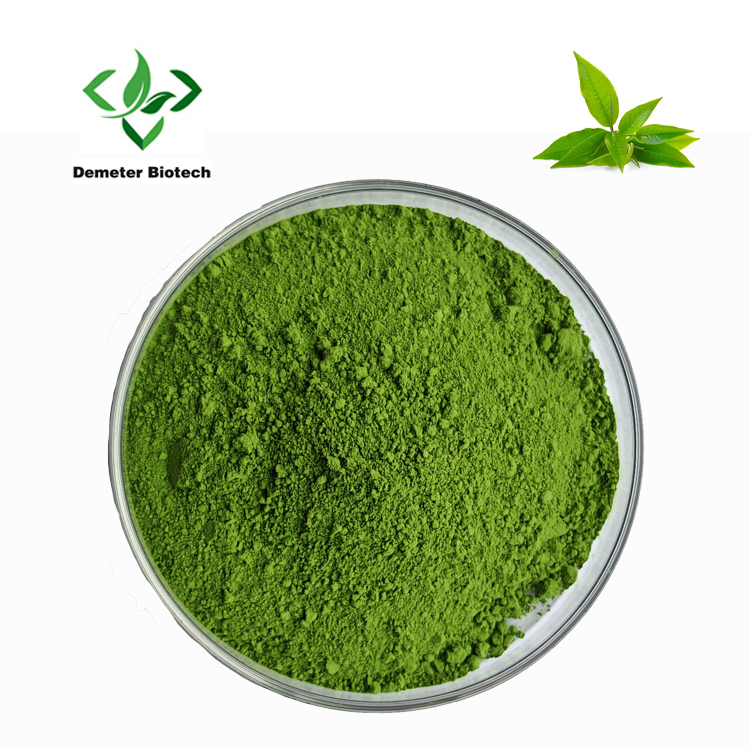
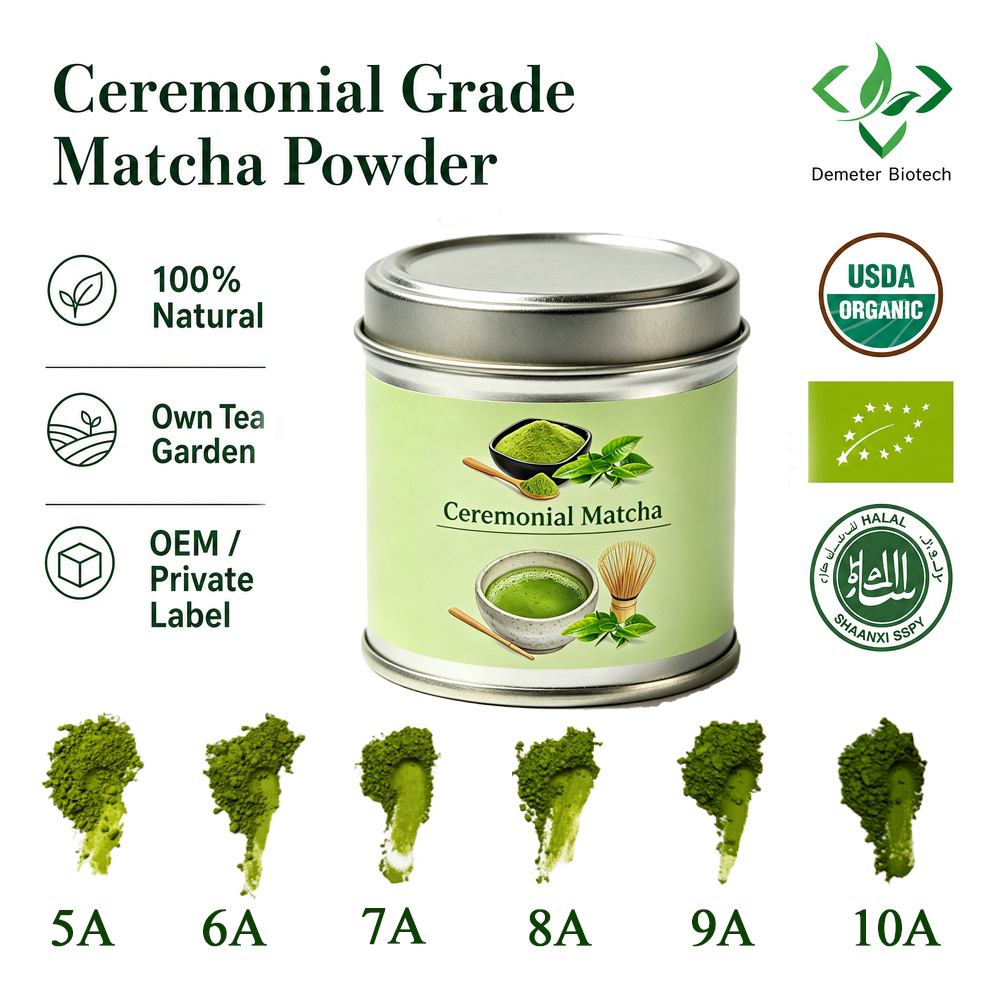
USDA & EU Organic Certified Ceremonial Matcha — A-10A
Shaded first-flush tencha from our own gardens, de-stemmed and de-veined, stone-milled below 40 °C, dual-certified USDA and EU Organic. The lot certificate reports colour on a standardised dispersion, particle size as a distribution, moisture with the measurement point named, the catechin and theanine profile and a residue screen. Halal available; private label supported in tins, pouches and bulk.
500–1500 Mesh Fine Ceremonial Matcha — Bulk Supply
The fine cut for programmes where the powder has to wet out cleanly or fill a small chamber: 500–1500 mesh in the same organic specification, milled from de-stemmed tencha, with the full size distribution, colour and moisture reported per lot so that a dispersion or a fill weight can be designed instead of corrected.
References
- Horie H, Ema K, Sumikawa O. Chemical components of matcha and powdered green tea. Journal of Cookery Science of Japan. 2017;50(5):182-188. doi:10.11402/cookeryscience.50.182 (in Japanese, with English abstract)
- Yamashita H, Tanaka Y, Umetsu K, Morita S, Ono Y, Suzuki T, Takemoto T, Morita A, Ikka T. Phenotypic markers reflecting the status of overstressed tea plants subjected to repeated shade cultivation. Frontiers in Plant Science. 2020;11:556476. doi:10.3389/fpls.2020.556476
Official statistics and industry figures cited in the text: Ministry of Agriculture, Forestry and Fisheries (Japan), review of the tea situation published 1 October 2026, together with its crude tea crop statistics; China Tea Marketing Association, national matcha industry report released at the Tongren matcha conference, May 2026, as reported by the association and by provincial and trade press. Regulatory references: GB/T 34778-2017 and the Guizhou provincial standard, summarised from secondary industry accounts; the Japan–EU EPA framework in relation to the geographical indication registered in July 2026.
This article compares published production, price and trade statistics for two origins and describes how specification fields behave. It is not a statement of efficacy, not advice on use, and not a legal opinion on labelling, origin or customs classification in any market. National statistics are compiled on different bases, and the conversion between tencha and milled powder used above is an illustrative estimate drawn from published industry ratios rather than a measured figure for any lot. Where a figure is described as an estimate, or attributed to trade-press reporting, it has not been independently verified by us. Prices move; the figures quoted are published averages for the periods named. The only values that bind a lot are those on its batch certificate of analysis.
Post time: Nov-20-2026


