


Products


Food Grade Catechu Bark Extract Powder 10:1 20:1 Acacia Catechu Herbal Extract for Dietary Supplements
Ratio Extract · 10:1 or 20:1
Natural Acacia Catechu Ratio Extract
There are two ways to buy this wood. At 10:1, ten kilos of dried Acacia catechu stem and branch go into one kilo of powder; at 20:1, twenty do. Both come off the same line in Xi’an, both pass 80 mesh, both hold moisture under 5.0%, and both dissolve in water and water-ethanol blends. What changes is how much wood the powder stands for, and what that costs per kilo. Tell us the ratio your formula assumes and we will quote against it.
CAS 8001-76-1
Trial Bags
Product Specification
| Parameter | Detail |
|---|---|
| Product Name | Acacia Catechu Extract 10:1 / 20:1 |
| Botanical Name | Acacia catechu (L.f.) Willd.; synonym Senegalia catechu |
| Plant Part | De-barked stem and branch wood, dried |
| Extraction Ratio | 10:1 / 20:1 — two grades, named at order |
| Assay (Marker) | Ratio grade — catechins reported per lot on request; no fixed figure on the sheet |
| Extract CAS No. | 8001-76-1; EINECS 232-291-7 |
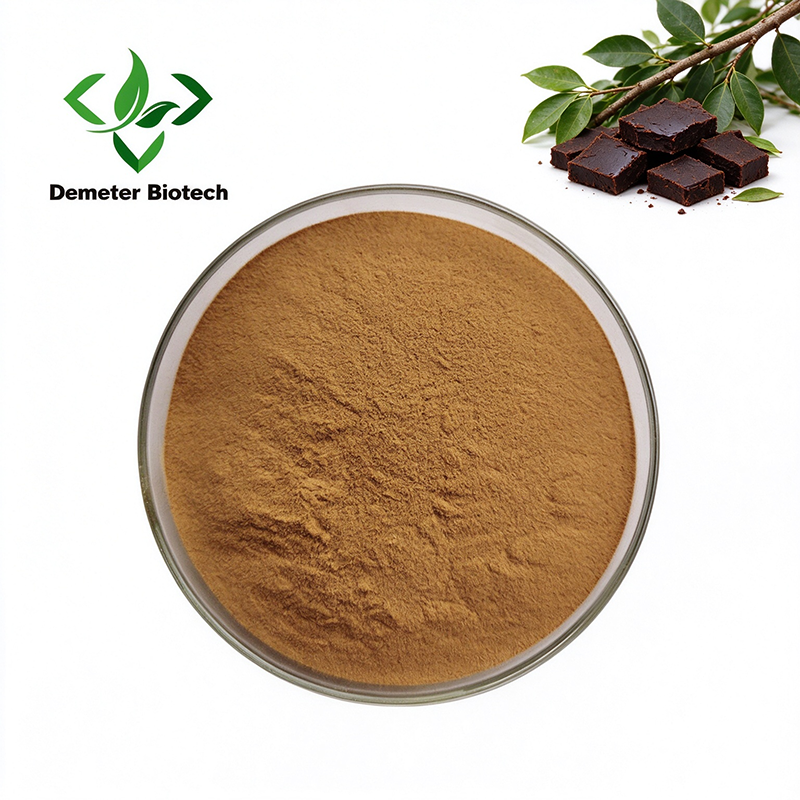
| Appearance | Fine brown to dark brown powder |
| Solubility | Water and hydro-alcoholic; not oil-soluble |
| Loss on Drying | ≤5.0% |
| Total Ash | ≤5.0% |
| Particle Size | ≥95% passing 80 mesh |
| Bulk Density | 45–60 g/100 mL |
| Heavy Metals | Total ≤10 ppm; Pb ≤2.0, As ≤2.0, Cd ≤1.0, Hg ≤0.1 ppm (ICP-MS) |
| Microbiology | TPC ≤1,000; yeast & mould ≤100 cfu/g; E. coli negative; Salmonella negative |
| Packaging | 25 kg fibre drum, double LDPE liner; 1 kg foil bag samples |
| Storage | Under 25 °C, dry, dark; keep sealed |
| Shelf Life | 24 months, drum unopened |
| Certifications | ISO 9001, FSSC 22000, HACCP; Kosher / Halal on request |
| Origin | Shaanxi, China (Xi’an) |

Key Highlights
01
02
03
04
05
Certificate of Analysis
| Test Item | Specification | Result | Method |
|---|---|---|---|
| Appearance | Fine brown to dark brown powder | Complies | Visual |
| Extraction Ratio | 10:1 / 20:1 | Complies | Weight basis |
| Total Catechins | Reported per lot | Reported per lot | HPLC, 280 nm |
| Loss on Drying | ≤5.0% | Complies | USP<731> |
| Total Ash | ≤5.0% | Complies | USP<281> |
| Particle Size | ≥95% through 80 mesh | Complies | Sieve |
| Bulk Density | 45–60 g/100 mL | Complies | ASTM D1895B |
| Heavy Metals (as Pb) | ≤10 ppm | Complies | ICP-MS |
| Lead (Pb) | ≤2.0 ppm | Complies | ICP-MS |
| Arsenic (As) | ≤2.0 ppm | Complies | ICP-MS |
| Cadmium (Cd) | ≤1.0 ppm | Complies | ICP-MS |
| Mercury (Hg) | ≤0.1 ppm | Complies | ICP-MS |
| Total Plate Count | ≤1,000 cfu/g | Complies | USP<61> |
| Yeast & Mold | ≤100 cfu/g | Complies | USP<62> |
| E. coli | Negative | Complies | USP<62> |
| Salmonella | Negative | Complies | USP<62> |
Extract Profile
Ratio, Not Assay
The number tells you the wood-to-powder weight, and nothing about a catechin percentage.
Two Doses From One Drum Line
Switching between 10:1 and 20:1 needs no requalification of mesh or moisture.
Deep Brown Colour
Both grades carry the wood tone; the 10:1 sits darker, the 20:1 lighter.
Same Paper Trail
COA, TDS and SDS follow the drum whichever ratio you order.
Application Fields


Volume Capsule Lines
Chosen when the formula fixes a wood equivalent per capsule rather than a catechin figure.
Hide & Leather Work
Works as a vegetable tannin; pick 20:1 when the finished hide must stay pale.
Cloth Dyeing
Lays brown and khaki onto cotton and wool as a plant-derived colour.
Flavour Compounds
US listing is FEMA 2264, cited at 21 CFR 172.510 for flavouring use.
Oral Care Pastes
Supplied as water-soluble powder for paste and rinse systems.


