

Products


Pure Natural Hops Flower Extract Powder 2.5% Flavones (UV) Hops Extract Humulus Lupulus Extract
Food Grade Botanical
Natural Hops Flower Extract 2.5% Flavones
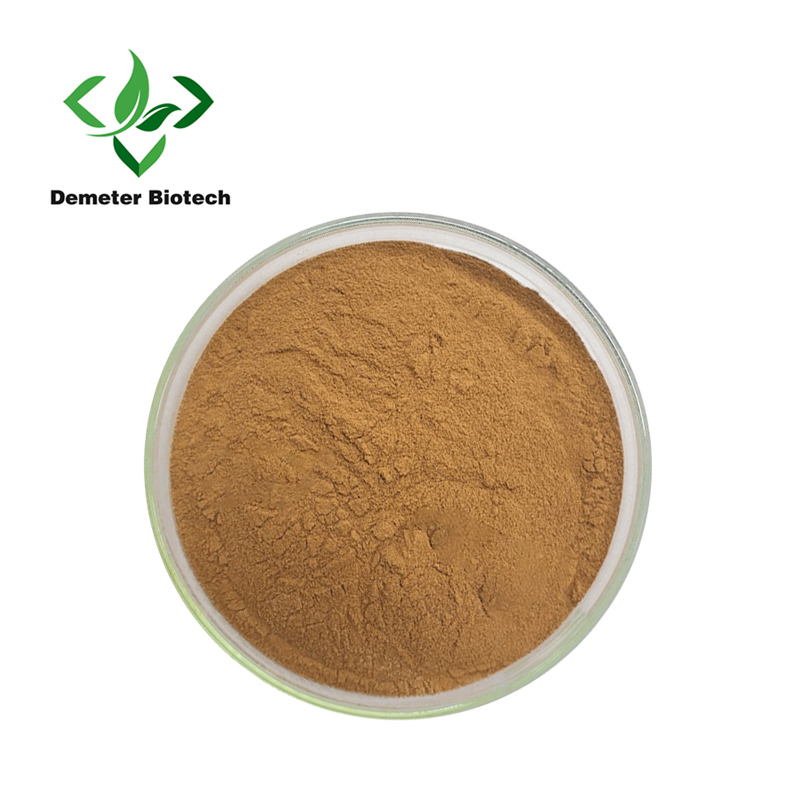
The hop cone is grown for its resins and its prenylated flavonoids, and this powder carries both out of the kiln-dried flower. We standardise it to 2.5% total flavonoids, read by UV against a rutin standard, and we print that method on the label so nobody has to guess what the number represents. Colour runs from dark brown to brown-yellow, the aroma stays in the powder, and the material suits beverages, flavour systems and supplement blends alike.
CAS 8060-28-4
2.5% UV
Free Sample

Product Specification
| Parameter | Detail |
|---|---|
| Product Name | Hops Flower Extract Powder, 2.5% Flavones |
| Botanical Name | Humulus lupulus L. |
| Plant Part | Female inflorescence (cone), dried |
| CAS Number | 8060-28-4 |
| EINECS No. | 232-504-3 |
| FEMA No. | 2578 |
| US Regulatory | 21 CFR 182.20 (GRAS, flavouring agent) |
| Appearance | Fine powder, dark brown to brown-yellow |
| Assay | Total flavonoids 2.5% min, UV-VIS as rutin |
| Extraction Solvent | Ethanol / purified water |
| Solubility | Soluble in aqueous ethanol; partly dispersible in water; insoluble in fixed oils |
| Loss on Drying | ≤5.0% |
| Total Ash | ≤5.0% |
| Particle Size | ≥95% through 80 mesh |
| Heavy Metals | Pb ≤2.0; As ≤1.0; Cd ≤1.0; Hg ≤0.1 ppm — ICP-MS, values per lot |
| Microbiology | TPC ≤1,000 cfu/g; Yeast & Mould ≤100 cfu/g; E. coli absent/g; Salmonella absent/25 g |
| Packaging | 25 kg fibre drum, double LDPE inner bag; 1 kg foil bag samples |
| Storage | Sealed, protected from light, below 25 °C |
| Shelf Life | 24 months, unopened original pack |
| Certificates | ISO 9001 and HACCP available; Kosher / Halal on request |
| Origin | Shaanxi, China (Xi’an) |

Key Highlights
01
02
03
04
05
06
Certificate of Analysis
| Test Item | Specification | Result | Method |
|---|---|---|---|
| Appearance | Dark brown to brown-yellow powder | Complies | Visual |
| Total Flavonoids (as rutin) | 2.5% min | Complies | UV-VIS |
| Xanthohumol (XN) | Present, not standardised | Reported per lot | HPLC |
| 8-Prenylnaringenin (8-PN) | Present, not standardised | Reported per lot | HPLC |
| Loss on Drying | ≤5.0% | Complies | USP<731> |
| Total Ash | ≤5.0% | Complies | USP<561> |
| Particle Size | ≥95% through 80 mesh | Complies | Sieve |
| Lead (Pb) | ≤2.0 ppm | Numeric per lot | ICP-MS |
| Arsenic (As) | ≤1.0 ppm | Numeric per lot | ICP-MS |
| Cadmium (Cd) | ≤1.0 ppm | Numeric per lot | ICP-MS |
| Mercury (Hg) | ≤0.1 ppm | Numeric per lot | ICP-MS |
| Total Plate Count | ≤1,000 cfu/g | Complies | USP<61> |
| Yeast & Mould | ≤100 cfu/g | Complies | USP<62> |
| E. coli | Absent / g | Absent | USP<62> |
| Salmonella | Absent / 25 g | Absent | USP<62> |
Function & Wellness Support
Resin & Bitter Profile
Alpha and beta acids remain in the powder, so bitterness can be dialled in without dosing leaf.
Prenylated Flavonoids
Xanthohumol and 8-prenylnaringenin occur naturally in the cone and travel into the extract unchanged.
Relaxation Positioning
Brands most often build calming and sleep-oriented formulas around hops; the ingredient supplies the base, the claim belongs to the brand.
Menopausal Comfort Category
8-PN has drawn interest for women’s mid-life formulas, a positioning that sits in the brand’s dossier, not in ours.
Application Fields
Brewing
Bittering and stability work in beer, the application the 21 CFR 182.20 entry was written for.
Functional Drinks
Hop-forward soft drinks and evening blends, dosed as a concentrate rather than a leaf addition.
Dietary Supplements
Capsules, tablets and stick packs, often paired with valerian, lemon balm or passionflower in calming blends.
Flavour Compounding
An aroma-bearing botanical that flavour houses use to give a beer note to non-alcoholic formats.
Personal Care
The extract appears in topical formulas as a botanical with its own documented sensory and stability behaviour.