


What Is GHK-Cu? Identity, CAS, Formula, Structure
GHK-Cu is the copper(II) complex of a three-amino-acid peptide — glycyl-L-histidyl-L-lysine, written Gly-His-Lys. In the cosmetic ingredient system it is listed as Copper Tripeptide-1. This article is a pure identity and specification reference: what the molecule is, the numbers that identify it on a certificate, and how a raw-material lot is documented. It does not discuss performance.
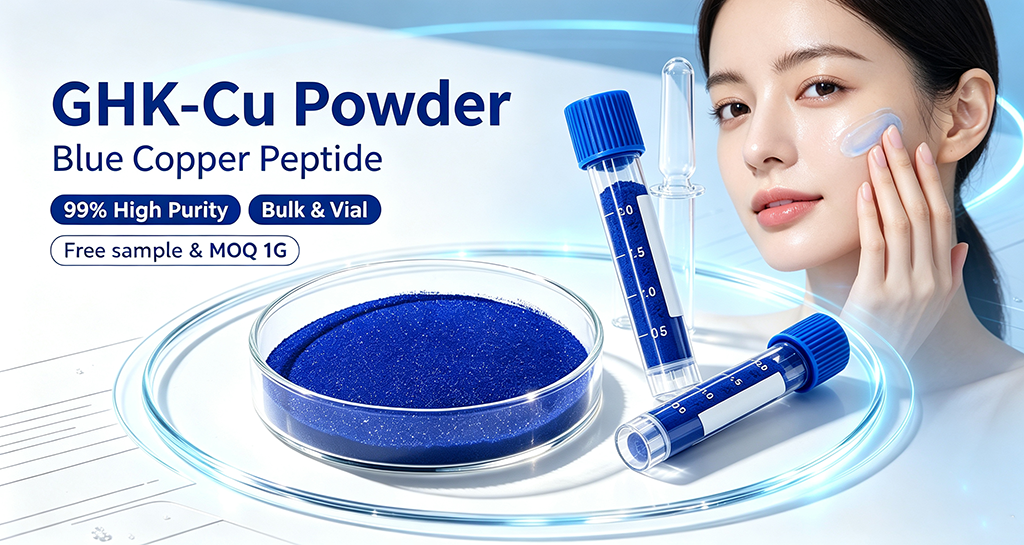
Two products on the market share the GHK-Cu name but differ in how they are regulated and what they are for. This series covers only the cosmetic raw-material side: a topical ingredient supplied to formulators and brands. For a purchasing or formulation team, the first job is to read the molecule correctly: a tripeptide that binds one copper ion. That single structural fact drives its colour, its solubility behaviour, its storage needs and the way a batch is specified. At Demeter Biotech we supply GHK-Cu as a cosmetic-grade lyophilized powder in 1 g bottles, and every lot ships with a full certificate of analysis. Below is the identity baseline every specification should start from.
1. The molecule at a glance
GHK-Cu is built from three amino acids — glycine, histidine and lysine — linked in the sequence Gly-His-Lys. The free tripeptide, GHK, has a strong natural affinity for copper(II). When it binds one copper ion it forms a chelate that gives the characteristic blue complex used in cosmetics. The peptide was first isolated from human plasma in 1973 (Pickart, 1973), and the copper complex has since become one of the most documented peptides in cosmetic raw-material literature. In the INCI (International Nomenclature of Cosmetic Ingredients) system the ingredient is named Copper Tripeptide-1, and its recorded function is skin conditioning.
2. Identity specification
These are the figures a laboratory reports on an identity line. They are not potency numbers; they tell you what the material is, not what it does.
| Parameter | GHK-Cu (copper complex) | Free GHK tripeptide |
|---|---|---|
| CAS number | 89030-95-5 | 49557-75-7 |
| Molecular formula | C14H22CuN6O4 | C14H24N6O4 |
| Molecular weight | ~401.91 g/mol | 340.38 g/mol |
| Sequence | Gly-His-Lys, copper(II) bound | Gly-His-Lys |
| Appearance | Blue powder | White to off-white powder |
| Solubility | Water-soluble | Water-soluble |
| pH stability (typical) | Stable around pH 5–7 | Stable around pH 5–7 |
3. Why the copper defines it
The copper is not a filler — it is the structural centre of the complex. On a mass basis, the pure copper complex carries about 15.8% copper, calculated from the atomic mass of Cu (63.55) over the complex mass (~401.91). Commercial cosmetic-grade material often reports a lower copper figure because of salt form and hydration, so the only number that binds a lot is the one on its certificate. This copper-centred identity is also why the ingredient is handled as a metal-complex raw material: it is sensitive to conditions that disturb the coordination, a topic we cover in the stability and formulation articles of this series.
4. How it is supplied
GHK-Cu reaches the market in a few physical forms: lyophilized (freeze-dried) powder, pre-dissolved solution, and bulk powder for large-scale manufacturing. Each form trades off stability, convenience and handling. We cover the packaging question in detail in a later article — why freeze-dried bottles dominate, and what the alternatives are. For now, the practical point is that form should be written into the specification alongside the identity numbers above, because the same molecule behaves differently once water and time are involved.
5. How Demeter supplies GHK-Cu
At Demeter Biotech we supply cosmetic-grade GHK-Cu as a 1 g lyophilized bottle. The material is Copper Tripeptide-1 (INCI), water-soluble, and each lot is released against a certificate of analysis covering identity, assay, heavy metals and microbiology. Tell us your target specification — purity, documentation and certification — and we confirm the batch figures before the order is packed. We supply cosmetic raw material for formulators and brands.

Blue Copper Peptide GHK-Cu Powder — Copper Tripeptide-1, Water-Soluble Cosmetic-Grade Active
Cosmetic-grade GHK-Cu supplied as a 1 g lyophilized bottle. Copper Tripeptide-1 (INCI), water-soluble, released against a batch certificate covering identity, assay, heavy metals and microbiology. For formulators and brands building topical cosmetic systems.

Pure Blue Copper Peptide Powder GHK-Cu (CAS 89030-95-5) — Cosmetic Grade, 99% Tripeptide-1
High-purity cosmetic-grade GHK-Cu, CAS 89030-95-5, supplied as a 1 g lyophilized bottle. Copper Tripeptide-1 (INCI), water-soluble; full batch certificate provided on request.
Send us your target specification and your documentation list, and we will map the right lot and confirm the numbers on the certificate before you commit — so the material you specify is the material you receive.
References
- Johnson W Jr, Bergfeld W, Belsito D, et al. Safety Assessment of Tripeptide-1, Hexapeptide-12, Their Metal Salts and Fatty Acyl Derivatives, and Palmitoyl Tetrapeptide-7 as Used in Cosmetics. International Journal of Toxicology. 2018;37(3 Suppl):90S-102S. doi:10.1177/1091581818807863
- Pickart L. Growth-modulating plasma tripeptide. Analytical Biochemistry. 1973. doi:10.1016/0003-2697(73)90108-0
This article describes ingredient identity and specification only. It is not a statement of efficacy. References are cited to document identity and the cosmetic safety assessment, not to imply any effect on the human body. Molecular formula, molecular weight and CAS values are literature figures for the named compounds; the only numbers that bind a lot are those on its batch certificate of analysis.
Post time: Oct-21-2026


