



Liposome technology is no longer limited to pharmaceutical development. It is increasingly being applied in dietary supplements, functional foods, and high-end nutritional formulations, where absorption efficiency, stability, and formulation compatibility are becoming critical. For brands and R&D teams, liposomes are valued not only as a way to “carry” active ingredients, but also as a platform that helps ingredients maintain better dispersibility, stability, and usability in complex product systems.
At the industrial level, the significance of liposomes lies in whether they can support the successful translation of active materials into scalable commercial products. In this sense, liposome technology has evolved from a laboratory concept into a formulation platform with real industrial relevance.
What Liposomes Are
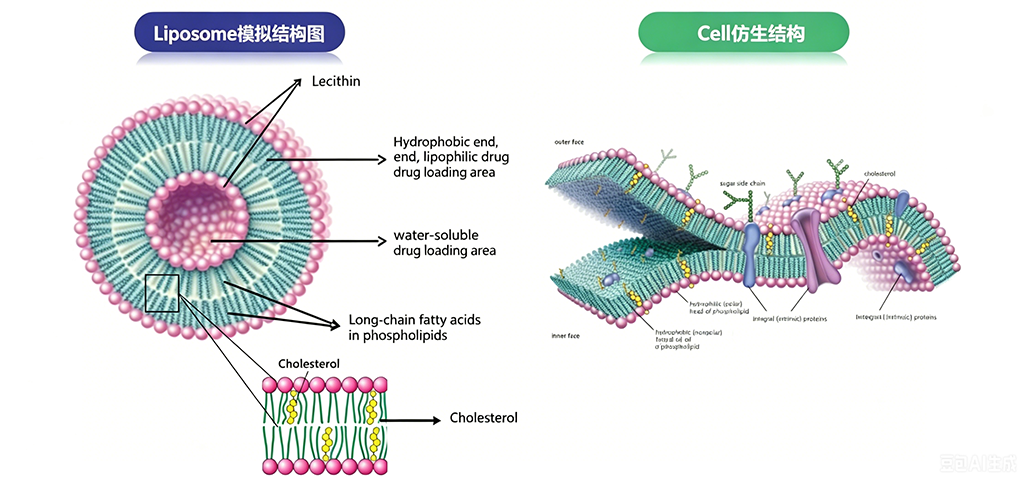
Liposomes are closed vesicular structures formed by phospholipid molecules in an aqueous environment. Their defining feature is a phospholipid bilayer, which gives them a structure similar to biological membranes. Because of this biomimetic architecture, liposomes are widely regarded as highly biocompatible delivery systems.
Their structure allows them to encapsulate both hydrophilic and lipophilic ingredients. Hydrophilic compounds can be carried in the inner aqueous core, while lipophilic compounds can be incorporated into the bilayer membrane. This dual-loading capability makes liposomes suitable for a wide range of applications in pharmaceuticals, nutritional products, and functional foods.
Why Liposomes Matter
Liposomes are widely recognized because they offer several technical advantages. First, they are generally biocompatible and biodegradable, which supports their use as a mature and versatile delivery system. Second, they can improve the dispersibility and formulation compatibility of certain active ingredients. Third, they provide more design flexibility for oral delivery, local delivery, and sustained-release systems.
In nutritional ingredient development, these advantages are especially important. Many functional actives face challenges such as poor solubility, limited stability, or weak absorption behavior. Liposomes can help address these formulation barriers by improving how the ingredient behaves in the final product system.
The Structure of Liposomes
A typical liposome is composed of phospholipids and often includes cholesterol or similar stabilizing components:
- Phospholipids: These essential lipids self-assemble to form the fundamental lipid bilayer structure.
- Cholesterol: This component helps reinforce membrane stability and maintain structural integrity during processing and storage.
From a formulation science perspective, the real value of liposomes is not just whether vesicles are formed, but whether key parameters such as particle size, encapsulation efficiency, PDI, and surface charge remain stable and reproducible. These factors directly influence performance in practical applications and determine whether a liposome system is suitable for industrial scale-up.
How Liposome Technology Has Evolved
Liposome development has progressed from basic phospholipid vesicles to modified liposomes, long-circulating systems, actively targeted systems, and co-loaded liposome platforms. This evolution shows that liposomes are no longer simply ingredient carriers; they have become adaptable delivery systems that can be optimized according to application needs.
Functional Component Design
At more advanced levels, liposomes can be designed with natural functional components or modified materials to improve stability and application fit.
Integrated Formulation Platform
This methodology is helping liposome technology move from a single-purpose carrier concept toward a highly versatile, integrated formulation platform.
Key Factors in Industrialization
Whether liposomes can become a viable commercial ingredient depends on their ability to be produced stably, reproducibly, and at scale. For industrial raw materials, encapsulation efficiency, particle size distribution, PDI, and zeta potential are not just characterization parameters; they are essential quality indicators that influence formulation consistency and batch reliability.
Research has shown that higher encapsulation efficiency and more controlled particle size can improve the performance of certain active ingredients. However, such improvements do not come from a single parameter alone; they result from the combined effect of liposome structure, preparation process, and downstream handling conditions. In industrial development, the value of liposomes lies in system-level optimization rather than isolated performance claims.
Applications in Nutritional Ingredients
In dietary supplements and functional foods, liposomes are often used to address ingredients that have limited absorption, lower stability, or weaker formulation compatibility. They are highly suitable for softgels, hard capsules, oral liquids, instant powders, and functional beverages, as well as products where mouthfeel, dispersion, and homogeneity are important.
For brands, the appeal of liposomes lies in their ability to support both premium product positioning and complex formulation development. In products where dosage, stability, and consumer experience must all be balanced, liposomes provide a more structured and technically credible solution.
Quality Control and Compliance
To enter international markets, liposome products must be supported by a complete quality control system. In addition to basic ingredient analysis, parameters such as particle size, encapsulation efficiency, zeta potential, stability, and microbiological or heavy metal limits are typically included in batch testing and release standards.
For overseas buyers, access to clear TDS, MSDS, and COA documentation is also critical. A mature liposome supplier must have not only process capability, but also analytical capability and documentation support in order to meet the requirements of different markets.
Industry Outlook
The future of liposome technology will not be defined only by higher encapsulation rates. It will increasingly depend on stable industrial delivery, broader formulation adaptability, and reliable technical documentation. As nutrient delivery systems continue to move toward higher-value and platform-based applications, liposomes are expected to appear more frequently in functional foods, nutritional supplements, and premium personal care formats.
For ingredient suppliers, real competitiveness will come not just from being able to make liposomes, but from being able to deliver stable, traceable, and scalable liposome products. For brands and R&D teams, that is what turns a technical concept into a practical industrial solution.
TECHNICAL SEO INDEXING MATRIX:
Liposome Delivery Platform Scientific Review, Phospholipid Bilayer Architecture, Encapsulation Efficiency Parameters, Nanoscale Particle Size Distribution, Liposomal Technical Evaluation, Nutrient Delivery Systems Academic Overview, Formulators Reference Matrix.
Post time: Jun-08-2026


