


Precision Engineering: Achieving 99% Purity in Sodium Copper Chlorophyllin Production
Redefining water-soluble pigments through high-purity standardization and stability.
Sodium copper chlorophyllin, commonly abbreviated as SCC and identified by CAS 28302-36-5, is one of the most widely recognized water-soluble green pigments used in food and related formulations. For B2B buyers, its importance does not come from color alone. Instead, SCC is increasingly evaluated as a precision ingredient whose real value lies in its purity, solubility, and stability across a range of formulation conditions.
In practical terms, SCC is a chlorophyll derivative that undergoes copper complexation and salt formation to create a more process-friendly green colorant. That processing step matters because it changes the behavior of the molecule in water-based systems. Unlike pigment systems that require oil carriers or special dispersion methods, SCC can dissolve in aqueous formulations, making it useful in beverages, liquid nutrition products, and other systems where uniform color distribution is essential.
Core Specifications
- Assay Purity: ≥ 99.0%
- Solubility: 100% Water Soluble
- State: Fine Dark Green Powder
- Standard: Food/Pharma Grade
01
The 99% Purity Benchmark: Sensory and Visual Integrity
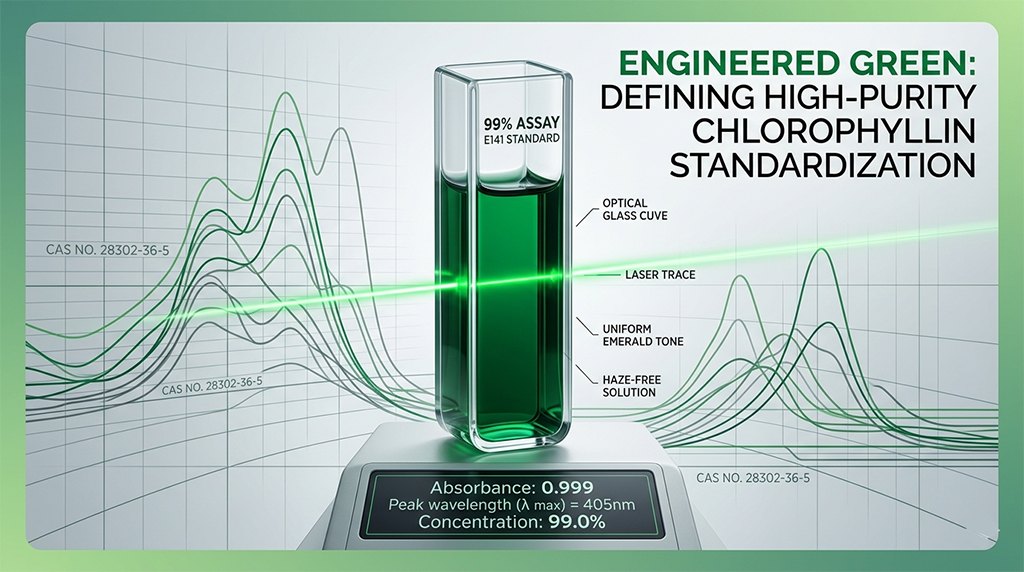
For technical purchasers, purity is a central specification. A 99% purity grade is not simply a marketing label; it reflects a tighter manufacturing standard that reduces the presence of unwanted by-products and contributes to a cleaner sensory profile. In food applications, impurities can influence both color tone and odor, so higher-purity material is often preferred when the final product must maintain a consistent appearance and neutral sensory impact. That is especially important in liquid systems, where any off-note or haze can be immediately visible to consumers.
Precision Manufacturing Pathway
Standardized stages designed to convert raw chlorophyll into stable, predictable pigment.
02
Aqueous System Optimization: Solubility and pH Stability
One of the most useful properties of SCC is its water solubility. This characteristic sets it apart from many other green color systems and helps explain why it is common in beverages and liquid blends. In formulation terms, water solubility supports easier mixing, better distribution, and reduced dependence on emulsified carrier systems. For manufacturers working with ready-to-drink products or premix liquids, this can simplify processing and reduce the complexity of color adjustment.
Stability is equally important. Chlorophyll-based colorants often behave differently under varying pH conditions, and food formulators need to understand how a pigment performs across the intended application range. Technical references on plant-based pigments consistently show that pH, temperature, oxygen, and moisture can influence color retention. SCC is used because it offers a more practical balance of stability and solubility than many simpler chlorophyll preparations, especially when the application demands a controlled green tone in a liquid environment.
03
Consistency in Industrial-Scale Processing
Thermal stability is another reason SCC remains relevant. Research on commercial grade sodium copper chlorophyllin has shown that heating can influence pigment degradation over time, which is why manufacturers pay close attention to process conditions. Even so, its behavior under heat is often more manageable than that of less processed natural pigments, making it suitable for products that undergo pasteurization, warm mixing, or moderate thermal treatment. For B2B buyers, this means the ingredient can be judged not only by color, but by how well it survives the realities of food manufacturing.
Another practical reason to specify a high-purity SCC grade is consistency. When colorants are used in large-scale production, small differences in assay or impurity profile can lead to visible changes between batches. A 99% purity product helps reduce that variability, which is especially valuable for brands that need repeatable results across global production lines. In that sense, high purity is not just about analytical numbers; it is about making a pigment more predictable for industrial use.
Conclusion: A Predictable Tool for Formulators
Because of these properties, SCC is particularly well suited to technical applications that prioritize uniformity and ease of use. Looking ahead, demand for standardized green pigments is likely to remain strong as manufacturers continue to favor ingredients that combine scientific definition with reliable processing behavior. SCC fits that need because it is not simply a colorant, but a well-characterized water-soluble pigment with a clear manufacturing pathway and a strong fit for liquid formulations.
Keywords Index:
Sodium Copper Chlorophyllin 99%,
CAS 28302-36-5 Chlorophyll,
Water-Soluble Pigment,
Food Grade Additive E141,
Natural Green Colorant Stability,
Liquid Beverage Pigment,
High Purity SCC Manufacturer
CONTACT US
Post time: Apr-16-2026


