



Liposome technology has become one of the most discussed topics in nutrient delivery and advanced formulation development. As more products begin using terms such as “liposome,” “nano-encapsulation,” and “high-absorption delivery,” buyers and R&D teams face a practical question: how can you tell whether a product truly uses liposome technology, or is simply borrowing the term for marketing purposes?
The answer is not found in promotional language alone. A genuine liposome product should be supported by a set of technical indicators that can verify its structure, loading method, and stability. In practice, serious liposome products are usually backed by particle size data, encapsulation efficiency, PDI, zeta potential, morphology images, release behavior, and stability data.
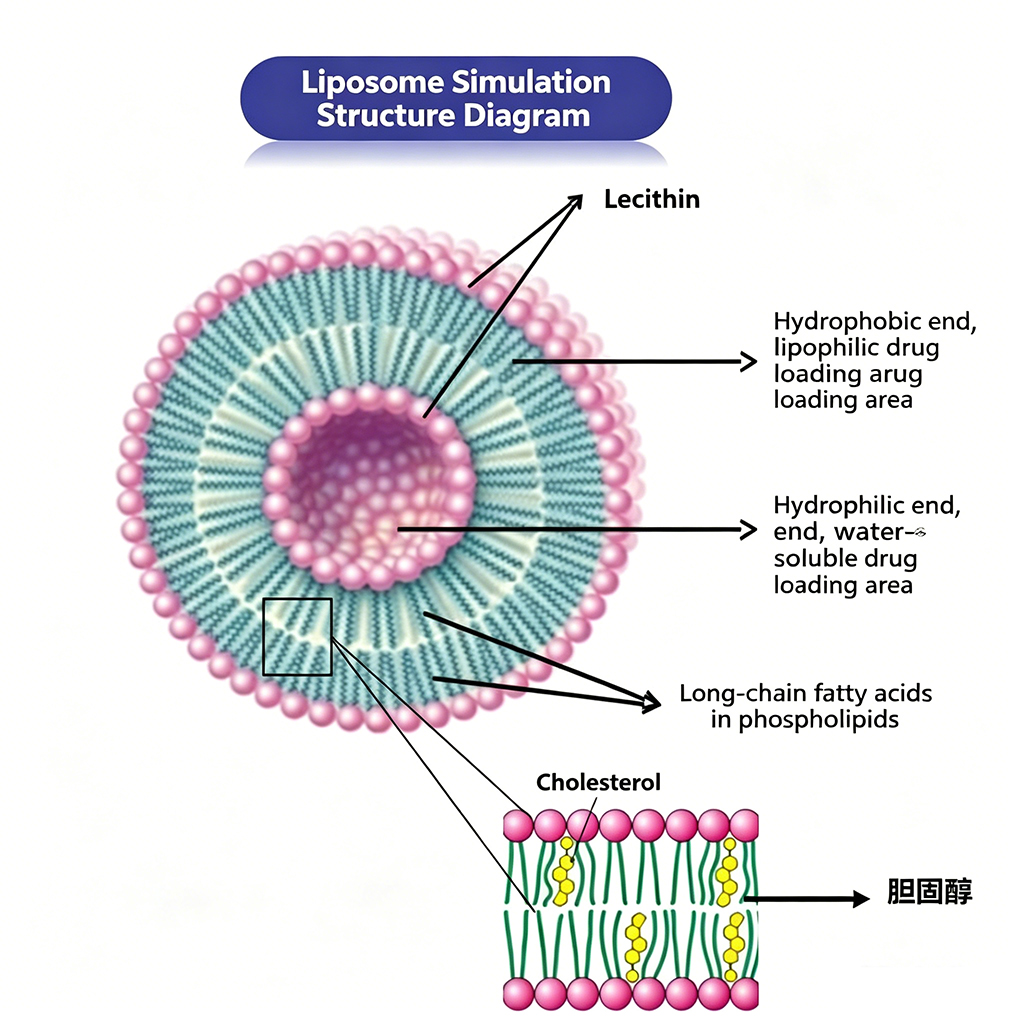
Liposomes Are a Structure, Not a Label
A liposome is a closed vesicular structure formed by phospholipids in an aqueous environment. Its defining feature is the phospholipid bilayer, which makes it structurally similar to biological membranes. Because of this, liposomes are widely considered a biomimetic delivery system.
This structural similarity is a major reason liposomes are used in pharmaceuticals, dietary supplements, and functional food development. A liposome is not simply a powder with a fancy name. It is a defined membrane-based system in which the active ingredient must be incorporated in a way that can be measured, characterized, and reproduced.
Critical Evaluation Framework: Key Technical Parameters
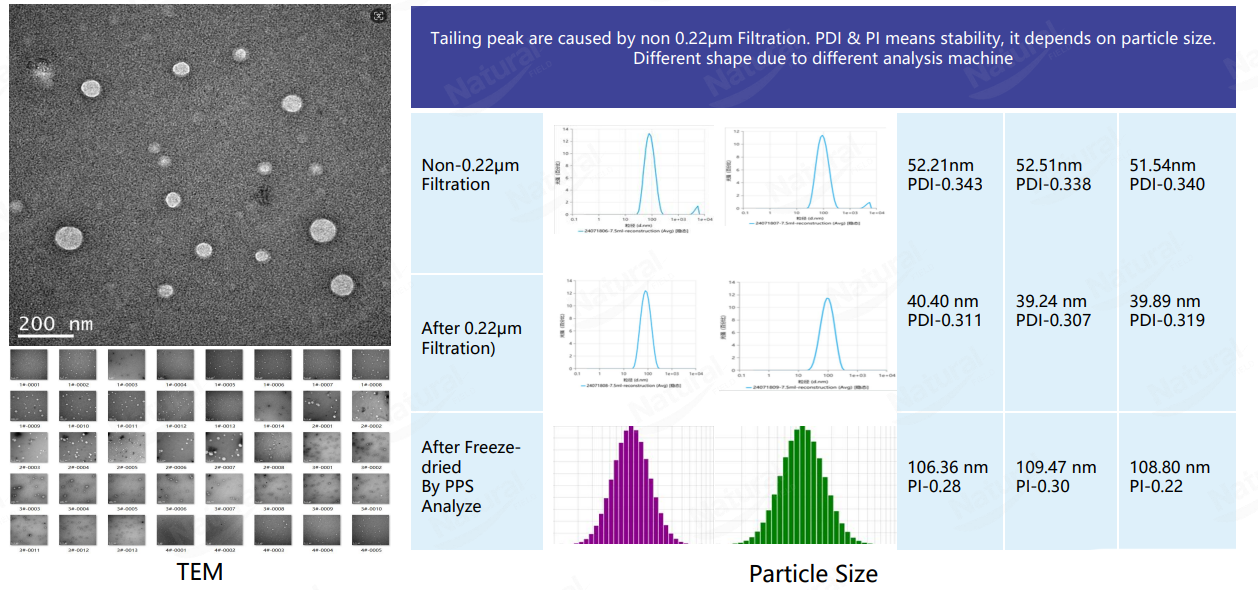
To establish a rigorous verification matrix, researchers and quality engineers evaluate several interconnected physical and chemical variables:
Particle Size: The First Checkpoint
Particle size is one of the most fundamental parameters used to characterize liposomes. In many cases, liposomes are measured by dynamic light scattering and evaluated to see whether they fall into a nanoscale range. However, particle size alone does not prove that a product is truly a liposome; it must always be interpreted together with morphology and composition data.
PDI: A Measure of Uniformity
PDI, or polydispersity index, is used to assess how uniform the particle size distribution is. From a quality control perspective, PDI is an important reflection of batch consistency and process control. For industrially relevant liposome products, the system must remain reproducible during scale-up and repeated manufacturing.
Encapsulation Efficiency: Core Loading Verification
Encapsulation efficiency reflects the percentage of total active material successfully entrapped in the delivery system. If encapsulation efficiency is low, a significant portion of the active ingredient remains free in the system rather than being incorporated into the liposome, dropping its core technical value.
Zeta Potential: A Stability Indicator
Zeta potential reflects the surface charge of liposome particles. It is often used as a practical reference for dispersion stability and the likelihood of aggregation or sedimentation. A system with stable particle size, good uniformity, and an appropriate surface charge is generally more reliable for industrial application.
Morphology Evidence: Visual Confirmation
Beyond numerical data, transmission electron microscopy (TEM) and other high-resolution imaging methods help confirm whether particles have the typical vesicular structure. If particle images, size data, and encapsulation data all support the same conclusion, the true liposome technology identity becomes fully validated.
Release Behavior: Controlled Kinetic Dissolution
Professional liposome products often include in vitro release behavior under simulated gastric or intestinal testing conditions. Release curves help formulators understand whether the liposome delivers the active in a controlled way, which determines how the final product performs in the real world.
Stability Data: Can the Liposome Survive Storage and Processing?
A liposome product is not complete just because it can be made. It must also show that it can remain stable during storage, transport, and downstream processing. Stability evaluation usually includes changes in particle size, encapsulation efficiency, leakage, oxidation, aggregation, and sedimentation.
For industrial buyers, stability is the dividing line between a research concept and a commercial ingredient. If the system drifts rapidly in size or loses its active load over time, its practical value drops sharply. That is why stability data, together with particle size, encapsulation efficiency, and zeta potential, forms the core evidence chain for a serious liposome product.
A Practical Checklist for Buyers
If you are a buyer, brand owner, or R&D professional, the following analytical questions can help you determine whether a product truly uses liposome technology:
- ●
Does the supplier provide particle size and standardized size distribution data? - ●
Is encapsulation efficiency clearly stated and backed by valid analytical protocols? - ●
Are reproducible PDI and zeta potential variables included in the batch logs? - ●
Are morphology images or high-resolution electron microscopic validations available? - ●
Is real-time stability data provided under standard storage or thermal processing conditions? - ●
Does the supplier explain the precise lipid composition matrices and preparation processes? - ●
Are comprehensive technical dossiers including TDS, COA, and MSDS documents instantly available?
If the answers are consistent and supported by matching analytical data, the product is far more likely to be a true liposome ingredient rather than a concept-driven formulation.
Conclusion
Liposome technology should be judged by structure, data, and reproducibility, not by marketing language alone. Particle size, PDI, encapsulation efficiency, zeta potential, morphology images, release behavior, and stability data together form the evidence chain that shows whether a product is truly liposomal and whether it is suitable for commercial use.
For the industry, understanding these parameters makes it easier to distinguish technically credible ingredients from products that only use the liposome label. For brands and R&D teams, it also improves the ability to select raw materials with real development value.
TECHNICAL SEO INDEXING MATRIX:
Evaluating Liposome Products, Verify True Liposome Technology, Encapsulation Efficiency Assay, Nanoscale Particle Size Criteria, Liposomal PDI Standards, Zeta Potential Stability Indicators, Liposomal Morphology Verification, R&D Formulation Ingredient Assessment.
Post time: Jun-09-2026


