



Product Supply Note
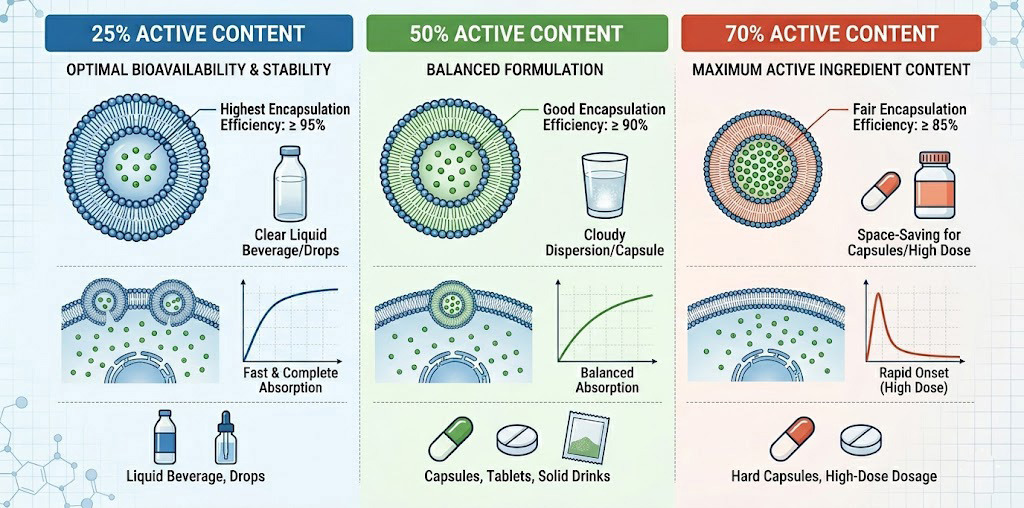
We supply high-standard liposomal Vitamin B1 raw material in both 50% and 70% loading grades. The material is suitable for capsules, tablets, compound powders, and multi-ingredient nutritional formulations. Buyers working on high-density dosage form design are welcome to contact us for samples and technical evaluation.
In modern nutritional formulation development, the real challenge is often not whether an active ingredient is available, but how to fit it into a limited dosage-form space without compromising the stability or processing behavior of the overall formula. This issue is especially relevant for Vitamin B1, a basic nutrient that is often used alongside other vitamins, minerals, botanical extracts, and functional ingredients.
The high-loading design of **liposomal Vitamin B1** was developed to address this kind of space-related formulation pressure. The 50% and 70% loading grades are not just numerical differences. They reflect different levels of active density, raw material footprint, and **formulation flexibility**. For B2B buyers developing compact, **multi-component products**, this difference is highly practical.
1. Why High Loading Matters
In formulation science, loading determines how much of the raw material is actual active ingredient, while the rest functions as carrier or structural support. Lower-loading ingredients often require a larger input to deliver the same effective dose, which can take up valuable formulation space and increase the overall size of capsules, tablets, or **powder blends**.
High-loading liposomal Vitamin B1 helps solve this problem by delivering more active input in a smaller material footprint. In other words, formulators do not need to sacrifice space that could otherwise be used for other ingredients. This is especially important in premium **multi-ingredient formulas**, where different functional modules must be integrated into a single **product system**.
2. How It Helps Capsules and Tablets
Capsules and tablets are the most space-constrained dosage forms. When a formula contains multiple actives, even one ingredient with a large footprint can push up total fill weight, increase capsule size, or add compression pressure during tableting. For brands and contract manufacturers, these factors directly affect **product design flexibility**.
High-loading liposomal Vitamin B1 makes it possible to deliver the required thiamine input without significantly increasing raw material volume. This makes it better suited for **compact capsules**, complex tablets, and **multi-active formulas**. The goal is not just to make the ingredient “more concentrated,” but to help formulators arrange active ingredients more efficiently within limited dosage space.
3. Why It Also Matters for Compound Powders
Although space pressure is often discussed first in capsules and tablets, **compound powder systems** also depend on ingredient density. In premixes, instant powders, nutrition shakes, and multi-component functional powders, too much carrier material or too little active density can reduce formulation efficiency and affect cost structure.
High-loading liposomal Vitamin B1 allows formulators to include more functional ingredients in the same blend volume, or to maintain the same dose while reducing the overall formula footprint. This is a practical advantage for brands developing premium, compact, and **multifunctional powder products**. Liposome structure can also improve **dispersion behavior** in powder systems.
4. Why Buyers Care About Particle Size, Encapsulation Efficiency, PDI, and Zeta Potential
High loading does not mean other technical indicators can be ignored. For B2B buyers, loading answers the question of whether the ingredient can fit into the formula. **Particle size**, **encapsulation efficiency**, PDI, and **zeta potential** determine whether the material can be used reliably over time.
Particle Size
Particle size affects uniformity in powder or dispersion systems and influences downstream processing and **structural stability**.
Encapsulation Efficiency
Encapsulation efficiency shows whether the active ingredient has truly been incorporated into the **liposome structure** rather than remaining free in the system.
PDI (Polydispersity Index)
PDI reflects whether particle size distribution is uniform; a narrower distribution usually indicates greater stability and better **batch consistency**.
Zeta Potential
Zeta potential is an important reference for whether particles are likely to aggregate, settle, or destabilize during
Post time: Jun-09-2026


