



Technical Briefing // Ingredient Stability Matrix
High Absorption Liposomal Vitamin E Powder: Supporting Shelf-Life Integrity in Complex Antioxidant Formulas
High Absorption Liposomal Vitamin E Powder (Tocopheryl Acetate, CAS 7695‑91‑2) is engineered to address a deeper formulation vulnerability: in multi‑ingredient manufacturing systems, standard vitamin E routinely acts as a “sacrificial” antioxidant, oxidizing prematurely and bleeding biological activity in order to shield more vulnerable co-actives. While this structural sacrifice delays bulk product degradation, it consistently leaves finished goods with heavily depleted vitamin E content long before reaching the end of their commercial shelf life. Advanced liposomal micro-encapsulation delivers a strategic spatial separation architecture that rigorously safeguards vitamin E retention until the exact moment of targeted deployment.
I. Vitamin E as a Sacrificial Antioxidant in Modern Formulas
In high-tier product design, formulators frequently combine multiple functional systems, such as Vitamin C + Vitamin E synergy networks, highly unsaturated marine fish oils, lipid-dense matrixes, and complex Coenzyme Q10 plant-extract blends.
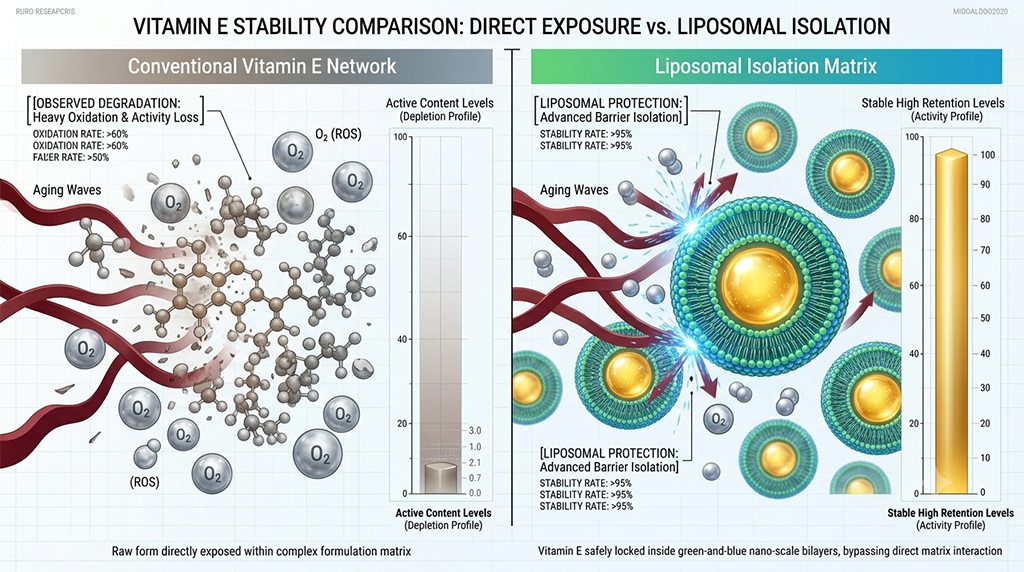
Within these densely packed molecular environments, unencapsulated vitamin E sits directly exposed to ambient atmospheric oxygen, trace processing metals, and localized moisture. It undergoes early oxidation during storage, absorbing oxidative stress to mask bulk changes like color shifts or product rancidity. Over extended periods, the concentration of intact active tocopheryl acetate declines sharply, leaving commercial shelf-life targets unpredictable and forcing companies to integrate massive, unscientific raw overages to hit label claims.
II. Liposomal Spatial Isolation: A Micro-Scale Barrier Concept
Our proprietary Liposomal Vitamin E Powder utilizes non-GMO, plant-derived phospholipid bilayers to erect a precise micro-scale physical barrier around each tocopheryl acetate molecule. The lipophilic core of the structured vesicle natively retains the vitamin E, partitioning it completely away from neighboring reactive components and dissolved oxygen trapped in the bulk formula matrix.
This rigorous spatial isolation prevents premature storage-phase interactions. By withholding the chemical antioxidant action until ingestion or topical contact breaks the vesicle, the lipid matrix ensures a significantly higher percentage of intact active nutrients survives intact. R&D teams can now model shelf-life lifecycles with absolute statistical precision.
III. From Blind Overages to Data-Informed Shelf-Life Design
Stabilizing the molecule inside robust lipid domains shifts the commercial paradigm from defensive packaging over-formulation to targeted, proactive ingredient performance. Complex multi-component supplement matrixes—including volatile oils, delicate emulsions, and botanical powders—can successfully sustain structural appearance and target values under a controlled antioxidant strategy.
By replacing blind overages with deliberate structural engineering, brands drastically improve batch consistency, curtail raw material waste, and guarantee that the end-consumer receives the precise nutritional density claimed on the product label.
IV. Technical Dossier Verification & Scalable Resilient Fulfilment
Our premium grade Liposomal Vitamin E Powder Bulk Supply is supported by batch-validated technical dossiers. Every delivery features detailed high-performance liquid chromatography (HPLC) validation assays, non-GMO lipid vehicle identity profiles, and laser-diffraction particle size consistency sheets demonstrating tight polydispersity index (PDI) boundaries.
Manufactured within highly automated, long-term bulk production lines subject to rigorous quality controls, we ensure a dependable global supply chain footprint for multi-regional enterprise operations. Backed by climate-stabilized warehouse reserves and temperature-mapped international logistics, we guard the integrity of the fragile phospholipid bilayers from our processing rooms straight to your manufacturing facilities.
Post time: Jul-06-2026


