



GHK-Cu Is a Cosmetic Ingredient: Where the Lane Is Drawn
A CAS number tells you which substance you have. It does not tell you which category the material sits in. That second question is answered by paperwork and by wording — and it is the question your compliance reviewer will actually ask.
When a brand owner or a formulator asks whether GHK-Cu is a cosmetic ingredient, the useful answer is not a yes or a no. It is a list. The molecule is a fixed chemical entity — a tripeptide holding one copper(II) ion, CAS 89030-95-5 — and a fixed entity has no category of its own. What places a material in the cosmetic lane is the purpose you state for it and the way you present it, supported by documents that can be checked. At Demeter Biotech we supply GHK-Cu as a cosmetic-grade lyophilized powder in 1 g bottles for topical cosmetic formulation, and nothing else; the batch documents that establish that position travel with every lot. This note sets out what those pillars are, and what should be in the file before you commit to a purchase order.
1. A molecule has identity, not a category
Chemistry gives you identity. Identity gives you a specification. Neither one assigns a market lane. A substance identifier resolves to a structure, a molecular weight and a set of physical constants; it says nothing about whether the material in the bottle is offered for topical cosmetic formulation, for laboratory work, or for any other framing. The lane is assigned downstream, by the party placing the material on the market, from two things: the intended use it states and the presentation it puts in front of the next party in the chain.
This is why two bottles of the same blue powder can carry completely different obligations. Same CAS number, same molecular formula, same appearance. What differs is the dossier attached to each, and the words used to describe it. If your purchasing brief asks only for a substance name and a price per gram, you have specified a chemical and left the category unspecified — and the category is where the compliance work lives.
2. Two pillars: intended use and presentation
Reviews of European cosmetics legislation describe the classification of a product as turning on exactly these two things: the use that is presented for it, and the way it is understood to act. That framing was set out when the legislation was revised, in work arguing that market surveillance should follow a documented, transparent basis for those judgments (Lodén et al., 2007). Reviews of national frameworks that implement the same principles reach the same conclusion from the other end of the chain: the category a product falls into follows the use intended and stated by the party putting it on the market (Altıokka and Üner, 2022).
For a raw material, the two pillars translate into two concrete things you can hold in your hand:
| Pillar | At raw-material level | At finished-product level |
|---|---|---|
| Intended use | The application the material is sold for, stated in the specification and the commercial documents: topical cosmetic formulation | The product type on the technical file and the notification, and the function the ingredient performs in the formula |
| Presentation | The INCI name on the document, the grade, and the way the material is described in correspondence and on the spec sheet | The label, the claims, the copy, the imagery: everything a reviewer reads to decide what the product is offered to do |
Notice that neither pillar is a chemistry question. Both are documentation questions. And both are answerable before you place an order, which is the practical point of this whole note: the lane is not something you discover after customs clearance.
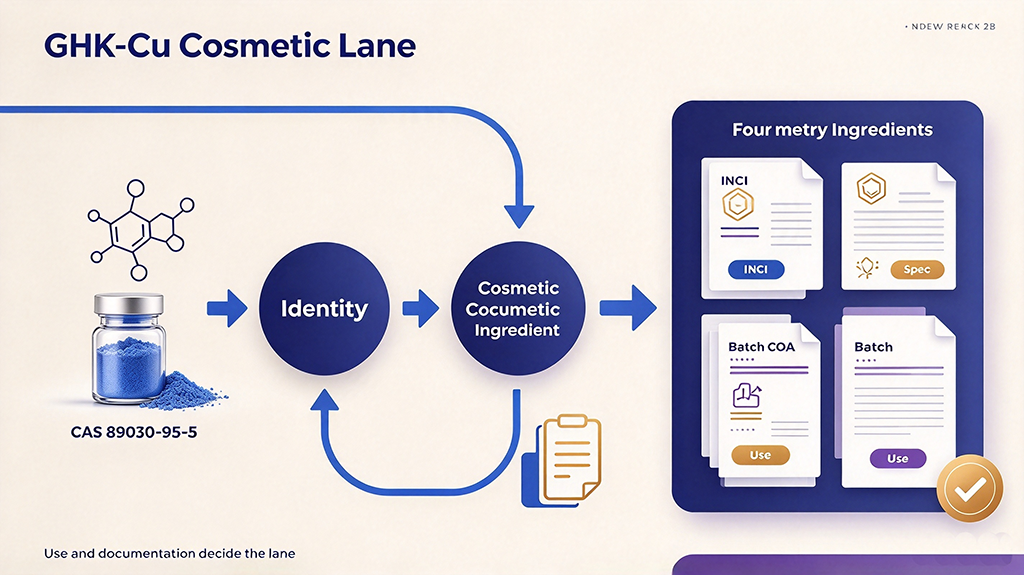
3. The entry ticket: four documents
If the category is a documentation question, then the way to be sure of your position is to be sure of your file. For a cosmetic peptide raw material, four items do the work. Ask for all four at quotation stage, and a good part of the ambiguity in this category disappears before money moves.
| Document | The field to look for | What it settles |
|---|---|---|
| INCI declaration | Copper Tripeptide-1 — the label-legal name, not a trade name | That the material is named the way a cosmetic ingredient label requires |
| Substance identifier | CAS 89030-95-5, with the molecular formula on the same page | Which substance was actually shipped, independent of any trade wording |
| Specification sheet | Assay basis and method, copper content, appearance, solubility, grade, stated application | That the grade and the stated use match what your formula requires |
| Batch certificate | Lot number, measured assay, heavy metals, microbiology, date of manufacture | That the specific lot in the box meets the sheet, not just that a sheet exists |
Two of these four are routinely missing from quotations in this category: the assay basis and the batch-level figure. A purity percentage with no method attached is not comparable with the next quotation, and a specification sheet with no lot number is a promise rather than a record. Both gaps are cheap to close at quotation stage and expensive to close after the goods have landed.
4. Why the trade name is the weakest line in the file
Category wording is where sloppiness enters. “Copper peptide” is not a declared ingredient name; it is a trade grouping that can cover the Gly-His-Lys complex, a different copper-binding sequence, or a copper salt with no peptide at all. A document that identifies the material only by that grouping has not told you which of those you are buying, and therefore cannot tell you which file you need. We set out the naming differences in a separate note in this series; the point here is narrower: the INCI name and the CAS number are the two lines that turn a category word into a checkable material.
5. Claims: one paragraph, deliberately
The pillar that moves most often after purchase is presentation. A raw material can arrive with a flawless file and still end up in a finished product whose wording has left the cosmetic lane, because wording travels with the product rather than with the ingredient. Two consequences follow for your own workflow. First, keep the intended use stated on your specification consistent with what your marketing team drafts, since those are the same pillar seen from two ends. Second, read the claim text as a document to be reviewed, not a line to be polished at the end of the project. Claim wording deserves its own note, and this series keeps it in a separate article; here we only note that it belongs to the same classification question as the certificate.
6. What this note leaves to its neighbours
Deliberately narrow scope keeps a series useful instead of repetitive. Regional notification and registration routes are a separate note, because they differ by market and change by year. The behaviour of the complex in a formula — pH window, what competes for the copper — is covered where we discuss formulation chemistry. Use levels and the arithmetic behind a small order sit in their own article. Packing forms, including the lyophilized bottle, are covered on their own. This note covers one question only: what makes this material a cosmetic raw material, and how you verify that position from documents.
7. How Demeter supplies GHK-Cu
At Demeter Biotech we supply the copper complex — Copper Tripeptide-1, CAS 89030-95-5 — as a cosmetic-grade lyophilized powder in 1 g bottles, for topical cosmetic formulation. That is the whole of what we supply. Every lot is released against a certificate of analysis that states identity, assay and method, copper content, heavy metals and microbiology, and the INCI name and CAS number are printed on the documents rather than left to be inferred. If your market requires an additional declaration or a specific format for the file, tell us what it is and we will confirm whether the lot documentation meets it before the order is packed. What we will not do is leave the category of the material vague in order to make a quotation look simpler.

Blue Copper Peptide GHK-Cu Powder — Copper Tripeptide-1, Water-Soluble Cosmetic-Grade Active
Cosmetic-grade GHK-Cu supplied as a 1 g lyophilized bottle. Copper Tripeptide-1 (INCI), CAS 89030-95-5, water-soluble, released against a batch certificate covering identity, assay, copper content, heavy metals and microbiology.

Pure Blue Copper Peptide Powder GHK-Cu (CAS 89030-95-5) — Cosmetic Grade, 99% Tripeptide-1
High-purity cosmetic-grade GHK-Cu, CAS 89030-95-5, in a 1 g lyophilized bottle. Copper Tripeptide-1 (INCI), water-soluble; the batch certificate states peptide assay, copper content and the analytical method used.
The category of a raw material is not a property of the molecule. It is a property of the file and of the words attached to the file — which makes it something you can audit before you order, and something your own team can break afterwards if the presentation drifts. Keep both ends of the pillar straight and the question stops being a worry.
References
- Lodén M, Ungerth L, Serup J. Changes in European legislation make it timely to introduce a transparent market surveillance system for cosmetics. Acta Dermato-Venereologica. 2007;87(6):485-492. doi:10.2340/00015555-0311
- Altıokka A, Üner M. Safety in cosmetics and cosmetovigilance, current regulations in Turkey. Turkish Journal of Pharmaceutical Sciences. 2022;19(5):610-617. doi:10.4274/tjps.galenos.2021.40697
This article discusses substance identity, documentation and the regulatory category of a raw material only. It makes no statement about the effect of the ingredient on any person, and it describes no application other than use as a cosmetic raw material. Descriptions of legal frameworks are summaries for orientation, not legal advice; the applicable text in your market governs, and the figures that bind a lot are those on its own batch certificate of analysis.
Post time: Oct-28-2026


