



Bulk Ingredients Supply Note
We supply high-purity liposomal PQQ powder in 50% and 70% loading grades (CAS 72909-34-3). Adopting non-GMO sunflower phospholipid nano encapsulation, our raw materials resolve oxidation loss and low absorption of conventional PQQ. Global formulators can request trial samples, full batch COA and professional formulation technical support.
Pyrroloquinoline Quinone (PQQ) is a premium clean-label ingredient famous for supporting mitochondrial biogenesis, antioxidant balance and long-term metabolic wellness. Yet countless supplement brands struggle with unstable finished goods and weak consumer feedback when using unprocessed, conventional PQQ. Its inherent sensitivity to light, heat and gastric acid creates two irreversible pain points: massive active degradation during production and minimal nutrient uptake after oral intake. This article breaks down these limitations and explains how biomimetic phospholipid bilayers turn liposomal PQQ into a more reliable raw material for modern wellness lines.
I. Two Inherent Critical Drawbacks of Uncoated Conventional PQQ
Free PQQ without protective encapsulation carries structural flaws that harm both manufacturing efficiency and end-product efficacy. The following two issues trouble formulators across capsules, beverage powders and oral liquids:
1. Easy Oxidation & Activity Loss During Processing & Storage
- Free PQQ is highly photosensitive and thermolabile. It oxidizes quickly when exposed to air, leading to obvious discoloration and sharp drops in active content;
- During wet granulation, powder blending and beverage premixing, oxidation causes uneven color distribution, failing visual quality standards;
- To offset activity decay, manufacturers must add extra antioxidant excipients or over-dose PQQ, raising overall formula costs.
2. Ultra-Low Oral Bioavailability Reduces Consumer Satisfaction
- Without a biological shield, most free PQQ molecules break down rapidly in acidic stomach fluid before reaching intestinal absorption zones;
- The small fraction that survives digestion struggles to cross lipid cell membranes, limiting mitochondrial activation effects;
- Long-term users report faint improvements in daily energy and anti-aging outcomes, dragging down product repurchase rates.
Performance Comparison Table: Conventional PQQ VS Liposomal PQQ
| Comparison Items | Conventional PQQ | Liposomal PQQ |
|---|---|---|
| Anti-Oxidation Ability | Poor, prone to discoloration | Excellent, phospholipid barrier blocks light/oxygen |
| Gastric Acid Resistance | Weak, most activity destroyed | Strong, intact delivery to intestines |
| Processing Compatibility | Risk of stratification & color shift | Uniform dispersion in all water-based formulas |
| In-Vivo Bioavailability | Low, limited mitochondrial support | Dozens of times higher cell uptake |
| Long-Term Shelf Stability | Significant active decline | Stable PQQ retention rate |
II. Liposomal Phospholipid Bilayer Delivery Technology: Dual-Sided Solutions
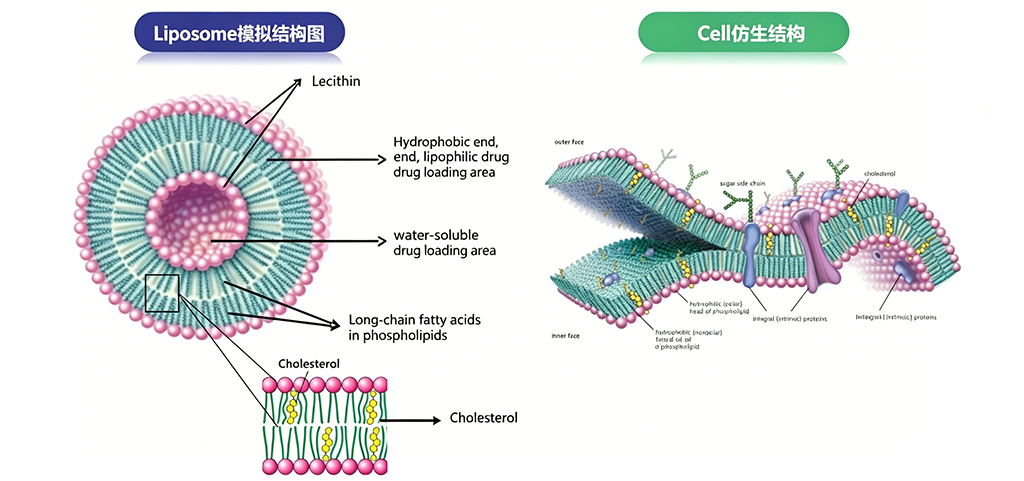
Our liposomal system uses non-GMO sunflower lecithin to form nano phospholipid vesicles that fully encapsulate PQQ core molecules. The biomimetic structure matches human cell lipid composition, creating a dual-function delivery system that fixes both manufacturing and absorption barriers at once.
1. Block Oxidation Loss in All Production Stages
- The compact phospholipid bilayer forms a physical shield against UV light, oxygen and temperature swings;
- Free-flow liposomal powder avoids agglomeration and color variation during mixing and filling;
- No extra synthetic antioxidants are required, simplifying clean-label ingredient lists.
2. Achieve Cell & Mitochondria Targeted Absorption
- Liposomal carriers survive harsh stomach acid and transport complete PQQ to intestinal absorption sites;
- Phospholipid vesicles fuse rapidly with intestinal epithelial membranes, boosting systemic PQQ concentration;
- Sustained nutrient release prolongs mitochondrial activation, delivering consistent energy and anti-aging benefits.
Rigorous quality control verifies genuine liposomal formation: encapsulation efficiency ≥80%, rehydrated particle size controlled at 80–300 nm, and consistent PQQ loading validated via HPLC per batch.
III. Clean-Label End Product Applications for Liposomal PQQ
Thanks to balanced stability and high bioavailability, our 50% & 70% liposomal PQQ powder fits multiple premium wellness categories:
- Single-ingredient anti-aging capsules and mini easy-swallow pills;
- Compound mitochondrial formulas blended with liposomal NR, CoQ10 or ergothioneine;
- Single-serve functional beverage sachets and daily nutrition premixes;
- Cognitive support supplements targeting middle-aged and senior groups;
- Sports metabolic recovery and oral beauty clean-label lines.
IV. Closing Summary & Brief Supply Logistics Note
Conventional unencapsulated PQQ is limited by unavoidable oxidation degradation and weak human absorption, restricting brand competitiveness in high-end wellness markets. Liposomal PQQ built on plant phospholipid bilayer technology eliminates both core bottlenecks simultaneously, enabling stable manufacturing processes and stronger consumer efficacy feedback. It has become a core differentiated raw material for global clean-label longevity supplement brands.
We maintain continuous bulk stock of 50% and 70% liposomal PQQ powder CAS 72909-34-3. Flexible MOQ supports small trial batches and long-term mass cooperation. Packaging ranges from 1kg foil bags to 25kg fiber drums with temperature-controlled sea and air logistics for global delivery. Contact our sales team to request free samples, full technical datasheets and customized wholesale quotations.
TECHNICAL SEO INDEXING MATRIX:
Liposomal PQQ Powder 50% 70%,
PQQ CAS 72909-34-3 Bulk Supply,
Conventional VS Liposomal PQQ,
High Bioavailability Mitochondrial Raw Material,
Non-GMO Sunflower Lecithin Liposomal PQQ,
Clean Label Anti-Oxidation Supplement Ingredient,
Low Oxidation Liposomal PQQ Factory Direct.
Post time: Jul-08-2026


