

0.5% L-Selenomethionine Powder: Practical Formulation Rules, Storage Stability & Field Livestock Breeding Solutions
Driven by the clean-label trend across Europe and North America, organic selenium premixes have gradually replaced inorganic selenium in premium feed and nutritional food formulas. The standardized 0.5% L-selenomethionine premix is specially designed for industrial blending, drastically lowering calculation errors for nutrition formulators. Combined with PMC peer-reviewed livestock trials and official NIST detection specifications, this article delivers actionable blending plans, storage precautions and applicable breeding scenarios for feed mills and food ingredient enterprises.
1. Core Application Scenarios & Dosage Guidelines
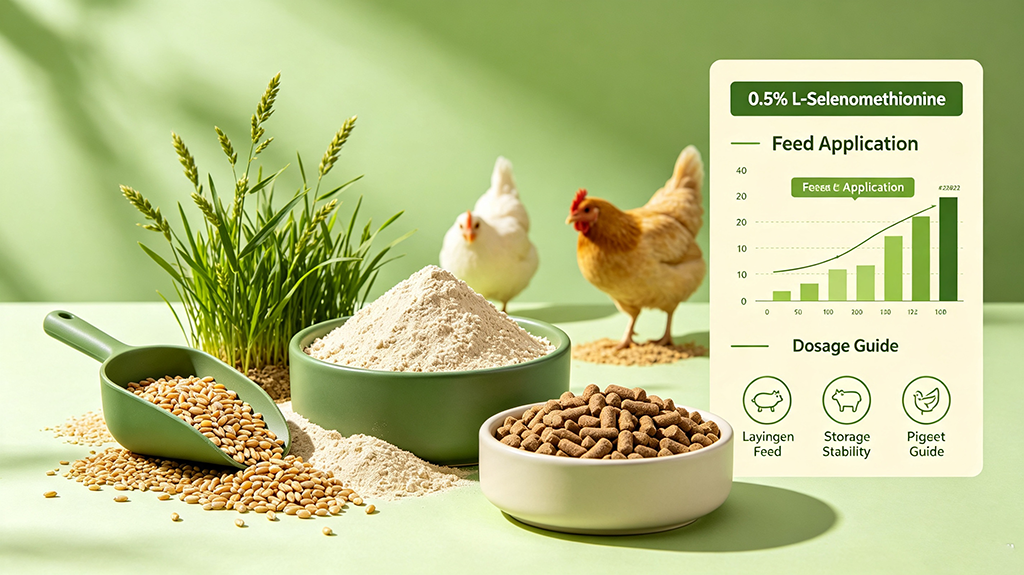
- Complete laying hen feed: Dilute the 0.5% premix to reach 0.5 mg/kg total selenium in final feed, elevating egg selenium content and overall antioxidant capacity, verified by SCI controlled trials;
- Weaned piglet diets: Appropriate supplementation alleviates oxidative stress post-weaning, protects hepatic function and stabilizes growth performance;
- Human functional food & dietary supplements: Low-proportion blending for gentle, long-term selenium nutritional support;
- Aquafeed & ruminant feed: Strictly abide by EU selenium caps for comprehensive nutritional fortification.
All blending schemes comply with EU Regulation 121/2014 selenium upper limits to avoid excessive intake and meet EU export compliance requirements.
Physicochemical Properties & Storage Stability Profile (CAS: 3211-76-5)
Appearance: Off-white free-flowing fine powder
Active ingredient content: 0.5% w/w L-Selenomethionine
Solubility: Slightly soluble in water, compatible with most common feed carriers
Storage requirements: Sealed, cool, dry and shaded warehouse; avoid high temperature and direct UV radiation to prevent active ingredient degradation
Testing standard: NIST mass spectrometry method for precise selenium quantification for internal QC and third-party inspection
2. Antioxidant Mechanism & Immunity Regulation Principles
Cellular research confirms L-selenomethionine activates the Nrf2/GPX4 antioxidant pathway to scavenge redundant free radicals and mitigate oxidative damage. A comprehensive review published on PMC elaborates its regulatory effects on intestinal flora and systemic immunity, which accounts for the superior performance of organic selenium under stressful intensive breeding conditions compared with inorganic alternatives.
NIST has released official mass spectrometry detection protocols for L-SeMet in premixes and finished foods. Manufacturers may adopt this method to build internal quality control systems and guarantee consistent selenium concentration across batches.
3. Key Advantages for Commercial Feed Mills
1. Fixed 0.5% standardized concentration simplifies weighing and mixing workflows and minimizes manual operational errors;
2. Better physicochemical stability than inorganic selenium, resistant to oxidation and deterioration during feed pelleting and long-distance transportation;
3. Natural organic attribute fits European and American clean-label trends, assisting downstream brands in premium market positioning.
4. Sample Trial & Technical Support
All batches are manufactured in strict accordance with USP standards, EU feed regulations and EFSA safety requirements. We can provide USP-compliant COA, heavy metal test reports, MSDS and chiral HPLC certificates. Buyers may request free samples for formulation and feeding trials before placing bulk orders.
References
1. USP L-Selenomethionine Monograph: https://doi.usp.org/USPNF/USPNF_M74840_04_01.html
2. EFSA Selenium Scientific Opinion: https://efsa.onlinelibrary.wiley.com/doi/full/10.2903/j.efsa.2023.7704?af=R
3. EU Feed Legislation EU 121/2014: http://faolex.fao.org/docs/pdf/eur131168.pdf
4. Laying Hen Feeding Trial: https://pmc.ncbi.nlm.nih.gov/articles/PMC9465117/
5. Piglet Oxidative Stress Research: https://pmc.ncbi.nlm.nih.gov/articles/PMC10967351/pdf/antioxidants-13-00295.pdf
6. NIST Official Detection Manual: https://archive.unu.edu/unupress/food/fnb23-3s-4.pdf
7. Immunity & Metabolism Review: https://pmc.ncbi.nlm.nih.gov/articles/PMC11941941/
8. Nrf2 Antioxidant Pathway Study: https://pubmed.ncbi.nlm.nih.gov/41897537/
Post time: Aug-13-2026


