


White Willow Bark Extract: The Latin Name Decides the Paperwork, Not the Number
One product name on a quotation sheet can stand for several different materials. Before two salicin figures mean anything, three lines have to be fixed — species, plant part, and the basis the extract is standardised on.
The words “white willow bark extract” name a tree by its common name, a plant part, and a processing step, and they leave the decisive line blank. White willow is a trade phrase rather than a botanical one, bark, twig and leaf all travel under the same description, and the field where a number belongs can hold either a ratio or a standardised content. Each of those gaps is cheap to close and expensive to discover late: they decide whether your documentation matches the market you are shipping into, whether two lots can be compared at all, and whether a price is being quoted for the same material. At Demeter Biotech we supply white willow bark extract from Salix alba L., bark only, and we put the species, the part and the analytical method on the file rather than in conversation. What follows is the reasoning behind that habit, using published measurements rather than trade claims.
1. A name is a category, not an identity
“Willow” covers a large genus, and the common name “white willow” has been applied in commerce to more than one of its species. That is not a labelling trick so much as a normal consequence of trading a genus by a folk name. The effect is that the same three words can describe barks whose baseline composition differs by a factor of several, which is the subject of the next section. Add the plant part and the standardisation basis and you have three separate axes, each of which can move a specification without the product name changing at all.
| Line | What it fixes | What goes wrong when it is missing |
|---|---|---|
| Genus and species, with the author citation | Which botanical baseline the bark comes from | Your file names one taxon, the certificate names another, and the market that recognises only certain taxa never gets satisfied |
| Plant part, with the branch age where the definition requires it | Which tissue was extracted, and how woody it is | Two “bark” lots behave differently because one is largely current-year twig, which is a different material with a different fibre load |
| Extraction ratio or standardised content, declared as one pair | How much raw bark is represented, and what the batch is held to | A ratio without a content figure, or a content figure without a basis, cannot be audited against a certificate |
None of these three lines is exotic, and none requires a laboratory to write down. They are simply the ones most often left out of a short product description, because the description was written to be searchable rather than to be checkable.
2. Between species, the baseline moves by a factor, not by a shade
The most direct evidence comes from a survey of willow barks analysed by high-performance liquid chromatography. Working across willow taxa, Kenstavičienė and colleagues reported salicin contents spanning 0.04% to 12.6% of bark depending on species, and listed Salix alba among the taxa that accumulated the lowest amounts (Kenstavičienė et al., 2009). A separate study compared six species under one chromatographic method and quantified total salicin after hydrolysis: S. alba clone 1100 gave 25.4 mg/g of total salicin, while S. daphnoides clone 1095 gave 96.47 mg/g (Pobłocka-Olech et al., 2007).
Total salicin in dried bark, two species under one method (mg/g)
S. daphnoides clone 1095 — 96.47 mg/g
S. alba clone 1100 — 25.4 mg/g, roughly a quarter of the figure above, under the same analytical method
Read those two numbers as a statement about raw material, not about extract quality. They say that if you buy bark without naming the species, the salicin you can expect to recover varies by a factor of nearly four before any processing decision has been made. Read them the other way and you will draw the wrong conclusion, which is the trap in the next section.
3. The layer trap: a bark figure and an extract figure are not the same quantity
The bark figure describes what the raw material contains. The extract figure describes what a finished powder is held to, after solvent extraction, concentration and, where needed, standardisation against a purified reference. Concentrating a low-baseline species into a high-content powder is entirely normal and is precisely why such a product is worth making: the ratio of bark to finished powder rises, the yield falls, and the cost per kilogram of powder follows. So a specification on Salix alba can carry a high salicin figure without contradicting the published bark numbers, and a quotation on a high-salicin species can be cheaper per kilogram of raw material while being dearer per kilogram of finished powder.
The practical instruction is to keep the two layers apart in your own file. State the species and part for the raw material, state the standardisation basis and the method for the finished extract, and never compare a bark percentage with an extract percentage. Most of the confusion in this category lives in that single skipped step.
4. The written definition of “willow bark” does not include white willow
This is the finding most worth carrying into a purchasing conversation, because it is checkable and it is almost never mentioned in a product listing. The European Pharmacopoeia monograph for willow bark, Salicis cortex (monograph 1583), defines the article as the whole or fragmented dried bark of young branches, or whole dried pieces of current-year twigs, of various species of the genus Salix including S. purpurea L., S. daphnoides Vill. and S. fragilis L. It sets a minimum of 1.5% of total salicylic derivatives expressed as salicin, calculated on the dried material, together with macroscopic identity requirements that include a current-year twig diameter of not more than 10 mm. The European Union herbal monograph on the same article, EMA/HMPC/80630/2016, works from the same three species.
Salix alba L. is not among them. So “white willow bark extract” and the pharmacopoeial article called willow bark are not the same specification, and a certificate written against the monograph will not be issued for a white willow lot however good the lot is. Note also how the monograph pairs its declarations: the herbal preparations it lists carry an extraction ratio and a content figure together — a dry extract of 8–14:1 at 15% total salicin, for example. The ratio and the content are written as one statement, which is the same discipline recommended in section 1, and it comes from the definition rather than from preference.
5. White willow is the official source somewhere else
The obvious next question is whether S. alba is therefore the wrong species. It is not, and the answer is more useful than a yes or no. The name index maintained by the Royal Botanic Gardens, Kew, records Salix alba L. as an accepted botanical source of the article Salicis cortex, and lists it as the named species in the Brazilian Pharmacopoeia — young-branch bark, sixth edition, 2019 — and in the German Commission E monographs, with the three European species recorded alongside it. One article name, four accepted botanical sources, different official standing by jurisdiction.
That reframes the whole conversation. “Which species is correct” has no jurisdiction-free answer; “which pharmacopoeia does your destination market assess against” does. If your file has to satisfy the European monograph, you need one of its three species and a white willow lot will not do, regardless of its salicin figure. If your market works from the Brazilian Pharmacopoeia or from German Commission E, S. alba is a named source. Both positions are defensible; only one of them applies to your shipment.
6. Part, branch age and harvest season are the other half of the identity
Species is only the first axis, and the pharmacopoeial definition shows why the second one matters: it does not simply say “bark”, it specifies the bark of young branches, or the whole current-year twigs, with a diameter limit. Bark from an old trunk, bark from a young branch and whole twigs are three materials with different fibre content, different extraction behaviour and different yields, and they can all be sold as willow bark.
The same source data shows the harvest side of the same point. In the survey cited above, bark from two-year-old plants collected in autumn carried about 25% more of these salicin-type derivatives than bark from one-year-old plants collected in spring — a within-species difference produced by age and season alone, with no change of species and no change of processing. So a specification worth the paper it is written on names the part, the branch age where the definition requires it, and the harvest window. Those three details cost nothing to record at the time of production and cannot be reconstructed afterwards.
7. The method line is not a formality
Two laboratories can report different salicin figures for one and the same powder without either being careless, because they are not measuring the same thing. A spectrophotometric method and a chromatographic method answer different questions: the first reads a colour reaction and returns a total, while the second separates individual phenolic glycosides and can report salicin on its own. Add the choice of reference standard and the choice of whether the glycosides are hydrolysed first — total salicin and free salicin are separate quantities — and a bare percentage stops being comparable across sources.
This is why the method belongs on the certificate and on your specification, not only in the laboratory file. A figure reported as total salicin after hydrolysis, quantified against a salicin reference, is a different quantity from a colorimetric total expressed as salicin, and the two can differ by more than the tolerance you are trying to police. When you compare two quotations, compare the method lines first; the numbers only become comparable after that.
8. Five lines to put on the sheet before you ask for a price
| Line | Why it decides the purchase |
|---|---|
| Genus, species and author citation | Decides which pharmacopoeial definition your file can meet, before any number is discussed |
| Plant part, with branch age or twig diameter | Bark, twig and leaf are different materials under one common name |
| Extraction ratio and standardised content, as one pair | Either figure alone cannot be audited; together they describe the material |
| Analytical method, reference standard, and whether the glycosides are hydrolysed | Total and free fractions differ, and two methods on one lot give two figures |
| Lot number on the certificate, matched to the package | A specification is a promise; a lot-level record is what you can inspect |
Five lines, one email, and the comparison stops being a comparison of adjectives. If your destination market assesses against a named pharmacopoeia, add its name as a sixth line — that single word decides whether a given species is usable at all.
9. How we document our white willow bark extract
At Demeter Biotech we supply white willow bark extract from Salix alba L., bark as the plant part, standardised to salicin and released against a batch certificate that states the species, the part, the standardisation basis, the analytical method behind the figure, heavy metals, microbiology, date of manufacture and the lot number. We tell you which species you are being quoted for at quotation stage, not at the packing stage, because that is the point at which it can still change your choice of market.
If your file has to be assessed against a pharmacopoeia that names particular Salix species, tell us before you order. We would rather confirm that the documentation lines up with your destination than ship a good lot into a definition it cannot satisfy. Send us the target market, the species your regulation names and the method your specification requires, and we will confirm what we can put on the file before the goods are packed.
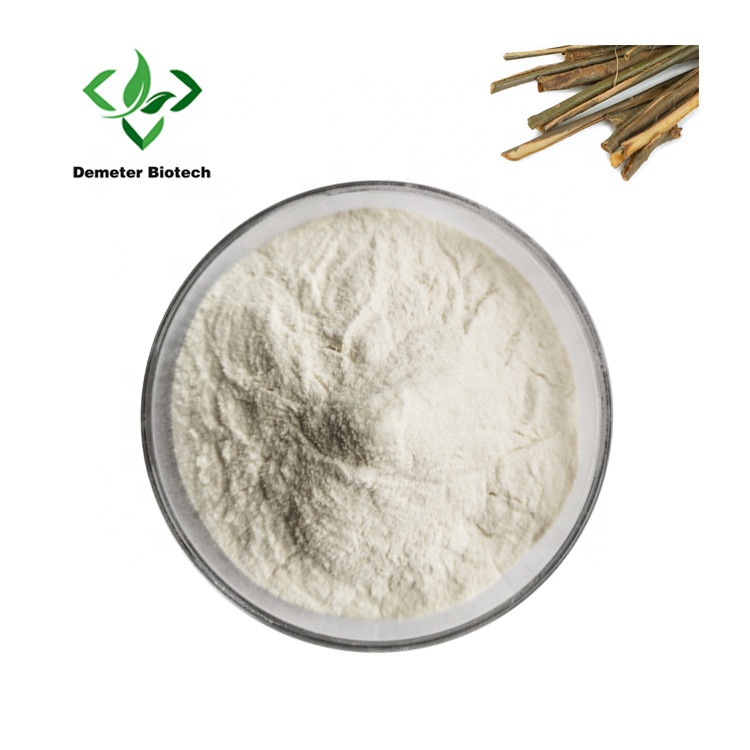
White Willow Bark Extract Powder — Salix alba L., Bark
Bark extract from Salix alba L., standardised to salicin. The batch certificate states species and plant part, the standardisation basis, the analytical method behind the figure, heavy metals, microbiology and the lot number. Packed in 1 kg foil bags and 25 kg fibre drums.
References
Kenstavičienė P, Nenortienė P, Kiliuvienė G, Zevzikovas A, Lukošius A, Kazlauskienė D. Application of high-performance liquid chromatography for research of salicin in bark of different varieties of Salix. Medicina (Kaunas). 2009;45(8):644–651. doi:10.3390/medicina45080084
Pobłocka-Olech L, van Nederkassel AM, Vander Heyden Y, Krauze-Baranowska M, Głód D, Bączek T. Chromatographic analysis of salicylic compounds in different species of the genus Salix. Journal of Separation Science. 2007;30(17):2958–2966. doi:10.1002/jssc.200700137
European Pharmacopoeia, monograph 1583 Salicis cortex. European Union herbal monograph on Salix [various species including S. purpurea L., S. daphnoides Vill., S. fragilis L.], cortex. EMA/HMPC/80630/2016.
This note covers botanical identity, plant part, standardisation and analytical method for a botanical raw material. It is written for purchasing and technical teams and is not a statement about what any ingredient does in a finished product. Pharmacopoeial and regulatory details are summarised for orientation; the current official text of any monograph governs. This note covers Salix alba only and refers to other Salix species solely to explain how the written definitions differ.
Post time: Nov-02-2026


