



In contemporary formulation design, the structural properties of bio-based polyphenolic compounds are undergoing rigorous re-evaluation. As a complex polyhydroxy molecule, Tannic Acid (CAS 1401-55-4) derived from gallnuts offers stable physiochemical functionality across various industrial sectors, supported by its high separation purity and functional group activity.
I. Molecular Structure and Reaction Mechanisms
Tannic acid belongs to the class of hydrolyzable tannins, characterized by a central glucose core esterified with multiple galloyl groups. This highly branched structure provides an abundance of hydroxyl (-OH) reaction sites:
-
Protein Interaction: Through hydrophobic bonding and hydrogen bonding, tannic acid facilitates the cross-linking of protein molecules. This mechanism serves as the theoretical basis for its use in beverage clarification and collagen stabilization in leather processing.
-
Metal Chelation: The ortho-diphenol hydroxyl arrangement allows for the formation of stable coordination complexes with multivalent metal ions (such as $Fe^{3+}$ and $Al^{3+}$). This property is utilized in anti-corrosion coatings and industrial water treatment systems.
II. Analysis of Industrial Applications Based on Chemical Stability
1. Colloidal Stability in Beverage Production
In brewing and juice processing, the function of food-grade tannic acid is primarily manifested in the removal of precipitates. By binding with haze-forming proteins (sensitive proteins), it forms insoluble complexes that can be removed via physical filtration. This process achieves clarity without the introduction of synthetic chemical agents, aligning with current industrial requirements for natural auxiliary processing aids.
2. Inhibition of Oxidation-Reduction Reactions
Due to its hydrogen-donating capacity provided by phenolic hydroxyl groups, tannic acid exhibits free-radical scavenging activity in aqueous systems. During food storage, it may delay lipid oxidation and the degradation of certain nutritional components. This antioxidant behavior is a result of physical interference with the oxidative reaction chain at the molecular level.
III. Sourcing and Purity Considerations: The Gallnut Advantage
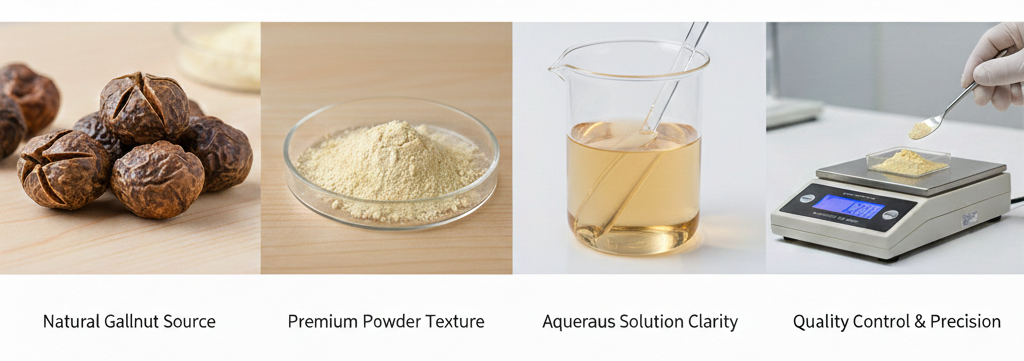
While tannic acid can be extracted from various botanical sources, Gallnut Extract Powder is preferred in precision manufacturing due to its high tannin-to-impurity ratio. Compared to wood-derived tannins, gallnut sources offer enhanced consistency in the following areas:
-
CAS 1401-55-4 Specification: Ensures molecular uniformity, reducing interference caused by varied by-products in fine chemical synthesis.
-
Contaminant Control: Food-grade production standards mandate strict limits on heavy metals (e.g., Lead, Arsenic), which is critical for safety in pharmaceutical intermediates and personal care formulations.
IV. Sustainability Assessment within Green Chemistry Frameworks
As Life Cycle Assessment (LCA) becomes a standard metric in manufacturing, the bio-based nature of tannic acid serves as a key indicator of its industrial value. Gallnuts, as non-timber forest products, are obtained through collection processes that do not rely on intensive agrochemical inputs. Furthermore, tannic acid exhibits favorable biodegradability; in wastewater treatment stages, its environmental burden is significantly lower than that of certain synthetic chelating agents, such as EDTA.
V. Conclusion
As a naturally occurring polymer with a significant history of use, Tannic Acid (CAS 1401-55-4) has transitioned from empirical application to precise, structure-based utilization in modern industry. By applying a deep understanding of its chemical reactivity, formulation engineers can achieve high-performance results while maintaining biological compatibility and environmental standards.
- Alice Wang
- Whatsapp: +86 133 7928 9277
- Email: info@demeterherb.com
Post time: Feb-09-2026


