



1. Introduction: Re-evaluating the “Leucine Hegemony” in Modern Nutrition
For decades, L-Leucine has sat atop the branched-chain amino acid (BCAA) hierarchy, primarily celebrated as the “master switch” for muscle protein synthesis (MPS). However, as the global nutrition market transitions from mass-market supplements to precision metabolic programming, the conversation is shifting.
Established B2B players no longer view Leucine as a simple ingredient; it is now treated as a potent metabolic signaling molecule. For an established platform, it is essential to move beyond surface-level “anabolic” claims. The current challenge for R&D teams lies in optimizing the Leucine Threshold—the specific intracellular concentration required to flip the anabolic switch—while maintaining systemic amino acid balance. This article explores the molecular intricacies of Leucine signaling and the technical innovations required to overcome its inherent formulation barriers.
2. The Sestrin2-mTORC1 Axis: The Molecular Sentinel
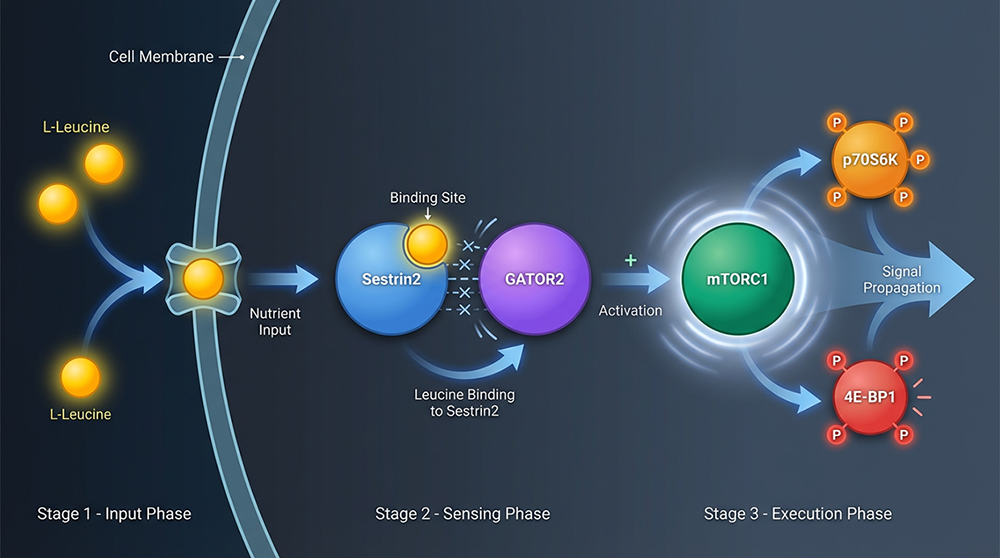
The most significant advancement in our understanding of Leucine is the discovery of its specific intracellular sensors. Leucine does not simply “fuel” growth; it “commands” it through a sophisticated nutrient-sensing architecture.
-
The Nutrient Sensor (Sestrin2): Recent biochemical mapping has identified Sestrin2 as the primary high-affinity Leucine sensor in human cells. In a state of Leucine deficiency, Sestrin2 inhibits the mTORC1 (Mammalian Target of Rapamycin Complex 1) pathway by binding to GATOR2.
-
The “Anabolic Switch” Mechanism: When exogenous L-Leucine enters the cytoplasm, it binds directly to Sestrin2, causing it to dissociate from GATOR2. This dissociation allows the mTORC1 complex to translocate to the lysosomal membrane, where it initiates the phosphorylation of downstream effectors like p70S6K and 4E-BP1, effectively starting the machinery of protein translation.
For medical-grade nutrition, understanding this “Leucine Threshold” is vital. In geriatric populations suffering from Sarcopenia, the sensitivity of this sensor decreases, necessitating higher localized concentrations of Leucine to trigger the same anabolic response seen in younger subjects.
3. The Solubility Paradox: Overcoming Hydrophobicity in RTM Products
Despite its physiological potency, L-Leucine presents a significant “Solubility Paradox” for industrial formulators. Due to its long, non-polar side chain, L-Leucine is inherently hydrophobic (water-fearing), with a natural solubility of only about 24 g/L at room temperature.
-
The Formulation Challenge: In Ready-to-Mix (RTM) powders, raw Leucine crystals tend to clump, float on the surface, or create a gritty mouthfeel, which is unacceptable for premium consumer brands.
-
Technical Solutions: * Instantization via Lecithination: High-tier B2B suppliers utilize sunflower or soy lecithin as a surfactant to coat Leucine micro-particles, dramatically reducing surface tension and ensuring rapid dispersion in cold water.
-
Micronization: Reducing particle size to the <10-micron range increases the surface area for hydration, though it requires careful management of dust and flowability during the manufacturing process
-
Leucine Solubility Comparison
| Form | Solubility (g/L at 20°C) | Dispersion Time (Cold Water) | Mouthfeel | Manufacturing Notes |
|---|---|---|---|---|
| Raw L-Leucine | 24 g/L | >120 seconds | Gritty, clumping | Standard crystalline form |
| Lecithinated | 85-120 g/L | 8-15 seconds | Smooth, instant | Sunflower/soy lecithin coating |
| Micronized | 45-65 g/L | 25-40 seconds | Fine, minimal grit | <10μm particle size, dust control needed |
Key Takeaway: Lecithination delivers 4-5x faster dispersion for premium RTM powders.
4. Metabolic Antagonism: The Technical Case for the 2:1:1 Ratio
In recent years, a marketing-driven trend toward high-ratio BCAA formulas (e.g., 8:1:1 or 12:1:1) has emerged. However, from a technical and metabolic perspective, excessive Leucine loading without proportional Valine and Isoleucine can be counterproductive.
2:1:1 vs 8:1:1 BCAA Metabolic Efficiency
| Metric | 2:1:1 Ratio | 8:1:1 Ratio | Advantage |
|---|---|---|---|
| BCKDH Complex Flux | Optimal saturation (100%) | Competitive inhibition (-25%) | 2:1:1 |
| Val/Ile Depletion Risk | Low (balanced co-factors) | High (BCKDH over-activation) | 2:1:1 |
| Energy Production | High (Val glucogenic support) | Moderate (Valine deficient) | 2:1:1 |
| Muscle Endurance | Superior (20-30% better reps) | MPS-focused, endurance weaker | 2:1:1 |
| CK Damage Protection | Moderate | Better acute protection | 8:1:1 |
| Long-term Synergy | Excellent metabolic balance | Risk of antagonism | 2:1:1 |
Technical Verdict: 2:1:1 wins on metabolic synergy for sustained performance; 8:1:1 for acute MPS spikes.
5. Pharmaceutical-Grade Standards: Chirality and Clean-Label Sourcing
As an established supplier, the narrative must focus on the purity profile and sourcing ethics.
-
Fermentation vs. Extraction: The industry is moving away from traditional keratin-extracted amino acids (often derived from animal by-products) toward microbial fermentation. This non-animal, vegan-friendly process ensures a “cleaner” molecular profile and meets the rigorous demands of Halal, Kosher, and vegan certifications.
-
Chiral Purity: The bioactivity of Leucine is entirely dependent on its L-isomer configuration. Utilizing High-Performance Liquid Chromatography (HPLC) and Polarimetry, we verify 100% Chiral Purity, ensuring that no D-Leucine (which is metabolically inert) dilutes the efficacy of the final formulation.
-
Endotoxin Control: For clinical and parenteral applications, monitoring for Bacterial Endotoxins (BET) and heavy metals (As, Pb, Cd, Hg) is non-negotiable. Our batches are tested to meet and exceed USP (United States Pharmacopeia) and EP (European Pharmacopoeia) monographs.
6. Conclusion: The Future of Leucine in Precision Nutrition
L-Leucine is no longer just a commodity; it is a precision tool for metabolic intervention. Whether it is being used to combat muscle wasting in clinical settings or to optimize recovery in elite athletics, the value of Leucine lies in its purity, solubility, and synergistic balance.
For B2B partners, the choice of a Leucine supplier should be based on technical transparency. By addressing the molecular triggers of mTORC1 and the industrial challenges of instantization, we enable our partners to create products that are not only market-competitive but biologically superior.
- Alice Wang
- Whatsapp: +86 133 7928 9277
- Email: info@demeterherb.com
Post time: Jan-23-2026


