


Natural Dong Quai Extract is rapidly moving from a traditional herbal tonic to a data‑supported nutricosmetic active, aligning with the rising demand for systemic skin health solutions. This article reviews its scientific rationale for skin brightening and anti‑aging, centered on ferulic‑acid–driven antioxidation and microcirculation support, and outlines how brands can position this botanical on a mature platform site.
1.Beauty from Within: Market Context
The global nutricosmetics market has evolved from a niche segment into a strategic growth pillar for both beauty and nutrition companies. Recent forecasts indicate that the sector is projected to reach about USD 7.5 billion in 2025 and expand to roughly USD 16.5 billion by 2035, representing an estimated 8.2% compound annual growth rate. This momentum is driven by consumers who increasingly see “beauty from within” as a preventative, holistic approach that complements topical skincare rather than replacing it.
Within this landscape, ingredients that combine ethnobotanical heritage, mechanistic clarity and clean‑label credentials have a clear advantage. Natural Dong Quai Extract, derived from Angelica sinensis (Radix Angelicae Sinensis), fits this profile by offering anti‑aging, circulation‑supporting and potential skin‑brightening effects, underpinned by its content of ferulic acid and polysaccharides.
2.Key Constituents and Anti‑Aging Potential
Modern analyses show that Angelica sinensis contains a diverse chemical profile, including ferulic acid, ligustilide and multiple Angelica polysaccharides, which together contribute to its pharmacological effects. A recent review on the anti‑aging potential of Angelica highlights that these components help eliminate free radicals such as DPPH and ABTS, improve serum antioxidant capacity, and inhibit cellular senescence pathways. In parallel, Angelica polysaccharides have been reported to exhibit anti‑oxidative, anti‑inflammatory and cytoprotective actions in various cell types.
Ferulic acid in particular has drawn attention as a multi‑functional phenolic compound that protects keratinocytes, fibroblasts, collagen and elastin from oxidative damage. It is used in topical skincare as a photoprotective and brightening agent, with evidence that it delays photoaging processes and supports barrier integrity. When delivered orally via Natural Dong Quai Extract, ferulic acid contributes to a systemic antioxidant network that may translate into improved skin resilience and reduced dullness over time.
3.Skin Brightening and Tyrosinase Inhibition
Beyond general anti‑aging, Natural Dong Quai Extract shows promise in skin‑brightening applications. A Chinese patent describes the use of Radix Angelicae Sinensis extract in skin‑whitening and speckle‑dispelling products, reporting positive clinical outcomes when used in topical formats. Although more controlled clinical studies are needed in oral beauty applications, this patent supports the relevance of Angelica‑based extracts to pigmentation management.
Mechanistically, ferulic acid is known to inhibit melanogenesis by suppressing tyrosinase activity, the rate‑limiting enzyme responsible for converting L‑tyrosine and L‑DOPA into melanin. By attenuating this enzymatic step, ferulic acid can reduce the formation of new melanin, which is particularly relevant to UV‑induced hyperpigmentation and uneven tone. In vitro and formulation data also suggest that ferulic acid enhances angiogenesis and accelerates wound repair, potentially contributing to post‑inflammatory mark resolution and texture improvement.
When Natural Dong Quai Extract is standardized to a defined ferulic‑acid content, it becomes possible to design nutricosmetic products that target both oxidative stress and melanin pathways in a predictable manner. This dual mechanism—ROS control and tyrosinase modulation—offers a more comprehensive approach to skin brightening than melanin inhibition alone.
4.Microcirculation, Vascular Health and “Glow”
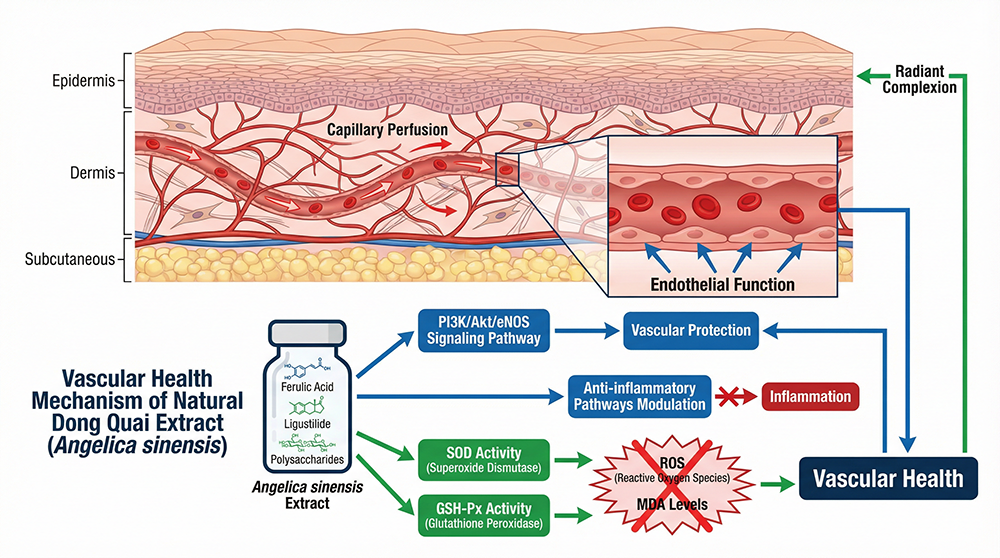
One of the most distinctive aspects of Angelica sinensis is its long‑documented role in blood and vascular health. Pharmacological studies show that Angelica extracts exert significant preventive and therapeutic effects on cardiovascular and cerebrovascular diseases, in part by regulating PI3K/Akt/eNOS signaling, increasing SOD and GSH‑Px activities, reducing ROS and MDA levels, and modulating multiple inflammatory pathways. These actions translate into protection of vascular endothelial cells, improved microvascular function and better hemorheology in preclinical models.
For skin, this vascular dimension is critical. Capillary perfusion and dermal oxygenation strongly influence complexion, particularly in individuals with sallow or fatigued tones. By supporting endothelial function and antioxidant defenses within the vasculature, Natural Dong Quai Extract has the potential to enhance micro‑circulation and nutrient delivery to the dermis. This introduces the idea of “circulatory brightening”: a more physiologic form of glow driven by improved blood flow and oxygenation, rather than purely by pigment suppression.
5.Standardization, Formulation Strategy and B2B Relevance
From a B2B R&D perspective, the value of Natural Dong Quai Extract lies in standardization, quality evaluation and formulation versatility. Recent work on quality assessment of Angelica Sinensis Radix emphasizes the importance of controlling key markers, including ferulic acid, to ensure batch‑to‑batch consistency and reliable pharmacological outcomes. For nutricosmetic use, defining a ferulic‑acid range and polysaccharide profile enables brands to link composition with claims on antioxidant capacity, skin support and circulatory benefits.
Formulation opportunities include stand‑alone Natural Dong Quai Extract capsules targeting “circulation and radiance,” as well as synergistic blends. Combining Dong Quai extract with collagen peptides and vitamin C can address structure, repair and ROS simultaneously, while pairing it with glutathione or other brightening actives builds a more complete melanin‑management system. Because Angelica is plant‑derived and compatible with non‑GMO and vegan positioning, it also fits clean‑label expectations held by many global beauty and wellness brands.
6.Outlook: From Traditional Tonic to Modern Nutricosmetic Anchor
For an established site with a five‑year history, publishing an in‑depth feature on Natural Dong Quai Extract can signal a clear editorial shift toward mechanistic, evidence‑based coverage of botanicals. The emerging body of literature around Angelica’s anti‑aging, antioxidant, vascular and potential skin‑brightening properties provides a solid scientific backbone, while its cultural heritage adds storytelling depth.
As more clinical data become available, Natural Dong Quai Extract is well positioned to move from “traditional blood tonic” to “systemic skin health active” in the nutricosmetics toolbox. For brands and formulators, it offers a rare combination: mechanistic plausibility, multifunctional benefits and strong alignment with the beauty‑from‑within narrative that is reshaping the global market.
- Alice Wang
- Whatsapp: +86 133 7928 9277
- Email: info@demeterherb.com
Post time: Jan-27-2026


