



As global focus on metabolic health intensifies, Berberine HCl has gained significant traction for its potential in modulating glucose and lipid metabolism. However, this rise in popularity has brought professional inquiries regarding its origins, side-effect management, dosage standards, and clinical applications. This report provides an objective guide based on current evidence for both consumers and industry professionals.

1. What is Berberine HCl? From Botanical Source to Standardized Extract
Berberine HCl (Berberine Hydrochloride) is a natural isoquinoline alkaloid extracted and refined from various traditional medicinal plants. Its primary botanical source is Cortex Phellodendri (Amur Cork Tree bark), though it is also abundantly found in the bark and roots of plants like Coptis chinensis and Berberis.
-
The Extraction Process: Using Cortex Phellodendri as a benchmark, high concentrations of the alkaloid (berberine) are isolated from the plant tissue through specialized solvent extraction. It is then converted into a more chemically stable hydrochloride (HCl) salt form through a hydrochlorination process.
-
Physical Properties: Refined Berberine HCl appears as a distinctive vibrant yellow to brownish-yellow crystalline powder. It is odorless but possesses an intense, characteristic bitter taste.
-
The Advantage of the HCl Form: Compared to raw botanical powders, the hydrochloride form significantly enhances physicochemical stability and water solubility. This ensures that the potency remains intact during storage and provides a standardized physical foundation for precise dosing and optimized absorption in clinical applications.
2. Mechanism Comparison: Berberine HCl and Metabolic Regulation
In international biohacking circles, Berberine HCl is frequently compared to classic metabolic regulators due to their shared molecular pathways:
-
AMPK Pathway Activation: Research indicates that Berberine HCl activates the AMP-activated protein kinase (AMPK), often described as the body’s “master metabolic switch.” This process optimizes cellular energy homeostasis.
-
Multi-Target Modulation: Unlike certain synthetic agents that target a single receptor, naturally derived Berberine HCl operates through multiple pathways, including gut microbiota modulation and the enhancement of insulin receptor expression.
-
Clinical Evidence: Multiple randomized controlled trials (RCTs) demonstrate that Standardized Berberine HCl provides significant value in supporting healthy fasting blood glucose levels and improving insulin sensitivity.
3. Managing Gastrointestinal Tolerance
Gastrointestinal discomfort, such as mild bloating, is the most common feedback regarding berberine products. Addressing this depends on the formulation and strategy:
-
Formulation Advantage: High-purity Berberine HCl achieves target efficacy at lower physical volumes compared to crude extracts, thereby reducing the mechanical load on the digestive tract.
-
Administration Strategy: Clinical observations suggest that taking the supplement with or shortly before meals, combined with a “titration” strategy (starting with a low dose and gradually increasing), significantly improves individual tolerance.
4. Multi-Dimensional Applications of Berberine HCl
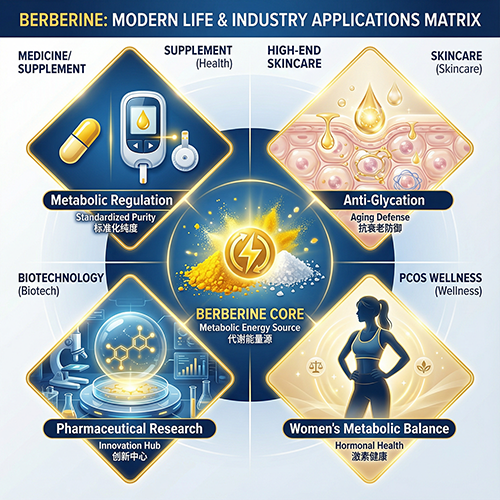
As a multi-functional natural alkaloid, the utility of Berberine HCl extends far beyond basic nutrition, demonstrating immense commercial value across various sectors:
-
Pharmaceuticals: Long utilized as a broad-spectrum antimicrobial agent for gastrointestinal infections. Additionally, its potential in cardiovascular health, such as supporting blood pressure management, is a growing area of clinical interest.
-
Precision Nutraceuticals: This is the fastest-growing sector. Beyond metabolic management for biohackers, it is widely used as a supportive nutritional tool for managing metabolic disturbances associated with PCOS (Polycystic Ovary Syndrome).
-
Cosmeceuticals & Skincare: Leveraging its anti-inflammatory and anti-glycation properties, Berberine HCl is being researched for its ability to delay skin sagging caused by glycation and to assist in managing inflammatory skin conditions like acne.
-
Animal Health & Green Agriculture: As a natural antimicrobial alternative, it plays a role in enhancing gut immunity in livestock and in the development of botanical biopesticides.
5. Quality Control and Long-term Use
-
≥97% Standardized Purity: This is the recognized industry benchmark for premium-tier nutraceuticals. High purity ensures batch-to-batch stability and eliminates residues or plant impurities that might trigger adverse reactions.
-
Scientific Cycling: While most studies support its safety, some experts recommend a periodic approach (e.g., 12 weeks of use followed by a 1–2 week break) to allow for the observation of the body’s endogenous metabolic response.
6. Conclusion: A Rational Tool for Metabolic Resilience
Berberine HCl is not a “quick fix” but a scientifically-backed tool for metabolic restoration. By choosing a high-purity HCl form and adopting a strategic administration protocol, users can enhance their metabolic adaptability while ensuring a smooth and effective health management experience.
- Alice Wang
- Whatsapp: +86 133 7928 9277
- Email: info@demeterherb.com
Post time: Dec-30-2025


